



Here is a complete article crafted from your source material, now organized with a clear structure, an FAQ section, and a conclusion.
***
### The State of Mathematical AI in 2026: Experiments, Automation, and the Enduring Value of Understanding
In the landscape of 2026, Artificial Intelligence is no longer just a helper for mathematicians; it is a collaborator, an experimenter, and a critic. However, the question remains: does AI make mathematics fundamentally easier, or does it simply change the nature of the work? This article presents a practitioner’s exploration, detailing two distinct projects involving an AI system—GPT-5.6 Sol—over a single weekend. The goal was not just to find answers but to understand how the “scientific loop” of hypothesis, experiment, and evaluation has transformed.
The conclusion drawn is one of “abundant experimentation, expensive understanding.” While AI has drastically reduced the cost of running mathematical experiments, the cognitive labor required to validate, interpret, and truly understand the results remains stubbornly high.
#### The Two Projects: A Tale of Two Problems
The weekend was split between two vastly different mathematical challenges.
**1. The Hadamard 668 Project: A Closed Search Space**
The first problem was a pure combinatoric challenge: constructing a Hadamard matrix of order 668. In practical terms, this requires filling a 668×668 grid with +1 and -1 such that every pair of rows is orthogonal (their dot product equals zero).
* **The Challenge:** 668 is the smallest order for which existence is unknown. A brute-force search is impossible, offering $2^{446,224}$ candidates.
* **The AI Approach:** The project utilized “parallel agents” and exact-arithmetic programs. One agent proposed constructions based on known mathematical families (like the factorization of 668 into 4 × 167). Another agent acted as a critic, using exact integer arithmetic to verify intermediate results and reject invalid candidates immediately.
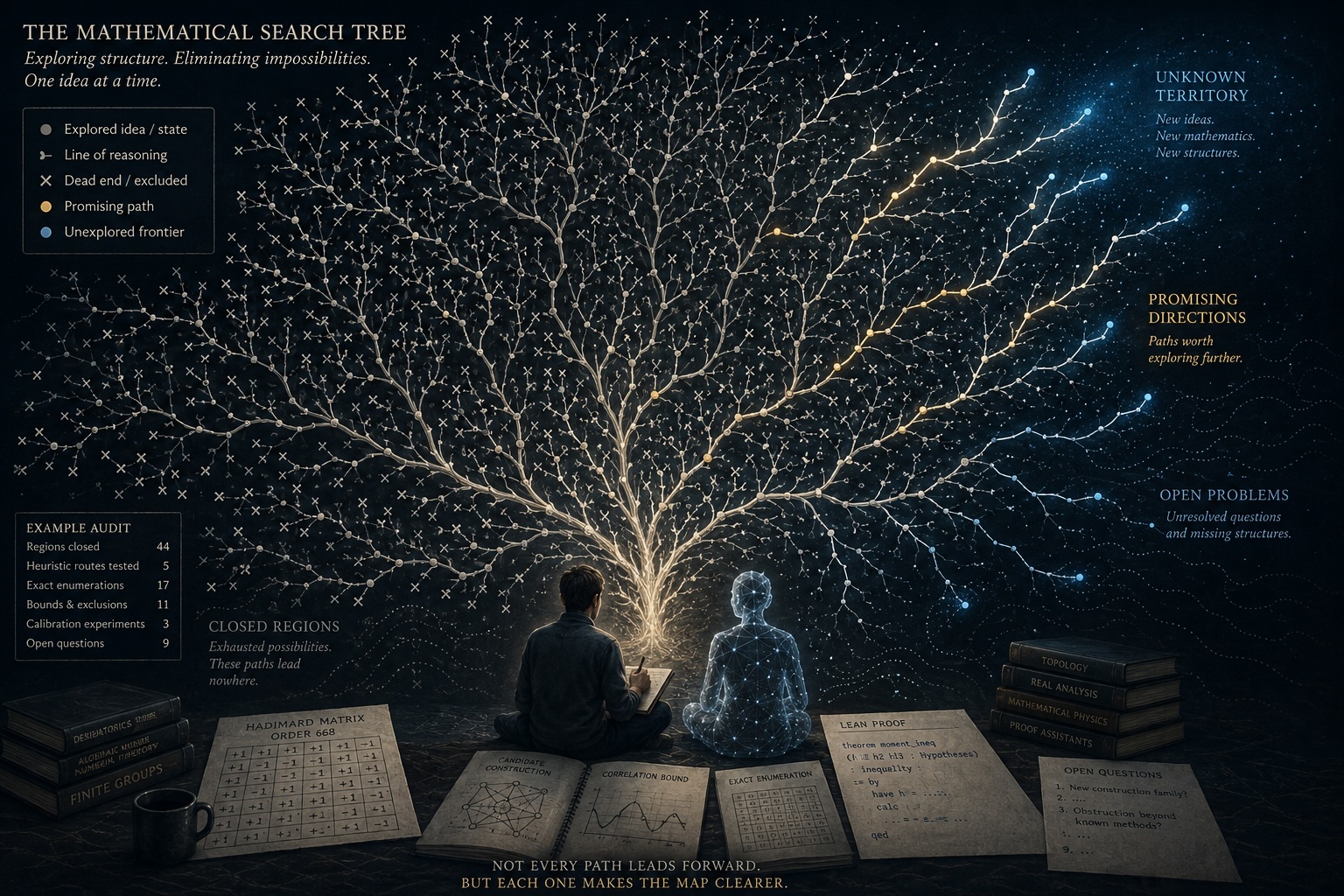
* **The Outcome:** The search was successful in mapping the landscape. The project identified **44 precisely defined “closed” regions** of the search space where a solution is impossible. It utilized nine distinct mathematical routes (including Legendre pairs and Williamson-type quadruples), each verified by exact arithmetic. Despite this exhaustive effort, **no Hadamard matrix of order 668 was found.** The project concluded that the problem remains open, with the eventual solution likely lying in a family the project never explored.
**2. The Maxwell Problem: An Open Physical System**
The second project tackled a problem in mathematical physics: bounding the number of stable equilibrium points created by point charges in space (Maxwell’s Problem). In 2026, it was proven that the historical formula for equilibrium points was incorrect; the new bound is higher and more complex.
* **The Challenge:** Prove that a specific candidate formula (max four equilibria for three charges) holds true for all positive exponents and non-collinear points.
* **The AI Approach:** Here, the AI assisted in generating a conventional mathematical argument involving barycentric coordinates and moment inequalities. The AI wrote the draft, and a proof assistant (Lean) checked the algebraic core.
* **The Outcome:** The Lean core verified successfully, with no “admit” (unfinished) statements found. However, the verification was incomplete. While the algebra was machine-checked, the critical geometric, topological, and differential steps linking the physical problem to the algebra were not formalized. The candidate proof remains just that—a candidate—due to the unverified logical bridges between its components.
#### The “From Tokens to Theorems” Loop
These projects are direct descendants of an earlier neuro-symbolic architecture: an LLM proposes, a symbolic engine (like SymPy or exact arithmetic code) checks, and failures become feedback.
Over the weekend, this loop became significantly richer:
1. **Parallel Agents:** Multiple LLMs acted as proposers, critics, and translators simultaneously.
2. **Exact-Arithmetic Programs:** These served as the first gatekeeper, eliminating impossible paths with absolute certainty.
3. **Proof Assistants:** Tools like Lean provided a second, higher-confidence gate for algebraic cores.
4. **Adversarial Critics:** Agents specifically tasked with breaking the proposed arguments, saving human reviewers the trouble.
The structure, as Jeff Dean described, remained consistent: **Propose, Implement, Evaluate, and Use that evaluation to generate a better proposal.**
#### The Key Discovery: Automation of Experimentation, Not Understanding
The most significant realization was not the success or failure of the specific problems, but the state of the **experimental cycle itself**.
* **Cheap Experiments:** Proposing a new construction or a potential proof path became dramatically cheaper. Failed approaches no longer consumed entire evenings; they were rejected in minutes by exact code.
* **Expensive Understanding:** Verification, however, did not become cheaper. Generating a candidate is fast, but validating its novelty, checking its every logical bridge, and determining if it represents true mathematical progress remains a slow, human-centric, and expensive process.
As the author notes, “Generating another route settles none of [the obligations of proof, understanding, novelty and independent review].” The bottleneck has shifted from *generation* to *curation*.
—
### FAQ
**Q1: Did the AI actually *prove* the Hadamatrix of order 668 exists?**
**A1:** No. The project exhaustively searched for a construction and documented why specific families fail. It concluded that the matrix likely does not exist, but it did not discover a new theorem or construction to prove existence. The problem remains officially open.
**Q2: Was the “Maxwell candidate” a valid proof?**
**A2:** Not yet. It is a proof *candidate*. The core algebraic logic was checked by a proof assistant (Lean), which is a significant step. However, the critical geometric and topological reasoning—the “bridges” between the physical problem and the algebra—were not formally verified. A plausible error could still exist in these unverified steps.
**Q3: What is the “standard toolkit” for attacking the Hadamard problem?**
**A3:** The project audited five standard routes, including:
* **Leung-Schmidt field descent** and **2-adic valuation**.
* **Hasse-Minkowski** theorem.
* **Multiplier theorems**.
* **Bruck-Ryser-Chowla** obstruction.
* **Difference families** and **cocyclic constructions**.
None of these provided the necessary obstruction for order 668.
**Q4: How did the AI accelerate the research process?**
**A4:** The AI acted as a high-speed collaborator. It proposed formulations, wrote code for exact verification, searched literature for prior work, and acted as an adversarial critic to attack weak points in arguments. This parallelization meant that a failed approach was discarded in minutes, not hours.
**Q5: What is the “abundance” mentioned in the title?**
**A5:** It refers to the abundance of *candidates* and *experimental paths*. AI generates a flood of plausible mathematical objects and proof sketches. The scarcity, however, lies in the cognitive resources required to understand, verify, and judge the novelty and validity of those candidates.
**Q6: What is the “human and institutional problem” raised at the end?**
**A6:** As AI generates more conjectures and proof candidates, the academic and archival infrastructure struggles to keep up. We face a problem of curation: how to properly attribute credit (which often goes to the human who interprets and formalizes the AI’s output, not the AI itself), how to record the vast number of “failed” attempts, and how to create systems of navigation that allow the mathematical community to build on prior work without duplication or misplaced confidence.
—
### Conclusion
The weekend experiment was a success, but not for the reason one might expect. It did not yield a breakthrough theorem or solve an open problem. Instead, it provided a high-fidelity portrait of mathematics in the age of AI.
We have entered an era of **mathematical abundance**, where the generation of ideas is cheap and automated, but true understanding remains expensive and irreplaceable. The value of the AI is not in its ability to *replace* the mathematician, but in its ability to *extend* the mathematician’s reach, automating the brute-force exploration of the search space and freeing the human to focus on the high-level judgment, interpretation, and deep understanding that defines the field.
The durable outcome of the weekend is not a proof, but a map. It is a record of what failed, a collection of calibrated verifiers, and a demonstration of a new, powerful research loop. The challenge for the future is not just to produce more mathematics, but to develop the institutions, tools, and critical standards necessary to navigate, validate, and truly comprehend this new landscape. The bottleneck has moved from the generation of experiments to the wisdom of their evaluation.
