



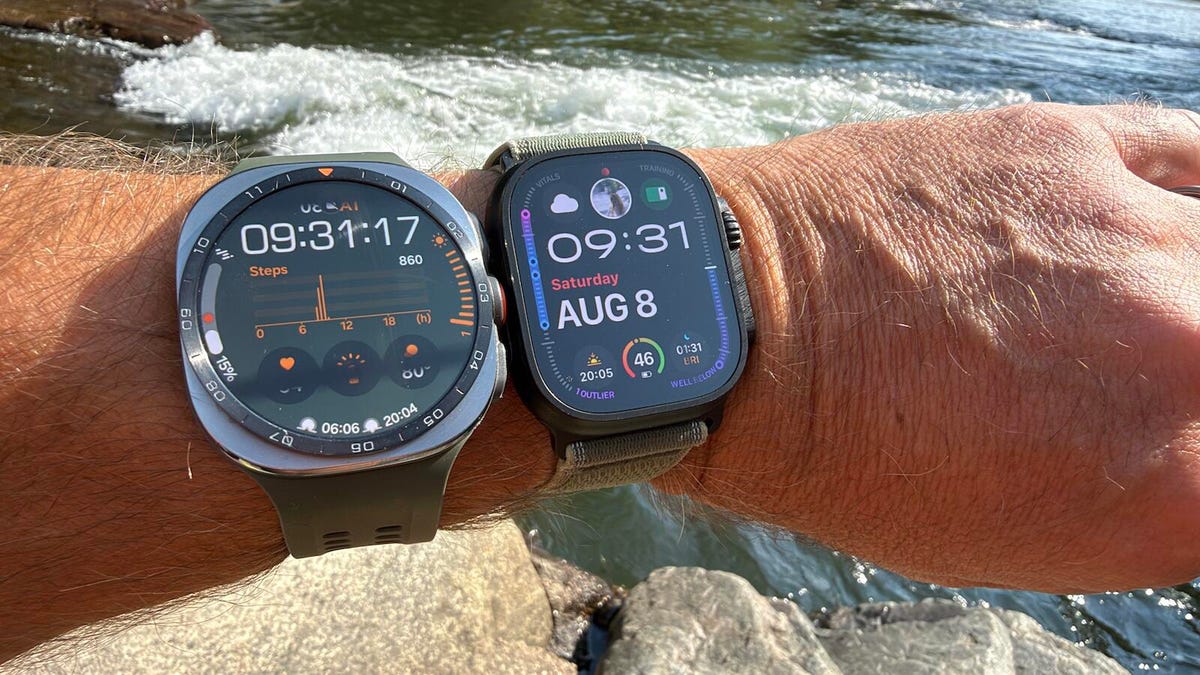
**Comparing the Apple Watch Ultra 3 and Samsung Galaxy Watch Ultra 2: Which Smartwatch is Right for You?**
In today’s wearable tech landscape, the debate between iOS and Android users often extends to smartwatches. For the past three weeks, I’ve had the unique opportunity to wear both the Apple Watch Ultra 3 and the Samsung Galaxy Watch Ultra 2 simultaneously. This deep dive into two of the market’s flagship devices has revealed significant insights for consumers stuck in the Apple or Google ecosystems.
Both the Apple Watch Ultra 3 ($799) and the Samsung Galaxy Watch Ultra 2 ($699) are premium products designed for durability and performance. They boast large, high-resolution displays, robust titanium casings, 10 ATM water resistance suitable for professional diving, and, crucially, cellular connectivity that allows them to function independently from a smartphone. They also share advanced safety features, including loud, attention-grabbing sirens for emergencies in remote locations. The primary differentiator lies not in their physical build, but in the software, AI capabilities, and health integrations they offer.
### **You Should Buy the Samsung Galaxy Watch Ultra 2 If…**
**1. You Want an AI Coach and a Robust Health Platform**
Samsung has made significant strides in catching up to, and in some areas surpassing, Apple’s health offerings. The Galaxy Watch Ultra 2 comes packed with Google’s AI-powered Health Coach. This virtual coach provides a daily energy score, a sleep score, five nightly vital statistics, daily cardio load tracking, heart health scores, and a custom running coach designed to improve your fitness and performance.
Furthermore, Samsung has integrated body composition analysis, allowing users to measure metrics like body fat and skeletal muscle mass. For users with high blood pressure, the watch offers a unique feature: the ability to take blood pressure readings using a compatible cuff for calibration. This provides invaluable data trends outside of a clinical setting, a feature currently unmatched by Apple or Google’s native offerings.
**2. You Want Google Gemini Integration**
Perhaps the most significant advantage of the Samsung Galaxy Watch Ultra 2 is its seamless integration with Google’s ecosystem. Accessing Google Gemini is as simple as pressing and holding a button, saying “OK Google,” or even enabling a wrist-raise gesture. This instant access allows users to quickly ask questions, get summaries, dictate messages, and leverage AI for a multitude of tasks directly from their wrist, a feature that feels more native and responsive than any third-party solution on Apple’s platform.
### **You Should Buy the Apple Watch Ultra 3 If…**
**1. You Plan to Explore Off-Grid Environments**
While the Samsung Galaxy Watch Ultra 2 offers LTE connectivity, the Apple Watch Ultra 3 takes a decisive lead with its integrated satellite connectivity. This feature is a game-changer for outdoor enthusiasts who frequently find themselves beyond the reach of cellular towers. Whether you’re trail running, hiking, fishing, or camping, the ability to send and receive messages and your location, or simply let loved ones know you’re safe, without needing your phone, provides a layer of security and communication that is simply unmatched.
**2. Accurate Sleep Tracking is a Priority**
My personal testing highlighted a key difference in the sleep tracking capabilities of the two watches. While the Samsung provided data, the Apple Watch Ultra 3 proved far more consistent and reliable in tracking sleep stages. It successfully tracked sleep almost every night and aligned closely with dedicated sleep trackers like the Oura Ring and Garmin Index, accurately recording light, deep, and REM sleep cycles. For users who base their recovery and wellness routines on sleep data, the Apple Watch Ultra 3 is the superior choice.
**3. You Prefer Tactile, Intuitive Watch Interactions**
Interaction design is an area where Apple excels. While both watches support gestures, Apple’s implementation feels more polished and integrated into the operating system. The Apple Watch Ultra 3 features a physical Digital Crown and side buttons, which provide a tactile, precise way to scroll through lists, navigate maps, and interact with apps. Gestures like a double-pinch of the finger and thumb are incredibly responsive and allow for quick control of music, calls, and smart stack widgets, creating a smoother and more efficient user experience.
### **The Verdict**
Choosing between these two smartwatches ultimately depends on your personal priorities and ecosystem allegiance. If you are deeply invested in the Google and Android ecosystem, value AI-driven health insights, blood pressure monitoring, and prefer a softer, more coach-focused approach, the **Samsung Galaxy Watch Ultra 2** is your ideal companion. Its robust health features and seamless AI integration make it a formidable contender.
Conversely, if you prioritize rugged off-grid communication via satellite, demand the most accurate and consistent sleep tracking possible, and prefer a more tactile, polished user interface, the **Apple Watch Ultra 3** stands out. It offers a level of independence and interaction fluidity that is perfect for adventurers and those who rely on their watch for critical, real-world performance.
—
### **FAQ Section**
**Q1: Which smartwatch has better battery life?**
**A:** The Samsung Galaxy Watch Ultra 2 offers superior battery life. With Always-On Display (AOD) off, it lasts for 80 hours, while the Apple Watch Ultra 3 manages 72 hours. With AOD enabled, the Samsung lasts 60 hours compared to the Apple’s 42 hours.
**Q2: Can I take blood pressure readings with both watches?**
**A:** No. While the Samsung Galaxy Watch Ultra 2 has a built-in blood pressure monitoring feature that requires a weekly cuff calibration, the Apple Watch Ultra 3 does not have this capability. Apple and Google watches can only notify you if your heart rate trends suggest hypertension; they cannot provide actual blood pressure numbers.
**Q3: What about satellite connectivity?**
**A:** The Apple Watch Ultra 3 has a clear advantage here. It features integrated satellite connectivity (via Globalstar), allowing for messaging and sharing your location off-grid without a phone. The Samsung Galaxy Watch Ultra 2 relies on standard LTE cellular networks and does not have built-in satellite communication.
**Q4: Which watch tracks sleep better?**
**A:** In real-world testing, the Apple Watch Ultra 3 demonstrated more reliable and accurate sleep tracking. It consistently recorded sleep data and matched up well with other dedicated sleep trackers, whereas the Samsung Galaxy Watch Ultra 2 occasionally failed to register sleep during the night.
**Q5: What is the price difference?**
**A:** The Samsung Galaxy Watch Ultra 2 is priced at $699, while the Apple Watch Ultra 3 starts at $799, making the Samsung model $100 less expensive.
—
### **Conclusion**
The comparison between the Apple Watch Ultra 3 and Samsung Galaxy Watch Ultra 2 highlights a classic clash of ecosystems: Apple’s polished, integrated hardware and software versus Samsung’s (and Google’s) AI-first, feature-rich approach. Both are excellent, rugged smartwatches capable of handling a demanding lifestyle. Your decision should be based on whether you value AI-driven health coaching and lower cost (Samsung) or superior satellite communication, sleep tracking accuracy, and user interface fluidity (Apple). Both represent the pinnacle of what current smartwatch technology has to offer.
