



**Advancing Spatial Transcriptomics: From Reference Atlases to Biological Insights**
Spatial transcriptomics has rapidly evolved from a emerging technology to a cornerstone of modern biomedical research, enabling the simultaneous measurement of gene expression and spatial localization within tissue sections. Recent advances in single-cell multi-omics, foundation models, and cell–cell communication inference have dramatically expanded the scope and resolution of spatial transcriptomics, offering unprecedented insights into tissue organization, cellular interactions, and disease mechanisms. This article synthesizes key developments in the field, highlighting how these innovations are transforming our ability to map and understand complex biological systems.
—
## **Key Advances in Spatial Transcriptomics**
### **1. The Rise of Single-Cell Multi-Omics and Foundation Models**
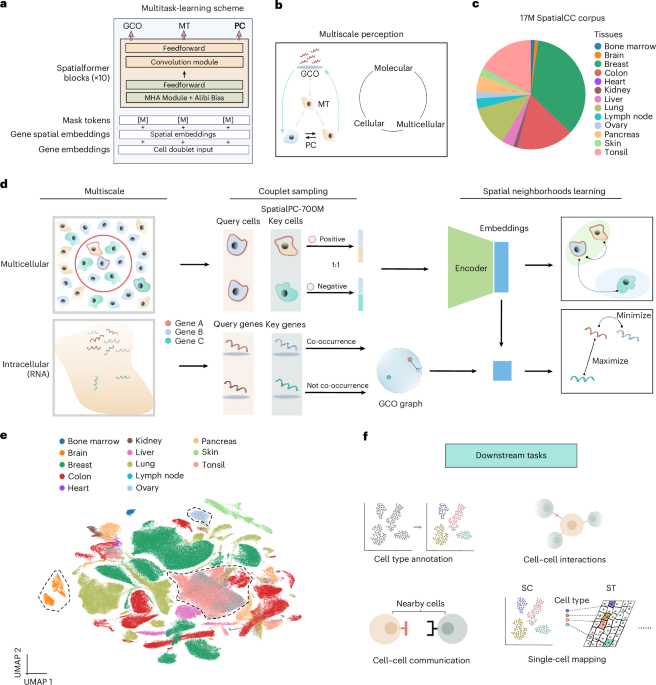
The integration of single-cell multi-omics with spatial transcriptomics has revealed remarkable cellular heterogeneity within tissues. Studies such as those by **Baccin et al. (2020)** and **Oliveira et al. (2025)** demonstrate how combining single-cell RNA sequencing with spatial data provides a more nuanced view of tissue microenvironments. These efforts have been further accelerated by the development of foundation models tailored for single-cell and spatial data, including **scgpt** (Cui et al., 2024), **Nicheformer** (Tejada-Lapuerta et al., 2025), and **CellChat** (Jin et al., 2021), which enable large-scale, data-driven inference of cellular states and interactions.
### **2. Cell–Cell Communication Inference**
Understanding how cells communicate is critical for deciphering tissue function and pathology. Tools like **CellphoneDB** (Efremova et al., 2020), **ligand–receptor interaction mapping** (Li et al., 2023), and **network-based approaches** (Theodoris et al., 2023) have made it possible to infer communication patterns from gene expression data. These methods rely on curated databases of ligand–receptor pairs and sophisticated statistical models to predict signaling pathways active in specific cellular contexts.
### **3. Benchmarking and Standardization**
As the field has grown, so has the need for rigorous benchmarking. Works by **Ren et al. (2025)** and **Luecken et al. (2022)** have systematically evaluated spatial transcriptomics platforms and integration methods, highlighting performance differences and guiding best practices. These studies emphasize the importance of standardized datasets, metrics, and computational tools to ensure reproducibility and comparability across studies.
### **4. Clinical and Translational Applications**
Spatial transcriptomics is increasingly being applied to clinical questions, particularly in oncology and immunology. For example, **IL17-producing CD4+ T cells** and **FoxP3+ regulatory T cells** have been spatially mapped in tumor microenvironments, revealing their role in immune regulation and patient outcomes (**Shao et al., 2020; Li et al., 2023**). These findings underscore the potential of spatial approaches to inform targeted therapies and improve disease prognosis.
—
## **Frequently Asked Questions (FAQ)**
### **What is spatial transcriptomics?**
Spatial transcriptomics is a set of technologies that measure gene expression while preserving information about the spatial location of transcripts within a tissue section. Unlike traditional bulk RNA sequencing, it provides both molecular and anatomical context.
### **How does single-cell multi-omics enhance spatial transcriptomics?**
Single-cell multi-omics integrates spatial data with other modalities such as chromatin accessibility, proteomics, and transcriptomics at single-cell resolution. This enables a more comprehensive understanding of cellular identity, function, and interactions within intact tissues.
### **What are foundation models in spatial transcriptomics?**
Foundation models are large, pretrained computational models that can be adapted to various downstream tasks. In spatial transcriptomics, models like Nicheformer and scgpt are trained on large datasets to learn universal representations of cellular states and interactions, improving tasks such as cell type annotation, communication inference, and cross-dataset generalization.
### **What tools are available for inferring cell–cell communication?**
Popular tools include CellphoneDB, Nichenet, CellChat, and SpatialDM. These tools use ligand–receptor databases and statistical models to predict signaling pathways and infer communication networks from spatial or single-cell data.
### **How is spatial transcriptomics used in clinical research?**
Spatial transcriptomics is increasingly used to study tumor microenvironments, immune cell infiltration, and disease progression. It helps identify spatially defined biomarkers, understand resistance mechanisms, and stratify patients for targeted therapies.
—
## **Conclusion**
The field of spatial transcriptomics has matured rapidly, driven by advances in single-cell multi-omics, foundation models, and computational tools for cell–cell communication. These innovations have transformed spatial transcriptomics from a purely descriptive technology into a powerful framework for unraveling the complex organization of tissues and their dysregulation in disease. As reference atlases expand and methods become more integrated and standardized, spatial transcriptomics will continue to play a pivotal role in both basic research and clinical translation, offering insights that were previously inaccessible. The future of the field lies in further scaling these approaches, improving data integration, and translating spatial insights into actionable biological and medical knowledge.
