



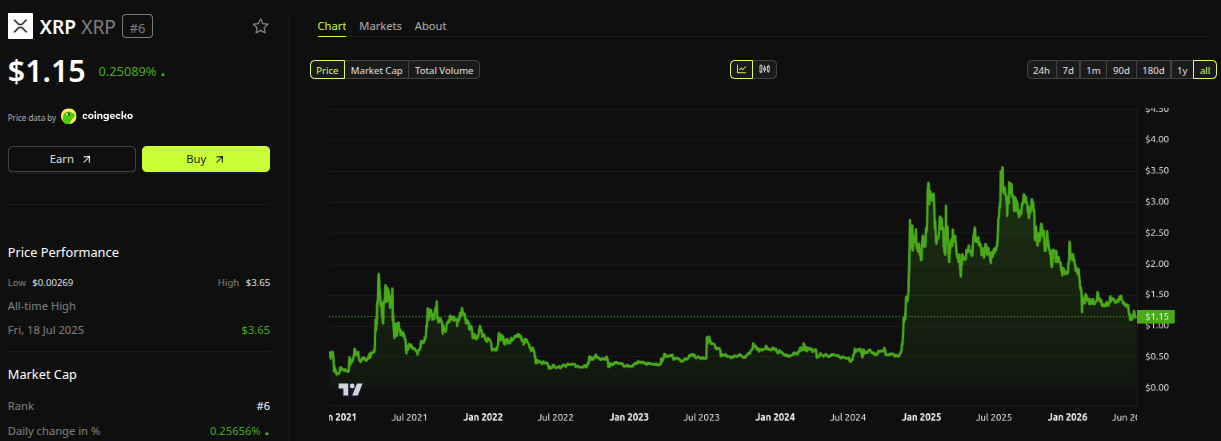
Even with the crypto market’s inherent instability, many investors still consider XRP a long-term holding that could either fund their retirement or serve as a hedge against inflation and currency devaluation.
But does that narrative hold up with actual math on its side? Some market forecasters have mapped out trajectories toward $1 million by 2035, while other experts caution that XRP continues to grapple with wild price swings and lingering questions about its real-world utility in decentralized finance and institutional settings.
How Much XRP Would You Need to Retire by 2035?
XRP serves as the native cryptocurrency of the Ripple network, built to facilitate rapid, affordable cross-border payments. Advocates point to its tangible adoption among financial institutions and its alignment with the ISO 20022 messaging framework — positioning it among the rare digital assets with direct links to existing banking infrastructure.
Follow us on X to stay up to date on breaking news.
The viability of this retirement strategy hinges entirely on the price assumptions an investor makes for the coming decade. Several long-term forecasting models outline three distinct pathways to building a $1 million portfolio by 2035. The token is currently priced around $1.34, and analyst outlooks range dramatically depending on the timeframe.
Under a conservative estimate — with XRP climbing to roughly $3.13 by 2035 — an investor would need about 319,000 tokens to reach the seven-figure mark.
Translated into today’s figures, that means committing approximately $428,000 worth of XRP, accumulated gradually through purchases at prevailing market prices.

A moderately optimistic outlook — with XRP trading between $9 and $10 — shifts the equation considerably. An investor would need only 100,000 to 105,000 XRP tokens to achieve the same retirement goal by 2035.
The initial capital requirement shrinks substantially since each token carries greater portfolio weight at that price level.
Under the most ambitious forecast — where XRP reaches $20 to $40 per token — as few as 25,000 XRP (worth roughly $33,000 today) could theoretically grow into a comfortable retirement fund.
It’s precisely this kind of disproportionate upside potential that continues to draw speculative capital toward the asset, even as mainstream financial advisors issue repeated cautions.
“You understand Bitcoin’s scarcity and have watched it become the best-performing asset of the past 15 years. You understand XRP’s utility and why many believe it could appreciate significantly if adoption keeps expanding. The real question is whether your retirement account reflects that conviction,” Bri Teresi remarked on X.
What Could Go Wrong: The Risks XRP Community Must Accept
Price turbulence isn’t the only concern when positioning XRP as a retirement asset. Participants need to honestly confront structural risks as well. Those who bought at earlier cycle highs spent years merely recouping their original investment — a timeline that doesn’t work for anyone who may need access to funds within the next decade.
Regulatory ambiguity remains despite recent milestones providing greater clarity in the United States. Future shifts in policy leadership could reverse current frameworks, or new international agreements might curtail cross-border cryptocurrency transactions.
Stablecoins launched by major financial institutions, along with emerging central bank digital currencies (CBDCs), are also vying for the same payment-use cases that underpin the bullish XRP thesis.
Custody presents yet another risk that new investors frequently underestimate. Throughout crypto’s history, exchange security breaches have wiped out years of stored savings in a matter of hours.
Using hardware wallets for self-custody is essential but demands a level of technical proficiency that retirees, in particular, must develop before committing meaningful sums of money.
Subscribe to our YouTube channel for expert insights from industry leaders and journalists.
The post The Great XRP Retirement: Testing the Math Behind the Hoax appeared first on BeInCrypto.
