



Introduction
Most enterprise security teams rely on 40 or more security tools, providing extensive visibility into internal telemetry and asset data. However, these tools often operate in isolation, producing overlapping alerts and fragmented data. Despite this abundance of information, breach dwell times remain stubbornly high—around 43 days—response windows close before teams can take action, and analysts are overwhelmed by the sheer volume of noise rather than focusing on actual threats.
The issue isn’t a lack of effort—it’s a flawed architecture.
Security programs were designed for an era when threats evolved slowly enough for humans to coordinate responses manually. That era is over. With the rapid advancement and adoption of AI capabilities—especially cutting-edge AI tools—a far more proactive security posture is essential, along with machine-speed responses to counter fast-moving adversaries. Gartner’s Continuous Threat Exposure Management (CTEM) framework supports this transition from reactive, periodic assessments to an ongoing, iterative process of scoping, discovery, prioritization, validation, and mobilization. Yet for most organizations, fully operationalizing CTEM remains elusive because the necessary tools still don’t communicate effectively with one another.
The Architecture Problem Behind Every Security Gap
Today’s security stacks are made up of specialized tools: a threat intelligence platform here, a vulnerability scanner there, a separate breach and attack simulation (BAS) tool, and a SIEM attempting to tie everything together. Each tool generates data, but none of them completes the cycle.
By the time intelligence is correlated, exposures are prioritized, validation is performed, and a remediation ticket is addressed, the adversary has often already moved on. The bottleneck isn’t any individual tool—it’s the gaps between them.
This architectural challenge is what keeps security leaders awake at night, and it’s precisely the problem that generic AI assistants—simply bolted onto existing workflows—fail to solve. Having a chatbot summarize a threat report is helpful, but it’s fundamentally different from having an AI system that autonomously cross-references that report against your live exposure surface, verifies whether your controls are effective, and determines what needs fixing first.
What “Agentic” Really Means and Why It Matters Now
The term “AI” has become so overused in security marketing that it’s important to be clear about what agentic AI actually entails in this context.
Assistive AI waits for instructions. It summarizes, translates, and retrieves information. It helps analysts work faster at tasks they were already performing.
Agentic AI takes action. It grasps context, sets priorities independently, and carries out multi-step workflows across systems—not as a one-off query, but continuously, in the background, at machine speed.
This distinction is critical because the threat landscape is increasingly operating at machine speed as well. With rapid progress in frontier AI models, the window from discovery to exploitation is shrinking dramatically. The security teams that stay ahead won’t necessarily be those with the most analysts—they’ll be the ones whose AI infrastructure can match that pace autonomously.
For CTEM specifically, this means three functions must no longer operate as separate workflows:
- Operationalizing threat intelligence: Continuously ingesting, structuring, and contextualizing threat, exposure, and vulnerability data against your environment. Understand what adversaries are doing and which assets and infrastructure are potentially at risk.
- Testing and validating your security posture: Continuously verifying whether your controls, teams, and processes actually hold up against the adversary behaviors you’re monitoring.
- Mobilizing response: Automatically prioritizing and routing remediation actions based on validated, intelligence-driven evidence and risk.
When these three functions operate as a closed loop—with AI agents transferring information and decisions between them without waiting for human intervention—a CTEM program evolves from a framework on a presentation slide into an operational reality.
Agentic AI to Operationalize CTEM and Proactive Security
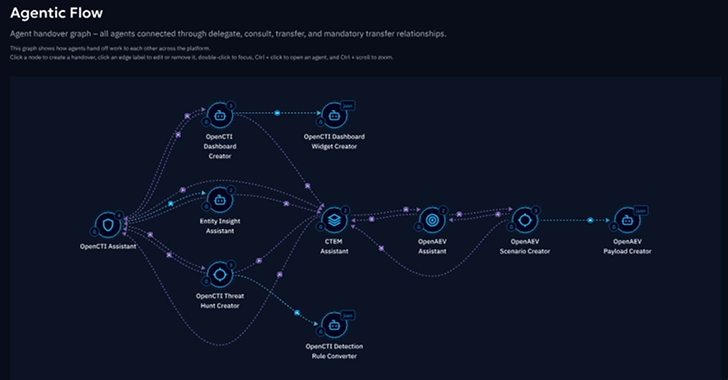
An agentic threat management architecture is what separates a CTEM framework that exists only in a strategy document from one that runs continuously in the background. This requires a dedicated AI orchestration layer that serves as a foundational, contextual backbone with interconnected agents. Rather than analysts manually linking threat intelligence to exposure validation, agents handle the heavy lifting continuously—with the right context and reasoning. The entire workflow is autonomous, with agents passing tasks between one another and across products while keeping humans in the loop for final decisions. Analysts can truly become the orchestrators of intelligence-driven actions.

The security teams building this capability now aren’t waiting for a perfect toolset. They’re establishing the operational model first and letting the architecture follow. Those that achieve this first will gain a structural advantage that grows over time: better data, stronger analysis, more compelling evidence, and increasingly well-tuned AI. General-purpose LLMs aren’t suited for this—it demands deep context and product-specific expertise.
The organizations closing the gap fastest are those treating CTEM as an operating model rather than a single tool, and selecting AI infrastructure purpose-built to execute it end-to-end. You can see this operational model in action with XTM One CTEM Assistant.
Watch It in Practice: Live Webinar
Filigran is hosting a live session that demonstrates what this looks like in practice: how security teams are leveraging agentic AI to connect intelligence, exposure validation, and response into a single continuous workflow—eliminating the handoff gaps that slow down every step in between.
The session will cover:
- Why the shift to agentic AI transforms the operational model for security programs, not just the tooling
- Where purpose-built agents outperform general-purpose AI when precision is critical
- How to evaluate agentic AI infrastructure for your own program
Register for a live session or request the recording:
