



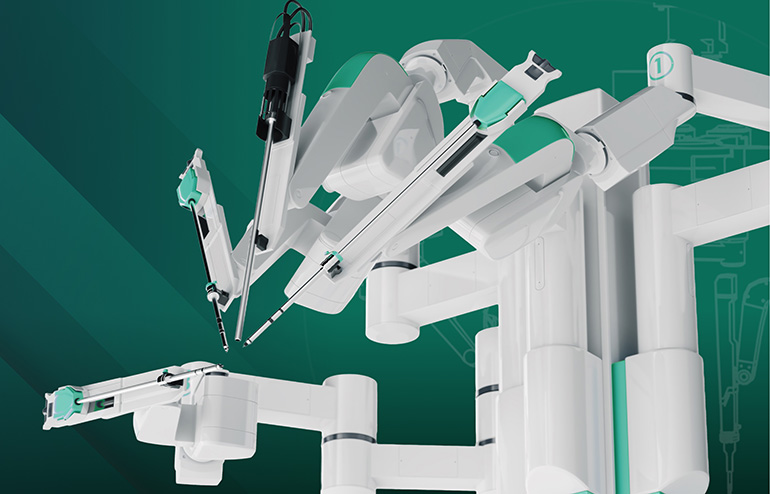
Thanks to Physical AI, robots are now able to acquire new skills and adjust to environments at a much faster pace. Source: Fictiv
Until recently, when people thought about AI, they mostly pictured large language models (LLMs) and chatbots. However, for many professionals in the field, leveraging AI to help source and produce complex mechanical components — especially those used in robotics — has been underway for more than ten years.
Yet in today’s manufacturing and logistics environments, the focus has shifted to something far more tangible. We’ve entered the era of real-world physical AI. Humanoid robots, once purely the domain of science fiction, are now becoming part of everyday operations at major companies such as Amazon.
As Fictiv’s vice president of business development, I speak every day with innovators who are pushing AI beyond the digital screen and into the physical world.
Physical AI represents the fusion of neural networks with mechanical precision. It bridges the gap between a machine’s logic and the physical world — but one critical distinction is necessary: we need to separate the excitement around humanoid robots from the practical realities of scaling hardware within a demanding global supply chain.
Transforming robotics: The impact of physical AI
Physical AI fundamentally transforms how machines “think.” By combining computer vision, reinforcement learning, and edge computing, robots are developing spatial awareness. They no longer depend on pre-programmed environments; instead, they can observe their surroundings, adapt on the fly, and continuously learn. This is revolutionizing the development process by dramatically shortening the feedback cycle.
“Sim-to-real” pipelines have emerged where AI agents undergo training inside highly detailed digital twins, completing millions of simulated iterations in just hours before they ever physically interact with a single component.
This evolution changes the developer’s role from a “programmer” to a “trainer,” empowering robots to tackle high-variability tasks — such as sorting irregular scrap metal or maneuvering through a busy hospital corridor — that were once considered beyond the reach of automation.
Editor’s note: At the 2026 Robotics Summit & Expo taking place this month in Boston, Fictiv’s Steve Ricketts will present on “Emergent Robotics: AI at the Edge of Hardware Innovation,” alongside other sessions focused on embodied and physical AI. Be sure to register today to attend.

Real-world progress versus the hype surrounding humanoids
Today, it’s easy to get swept up in what some call the “humanoid hype.” While viral videos of bipedal robots doing backflips or brewing coffee captivate mainstream audiences, the genuine progress is happening in far more essential applications.
At Fictiv, we’re observing real momentum in these key areas:
- Mobile manipulation: There’s been a surge in the deployment of autonomous mobile robots (AMRs) that go beyond simply transporting goods from one location to another — they can also physically interact with shelving at pickup and drop-off points.
- Collaborative precision: In electronics manufacturing, cobots powered by physical AI have become sensitive enough to work alongside human operators handling fragile components, dynamically adjusting their force and speed in real time to maintain both safety and product quality.
- Automated inspection: Vision systems integrated with AI on robotic arms are transforming quality assurance (QA). These systems can detect microscopic cracks in turbine blades that would escape even the sharpest human eye, continuously improving with every flaw they identify.
A real-world case study
Fictiv and MISUMI partner with major robotics companies. For one large enterprise client, this collaboration meant relocating production back to the United States. The partnership optimized material flows, logistics, and multi-region manufacturing to enable faster ramp-up and scaling.
Additional support provided included:
- Advanced manufacturing capabilities (composites, electromechanical assembly) along with high-precision robotics components.
- These efforts lowered operational risk, enhanced cost predictability, and shortened the path to market.
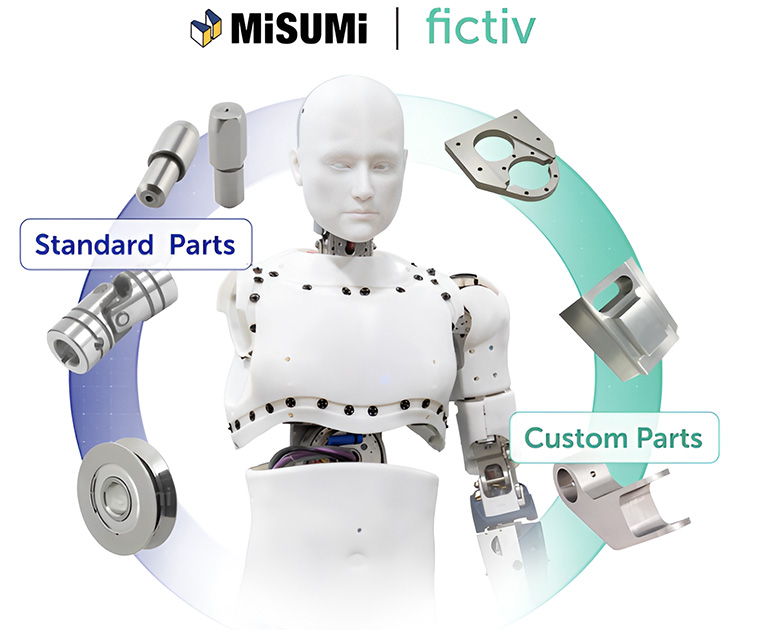
MISUMI acquired Fictiv with the goal of better serving its manufacturing customers. Source: Fictiv
The scaling bottleneck: Manufacturing and supply chain obstacles
The most sophisticated physical AI is worthless if you can’t manufacture the 10,000 hardware units needed to put it into action. At Fictiv, we view the “scaling wall” as the foremost challenge facing robotics companies in 2026.
The first hurdle is hardware agility. While digital AI can scale with a simple click, physical AI demands CNC-machined joints, injection-molded housings, and specialized sensors. Many robotics companies face significant difficulties when moving from a polished “gold sample” prototype into full-scale production.
The supply chain for high-precision components is notoriously unpredictable. Even a three-month holdup on a single custom actuator can stall an entire company’s product roadmap.
The second hurdle is lifecycle resilience. Unlike a SaaS product, a robot operating in a warehouse must contend with dust, extreme heat, constant vibration, and the occasional human mistake.
Designing for manufacturability and serviceability (DFM/DFS) is frequently an afterthought for AI-first companies. To achieve scale, these organizations must embrace a “digital-first” supply chain — utilizing platforms that offer real-time visibility into lead times and support rapid iteration of custom parts.
Finally, there’s the integration gap. The majority of existing manufacturing facilities weren’t built with physical AI in mind. Retrofitting a 20-year-old plant to support a fleet of autonomous robots demands a degree of systems integration that many startups underestimate. It’s not just about the robot itself — it’s about the charging infrastructure, reliable 5G/6G connectivity, and comprehensive safety protocols.
Physical AI demands a new manufacturing mindset
The pioneers of physical AI are recognizing that building intelligent machines requires more than software breakthroughs. It demands a new approach to manufacturing — one that’s agile enough to support rapid hardware iteration while robust enough to sustain production at scale.
Companies that master this dual challenge will lead the next wave of robotics innovation. Physical AI isn’t just about making robots smarter — it’s about building the infrastructure to bring millions of intelligent machines into the real world.
AI Points the Way Forward
Physical AI is set to bridge the gap between digital efficiency and real-world manufacturing. However, achieving this demands that hardware receives the same innovative focus as software.
The leading companies of the next ten years will be those that understand robotics is a team effort across multiple fields. While cutting-edge AI is essential, it must be paired with a strong, flexible, and clear manufacturing approach.
At Fictiv, we are honored to serve as the vital link for innovators creating the next wave of machines, making sure that physical AI moves beyond prototypes and succeeds in actual production environments.
 About the Author
 About the Author
Steve Ricketts serves as vice president of business development for robotics at Fictiv. With a background in senior manufacturing and operations roles, he has deep expertise in product design, development, and worldwide implementation.
He is known for lowering operational expenses, enhancing output quality, and boosting profits. Ricketts excels at creating new products, refining manufacturing workflows, and building lasting partnerships with clients and suppliers. He stands out for his dedication to high professional standards and his talent for blending technical know-how with business acumen and interpersonal skills.
