




Coaching frontier AI fashions is, at its core, a coordination drawback. Hundreds of chips should talk with one another repeatedly, synchronizing each gradient replace throughout the community. When one chip fails and even slows down, the whole coaching run can stall. As fashions scale towards tons of of billions of parameters, that fragility turns into more and more untenable. Google DeepMind is now proposing a distinct mannequin fully.
Google DeepMind researchers launched Decoupled DiLoCo (Distributed Low-Communication), a distributed coaching structure that decouples compute into asynchronous, fault-isolated ‘islands,’ enabling giant language mannequin pre-training throughout geographically distant information facilities with out requiring the tight synchronization that makes standard approaches brittle at scale.
The Downside with Conventional Distributed Coaching
To know why Decoupled DiLoCo is vital, it helps to grasp how distributed coaching sometimes works. Commonplace Knowledge-Parallel coaching replicates a mannequin throughout many accelerators (GPUs or TPUs), every processing a distinct mini-batch of information. After every ahead and backward cross, gradients have to be averaged throughout each gadget — a course of referred to as AllReduce — earlier than the following coaching step can start. This blocking synchronization step means each gadget should await the slowest one. Throughout hundreds of chips spanning a number of information facilities, that bottleneck isn’t just inconvenient; it makes global-scale coaching successfully impractical.
Bandwidth is one other arduous constraint. Standard Knowledge-Parallel coaching requires roughly 198 Gbps of inter-datacenter bandwidth throughout eight information facilities — far past what commonplace wide-area networking (WAN) can help between geographically distributed services.
How Decoupled DiLoCo Works
Decoupled DiLoCo builds on two prior methods from Google. The primary is Pathways, which launched a distributed AI system based mostly on asynchronous information stream, permitting totally different compute sources to work at their very own tempo with out blocking on each other. The second is DiLoCo, which dramatically decreased the inter-datacenter bandwidth required for distributed coaching by having every employee carry out many native gradient steps earlier than speaking with friends — dramatically decreasing how a lot information must stream between information facilities.
Decoupled DiLoCo brings each concepts collectively. Constructed on high of Pathways, coaching is split throughout separate clusters of accelerators referred to as learner items — the ‘islands’ of compute. Every learner unit trains semi-independently, performing many native steps, earlier than sharing a compressed gradient sign with an outer optimizer that aggregates updates throughout all learner items. As a result of this outer synchronization step is asynchronous, a chip failure or sluggish learner unit in a single island doesn’t block the others from persevering with to coach.
The bandwidth financial savings are dramatic. Decoupled DiLoCo reduces required inter-datacenter bandwidth from 198 Gbps to only 0.84 Gbps throughout eight information facilities — a number of orders of magnitude decrease — making it suitable with commonplace internet-scale connectivity between datacenter services somewhat than requiring customized high-speed community infrastructure.
Self-Therapeutic By means of Chaos Engineering
One of the vital technically vital properties of Decoupled DiLoCo is its fault tolerance. The analysis group used chaos engineering, a way that intentionally introduces synthetic {hardware} failures right into a working system to check its robustness throughout coaching runs. The system continued coaching after the lack of complete learner items, after which seamlessly reintegrated these items after they got here again on-line. This conduct is what the analysis group describes as ‘self-healing’.
In simulations involving 1.2 million chips underneath excessive failure charges, Decoupled DiLoCo maintained a goodput (the fraction of time the system is performing helpful coaching) of 88%, in comparison with simply 27% for traditional Knowledge-Parallel strategies. Goodput is the sensible metric that issues right here: a coaching run with excessive nominal compute however low goodput wastes vital sources.
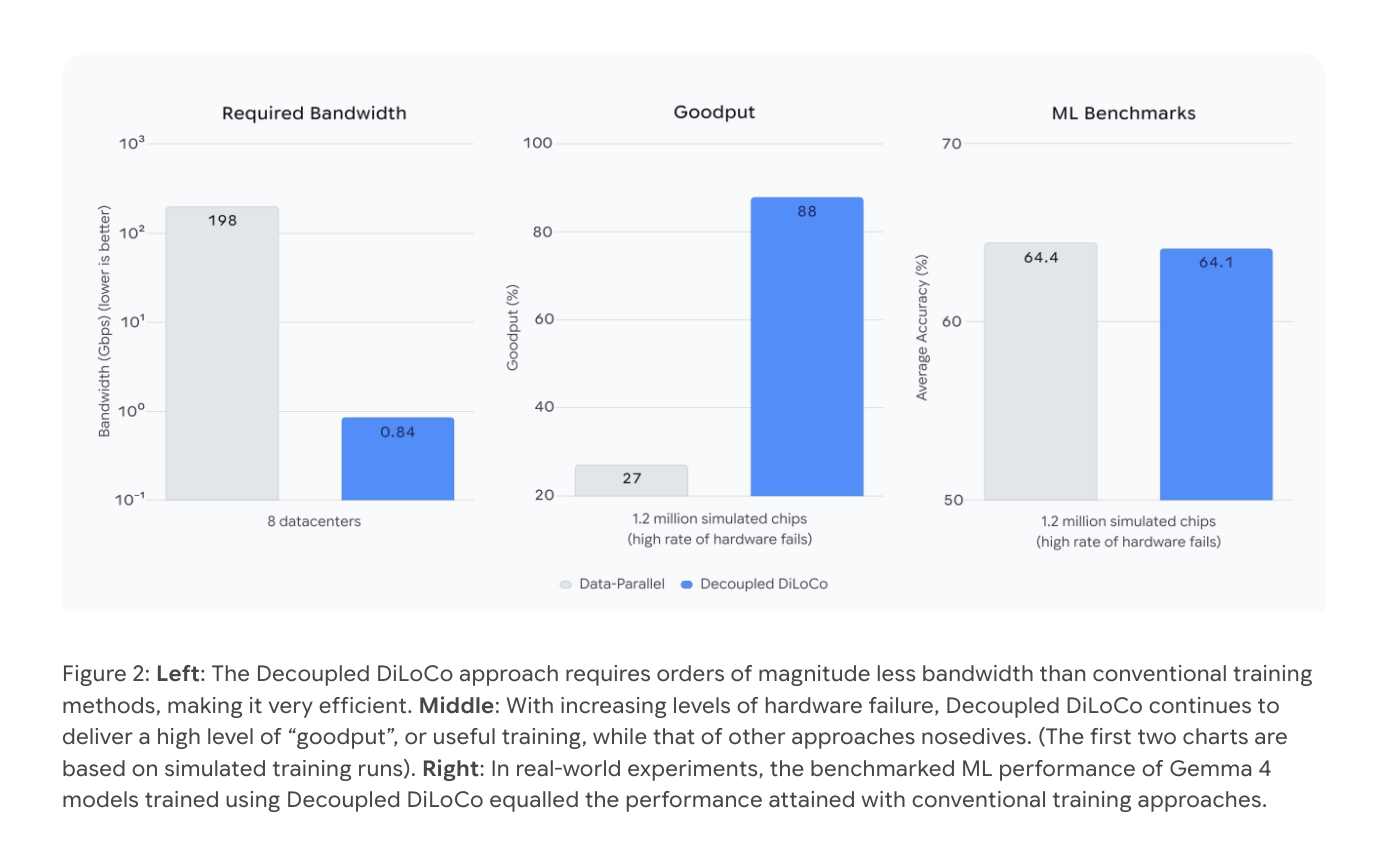
Critically, these resilience features include minimal degradation in mannequin high quality. In real-world experiments utilizing Gemma 4 fashions, Decoupled DiLoCo achieved a median ML benchmark accuracy of 64.1%, in comparison with 64.4% for the standard baseline — a distinction effectively throughout the noise of typical analysis variance.
Coaching a 12B Mannequin Throughout 4 U.S. Areas
The analysis group validated Decoupled DiLoCo at manufacturing scale by efficiently coaching a 12 billion parameter mannequin throughout 4 separate U.S. areas utilizing simply 2–5 Gbps of wide-area networking, a bandwidth degree achievable with current business web infrastructure between information heart services. The system completed this greater than 20 instances quicker than standard synchronization strategies. The important thing motive: somewhat than forcing compute to pause and await communication to finish, Decoupled DiLoCo incorporates required communication into longer durations of computation, eliminating the “blocking” bottlenecks that make standard distributed coaching sluggish at world scale.
Mixing {Hardware} Generations
An underappreciated implication of the structure is its help for heterogeneous {hardware}. As a result of learner items function asynchronously, they don’t have to run on equivalent {hardware} on the identical clock velocity. The analysis group demonstrated coaching runs that blended TPU v6e and TPU v5p chips — totally different {hardware} generations with totally different efficiency traits — in a single coaching job, with out degrading ML efficiency relative to homogeneous runs.
This has two sensible penalties value noting. First, it extends the helpful lifetime of current {hardware}, permitting older accelerators to proceed contributing meaningfully to large-scale coaching. Second, as a result of new {hardware} generations don’t arrive in all places without delay, with the ability to prepare throughout generations can alleviate the recurring logistical and capability bottlenecks that come up throughout {hardware} transition durations — an actual operational problem at organizations working giant coaching infrastructure.
Key Takeaways
- Decoupled DiLoCo eliminates the single-point-of-failure drawback in large-scale AI coaching by dividing coaching throughout asynchronous, fault-isolated “islands” of compute referred to as learner items — so a chip or cluster failure in a single island doesn’t stall the remainder of the coaching run.
- The structure reduces inter-datacenter bandwidth necessities by orders of magnitude — from 198 Gbps right down to 0.84 Gbps throughout eight information facilities — making globally distributed pre-training possible over commonplace wide-area networking somewhat than requiring customized high-speed infrastructure.
- Decoupled DiLoCo is self-healing: utilizing chaos engineering to simulate actual {hardware} failures, the system maintained 88% goodput in comparison with simply 27% for traditional Knowledge-Parallel coaching underneath excessive failure charges, and seamlessly reintegrated offline learner items after they got here again on-line.
- The method was validated at manufacturing scale, efficiently coaching a 12 billion parameter mannequin throughout 4 U.S. areas — reaching this greater than 20 instances quicker than standard synchronization strategies by folding communication into computation somewhat than treating it as a blocking step.
- Decoupled DiLoCo helps heterogeneous {hardware} in a single coaching run, demonstrated by mixing TPU v6e and TPU v5p chips with out efficiency degradation — extending the helpful lifetime of older accelerators and easing capability bottlenecks throughout {hardware} era transitions.
Try the Paper and Technical particulars. Additionally, be happy to observe us on Twitter and don’t neglect to affix our 130k+ ML SubReddit and Subscribe to our E-newsletter. Wait! are you on telegram? now you’ll be able to be part of us on telegram as effectively.
Have to associate with us for selling your GitHub Repo OR Hugging Face Web page OR Product Launch OR Webinar and so on.? Join with us
