



Key Insights
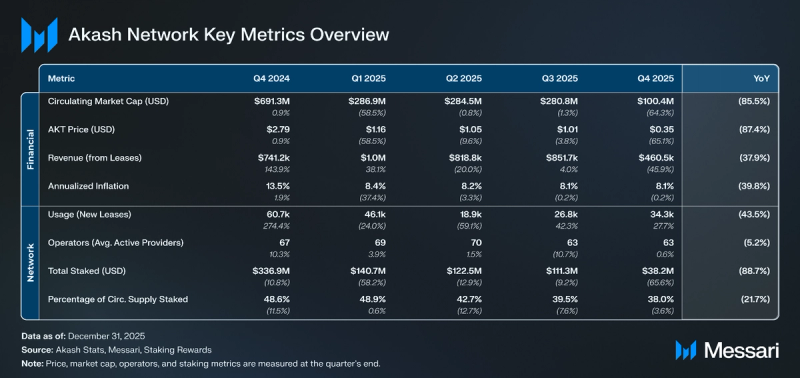
- New leases elevated 28% QoQ, rising from 26,800 to 34,300, extending the restoration in deployment exercise after earlier declines within the yr.
- Community income fell 46% QoQ in USD as a result of 65% drop in AKT’s worth, however AKT-denominated income elevated 16% QoQ and 229% YoY, indicating continued community exercise.
- GPU utilization declined 46% QoQ, whereas capability fell 16% QoQ to 587 GPUs. Nevertheless, GPU capability remained 1.7% larger YoY, indicating secure long-term infrastructure development.
- The Mainnet 14 improve migrated Akash to Cosmos SDK v0.53, whereas AkashML launched a managed inference layer to simplify AI deployment on decentralized GPUs.
- A complete of seven governance proposals have been permitted in This fall. Governance proposals throughout the quarter funded protocol upgrades, engineering improvement, and operational help, together with coordination of the Mainnet 14 migration and subsequent upgrades.
Primer
Akash (AKT) is a decentralized cloud computing market that facilitates the shopping for and promoting of compute assets. It’s an open-source, permissionless protocol that gives an alternative choice to at this time’s centralized cloud companies (i.e., AWS, Azure, and Google Cloud). Akash goals to leverage underutilized server capability, which might vary from 5% to over 30%. Akash is a Tendermint-based, Layer-1 community constructed utilizing the Cosmos SDK. Market exercise (requests, bids, lease particulars, and many others.) is saved onchain, and funds are settled with Akash’s native token, AKT.
The Akash market capabilities through a reverse public sale, giving customers the power to call a worth and describe the assets they need for deployments. Akash’s decentralized community of compute suppliers runs its open-source software program and competes to supply assets, usually at a fraction of the price of massive cloud suppliers. Particularly, Akash hosts containers the place customers can run any cloud-native utility (e.g., AI workloads, gaming servers, blockchain nodes, and web sites). Akash presents intensive cloud administration companies like Kubernetes, which can be utilized for internet hosting and managing containers. Moreover, Akash helps decentralized AI purposes comparable to Venice.ai, AkashChat, and AkashGen, reflecting its position in enabling AI infrastructure. For a full primer on Akash, check with our Initiation of Protection report.
Web site / X / Discord
Key Metrics
Utilization and Supplier Evaluation
Leases and Income
Akash’s market makes use of a reverse public sale, during which customers suggest a bid that describes the assets they’d like to make use of for a deployment. When accepted, a lease is opened onchain, managing the exercise of this relationship.
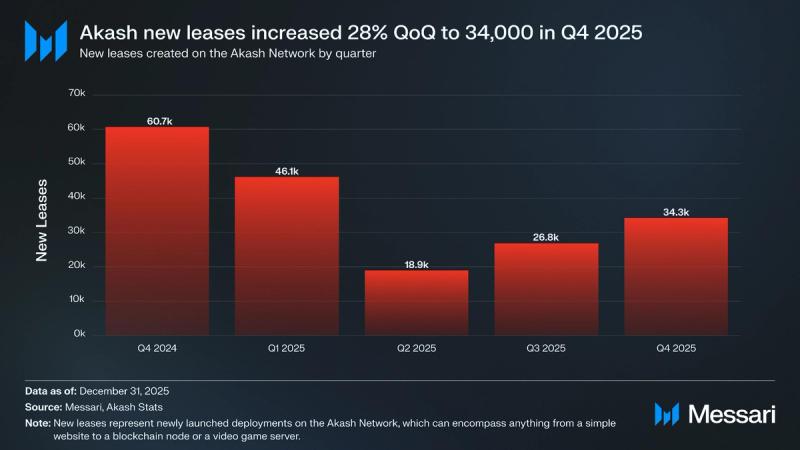
New leases on Akash Community signify agreements between customers and suppliers for renting computational assets. New leases elevated 28% QoQ, rising from 26,800 in Q3 2025 to 34,300 in This fall 2025, persevering with the restoration in community utilization following the sharp contraction earlier within the yr.
The rise in new deployments occurred alongside a number of community developments throughout the quarter. These included the Mainnet 14 improve, which launched infrastructure enhancements and protocol updates, in addition to the launch of AkashML, a managed inference layer designed to simplify entry to decentralized GPU assets. Extra developer tooling enhancements, such because the Chain SDK, console onboarding updates, and automated credit score reloading, diminished operational friction for deploying workloads on the community.
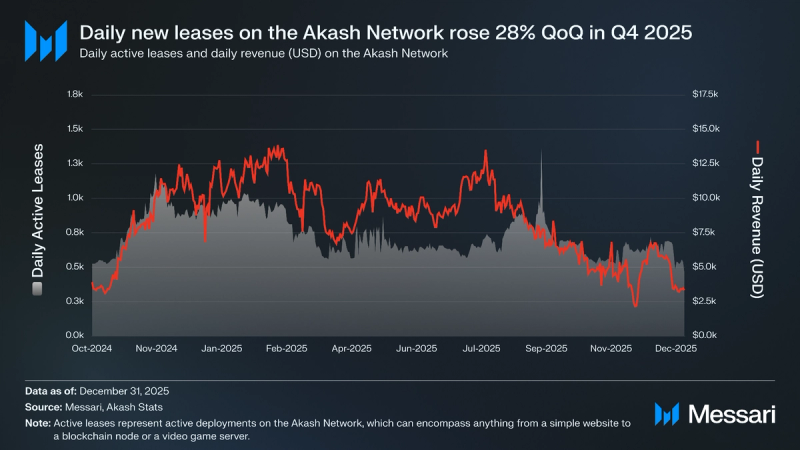
Lively leases on Akash signify ongoing agreements during which customers devour and handle computational assets on the community. Leases stay lively so long as workloads proceed working and terminate as soon as deployments are closed. Whereas new leases elevated 28% QoQ in This fall, rising from 26,800 to 34,300, this development didn’t translate proportionally into larger income. Lease income declined 46% QoQ, falling from $851,700 to $460,500 in This fall 2025.
Income generated from community transaction charges, which incorporates base charges, supplier take charges, and different transaction-level prices related to lease exercise, declined considerably in USD phrases throughout This fall 2025. Whole community income fell 46% QoQ, reducing from $860,100 in Q3 2025 to $463,200 in This fall 2025.
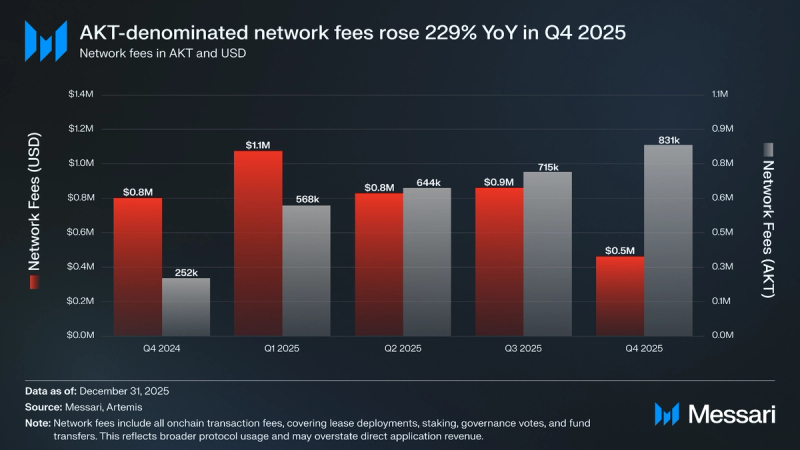
Nevertheless, this decline was primarily pushed by the sharp drop in AKT’s market worth, which fell from $1.01 in Q3 to $0.35 in This fall, considerably decreasing the USD worth of charges paid on the community. In native phrases, community income elevated 16% QoQ, rising from 714,562 AKT to 831,486 AKT, indicating that general financial exercise and payment era on the community continued to develop regardless of the token worth decline. The rise in new lease creation throughout the quarter seemingly contributed to the upper AKT-denominated income, whilst USD-reported income fell resulting from market situations.
On a YoY foundation, the divergence between USD and native-denominated income is much more pronounced. Whole community income declined 42% YoY in USD phrases, falling from $801,000 in This fall 2024 to $463,000 in This fall 2025. Over the identical interval, AKT-denominated income elevated 229%, rising from 252,406 AKT to 831,486 AKT. This divergence displays the substantial decline in AKT’s worth, which fell 87% YoY, from $2.79 to $0.35, considerably decreasing the USD worth of community charges regardless of sturdy development in native payment era.
Useful resource Compute
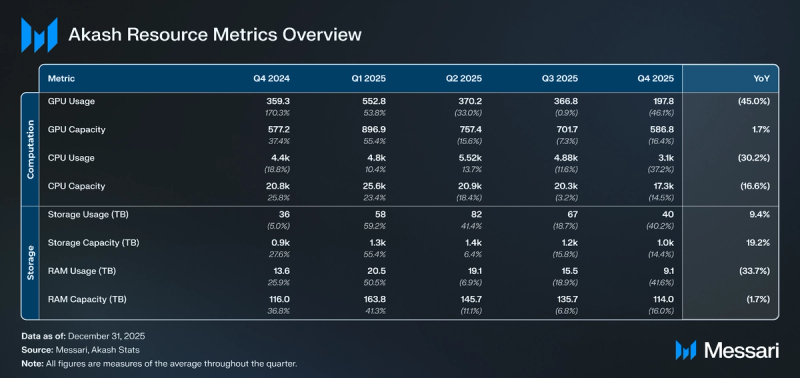
CPU Utilization and Capability: CPU utilization declined 37.2% QoQ, falling from a median of 4,880 vCPUs in Q3 to three,060 in This fall 2025, marking a sharper contraction than within the earlier quarter. CPU capability additionally decreased 14.5% QoQ, falling from 20,300 vCPUs to 17,300 vCPUs. The bigger drop in utilization relative to capability suggests {that a} portion of accessible compute assets remained underutilized throughout the quarter. On a YoY foundation, CPU utilization declined 30.2%, whereas CPU capability decreased 16.6%.
Storage Utilization and Capability: Storage utilization declined 40.2% QoQ, dropping from 67 TB in Q3 to 40 TB in This fall. Storage capability additionally decreased 14.4% QoQ, falling from 1,210 TB to 1,030 TB. Much like CPU metrics, the sharper contraction in utilization relative to capability signifies {that a} bigger share of accessible storage assets remained unused throughout the quarter. Nevertheless, on a YoY foundation, storage utilization elevated 9.4% and storage capability expanded 19.2%, indicating general development in storage infrastructure relative to the earlier yr.
RAM Utilization and Capability: RAM utilization decreased 41.6% QoQ, falling from 15.5 TB in Q3 to 9.1 TB in This fall, whereas RAM capability decreased 16.0% QoQ, from 136 TB to 114 TB. On a YoY foundation, RAM utilization declined 33.7%, whereas RAM capability remained comparatively secure, reducing barely by 1.7%.
GPU Compute
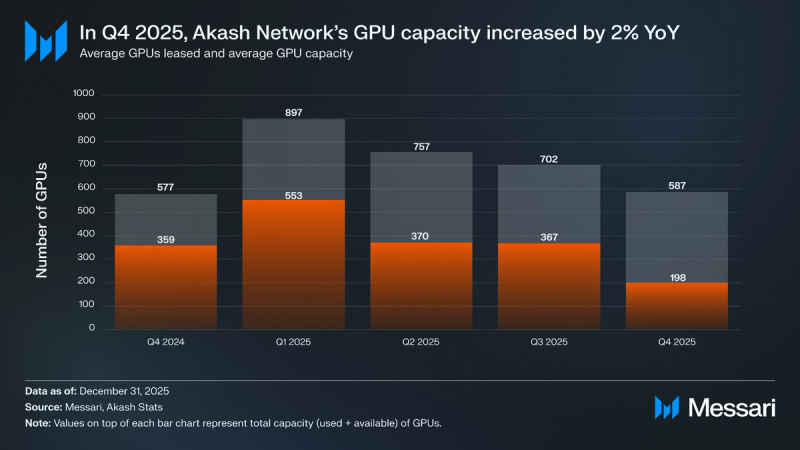
GPU utilization declined 46.1% QoQ, falling from a median of 367 GPUs in Q3 to 198 in This fall 2025, representing the biggest contraction amongst compute assets throughout the quarter. GPU capability additionally decreased 16.4% QoQ, declining from 702 to 587 GPUs as some suppliers diminished accessible infrastructure or quickly exited the community.
The bigger decline in utilization relative to capability signifies that accessible GPU assets have been utilized much less intensively throughout the quarter. Whereas infrastructure provide contracted reasonably, the sharper decline in utilization suggests {that a} better share of GPU capability remained idle in comparison with the earlier quarter.
On a YoY foundation, GPU utilization declined 45.0%, whereas GPU capability elevated barely by 1.7%, rising from 577 GPUs in This fall 2024 to 587 in This fall 2025.
Lively Suppliers
Akash’s permissionless community permits useful resource suppliers to affix from anyplace on this planet, making a geographically various and resilient infrastructure. This world distribution enhances the community’s capability to face up to regional disruptions, comparable to pure disasters, energy outages, or political instability. It additionally improves efficiency by enabling workloads to be processed nearer to finish customers, decreasing latency and enhancing information switch effectivity.
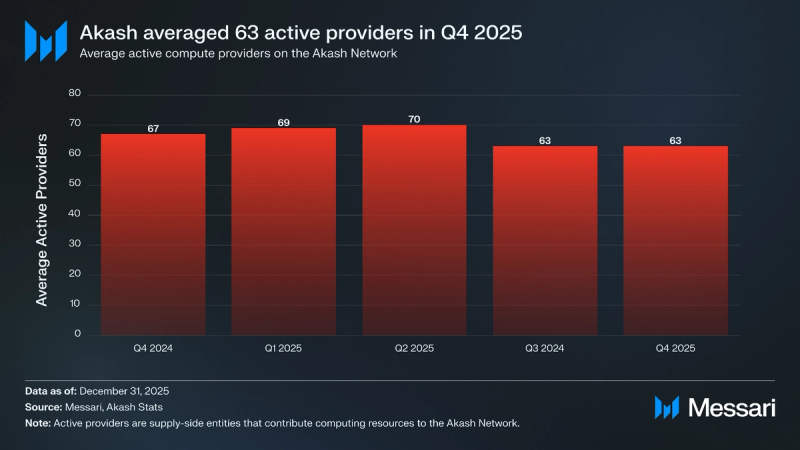
Common lively suppliers remained comparatively secure in This fall 2025, rising barely from 62.9 in Q3 to 63.3, representing a 0.6% QoQ improve. This stabilization adopted the contraction noticed in Q3, when the variety of lively suppliers declined after a number of quarters of growth.
Regardless of comparatively secure supplier participation, each infrastructure capability and useful resource utilization declined throughout the quarter, with GPU, CPU, RAM, and storage capability contracting modestly. Nevertheless, utilization throughout these assets fell considerably quicker than capability, indicating {that a} bigger share of accessible infrastructure remained unused in comparison with the earlier quarter.
This divergence means that infrastructure provide remained comparatively secure whereas general community utilization declined throughout the quarter.
Token Evaluation
Market Cap
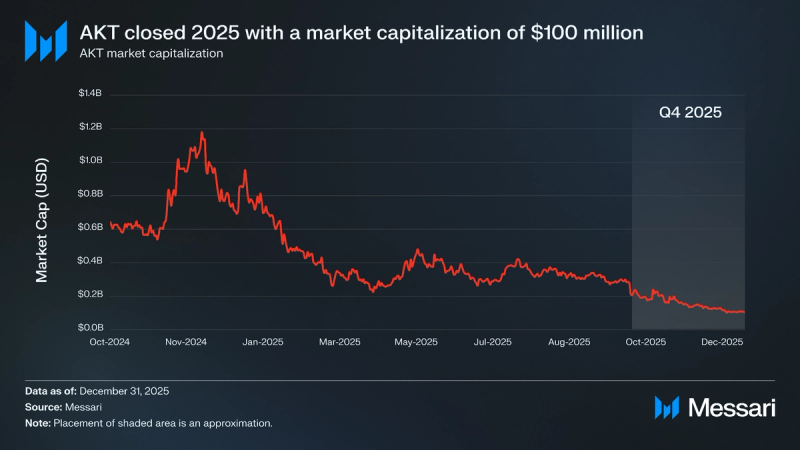
Akash’s circulating market capitalization declined in This fall 2025, falling 64.3% QoQ from $280.8 million to $100.4 million. The decline carefully mirrored the motion within the AKT token worth, which dropped 65.1% over the identical interval, falling from $1.01 to $0.35. The contraction in market worth was subsequently primarily pushed by token worth depreciation reasonably than adjustments in circulating provide.
Staking participation additionally declined throughout the quarter. The staking ratio fell from 39.5% to 38.0%, representing a 3.6% QoQ lower, whereas the USD worth of staked tokens declined alongside the broader market correction. The discount in staking participation seemingly displays weaker token worth efficiency and diminished staking incentives throughout the quarter.
Qualitative Evaluation
Partnerships and Developments
Throughout This fall 2025, Akash centered on executing main protocol upgrades, enhancing developer infrastructure, and formalizing operational governance buildings.
Mainnet 14 Improve
Akash executed Mainnet 14 on Oct. 28, 2025, upgrading the community to model v1.0.0 and migrating from Cosmos SDK v0.45 to v0.53. This improve represented one of the vital architectural adjustments to the protocol for the reason that introduction of GPU market performance. The migration modernized the underlying codebase, improved validator efficiency, and diminished a number of years of amassed technical debt. Working on older Cosmos SDK variations had begun to restrict improve flexibility and upkeep effectivity because the community expanded. By adopting the newer SDK structure, Akash aligned with present ecosystem requirements whereas enhancing long-term maintainability and upgradeability.
Mainnet 14 integrated a number of Akash Enhancement Proposals (AEPs) and protocol enhancements geared toward enhancing usability, safety, and operational flexibility.
- Managed Wallets / Credit score Card API (AEP-63): AEP-63 launched programmatic fee flows that permit deployments to be funded via bank cards and managed wallets reasonably than solely via crypto-native funding strategies. Beforehand, working workloads on Akash required customers to amass and handle AKT tokens straight, which created friction for enterprise customers unfamiliar with crypto-based fee flows. The brand new API permits purposes and organizations to deploy workloads utilizing typical billing infrastructure whereas nonetheless settling funds on-chain. This reduces onboarding friction for conventional builders and enterprises evaluating decentralized compute companies.
- JWT Authentication for Suppliers (AEP-64): AEP-64 launched JSON Net Token (JWT) authentication for supplier APIs. Earlier supplier interactions relied totally on certificate-based authentication tied on to blockchain infrastructure, which added operational complexity and restricted integration flexibility. JWT authentication permits shoppers to generate short-lived signed tokens utilizing pockets keys, which suppliers confirm utilizing public keys retrieved from the blockchain. This mannequin improves safety, reduces reliance on blockchain availability throughout authentication, and allows extra granular permission controls for deployment administration.
- Supplier Lease Termination Causes (AEP-39): AEP-39 launched structured metadata for lease termination occasions. Beforehand, deployments might shut with out clearly indicating the underlying trigger, making troubleshooting troublesome for tenants and suppliers. The addition of standardized termination causes improves observability throughout deployment lifecycles and permits customers to find out whether or not leases ended resulting from supplier failures, inadequate escrow balances, guide shutdowns, or different operational occasions.
- IAVL Storage Enhancements: The Cosmos SDK improve launched enhancements to the IAVL state storage system utilized by Akash. These adjustments improved block processing effectivity and diminished storage overhead within the community’s state tree. Improved state administration reduces computational load for validators and will increase responsiveness for community operations, significantly as transaction quantity and deployment exercise improve.
- Expedited Governance Paths: Mainnet 14 additionally launched expedited governance paths for sure kinds of low-risk proposals. Beforehand, governance proposals required full voting intervals even when addressing pressing fixes or operational changes. Expedited governance permits the community to reply extra rapidly to points comparable to software program bugs or parameter updates whereas sustaining validator oversight. This mechanism was utilized shortly after the improve to execute Mainnet 15.
- Multi-Depositor Escrow (AEP-75): AEP-75 launched a significant redesign of Akash’s escrow system. Previous to this improve, deployments might solely be funded by a single depositor account, and that depositor couldn’t be modified after the deployment was created. The brand new escrow structure permits deposits to be sourced from a number of accounts or authorization grants. This permits extra versatile funding buildings, together with multi-wallet treasury administration, DAO-funded deployments, and automatic escrow replenishment programs. The redesign considerably improves fee flexibility and helps extra subtle billing workflows required by enterprise customers.
AkashML Launch: Managed Inference Layer on Decentralized GPUs
Akash launched AkashML on Nov. 22, 2025, introducing a managed AI inference layer constructed on the community’s decentralized GPU infrastructure. AkashML supplies builders with an OpenAI-compatible API, permitting purposes to entry AI fashions with out straight managing GPU infrastructure or deployment orchestration. The system robotically routes inference workloads throughout accessible GPU suppliers throughout the community.
At launch, the service supported a number of open-source fashions, together with Llama 3.3-70B, DeepSeek V3, and Qwen3-30B-A3B, and supplied free developer credit alongside automated scaling throughout a number of datacenters taking part within the community.
By abstracting underlying model-serving infrastructure comparable to vLLM and Textual content Era Inference (TGI), AkashML simplifies deployment workflows whereas sustaining the fee benefits of decentralized compute infrastructure.
Developer and Console Infrastructure Enhancements
A number of developer tooling and console enhancements have been launched throughout This fall to enhance onboarding and operational reliability.
Chain SDK (AEP-56): Akash accomplished a unified Chain SDK in October 2025, offering a standardized TypeScript library for interacting with each blockchain nodes and supplier APIs. The SDK consolidates REST and gRPC interfaces, certificates administration utilities, and deployment tooling, simplifying integrations for builders constructing purposes and infrastructure on Akash.
Terraform Supplier Enhancements: The Akash Terraform supplier acquired efficiency optimizations that improved deployment execution speeds by roughly thrice. These enhancements assist streamline infrastructure automation for builders utilizing infrastructure-as-code workflows to handle Akash deployments.
Console Onboarding Enhancements (AEP-72): Akash redesigned the Console onboarding expertise to enhance consumer conversion and useful resource utilization. Key adjustments included rising trial credit from $10 to $100, introducing credit-card verification for brand spanking new customers, and implementing limits on trial deployment period. The earlier open trial mannequin typically resulted in deserted deployments or unused useful resource allocations. The up to date onboarding move goals to enhance tenant high quality, scale back idle useful resource consumption, and improve the probability that trial customers convert into long-term deployments.
Auto Credit score Reload (AEP-77): Later in This fall, Akash launched automated credit score reloading, permitting customers to replenish escrow balances robotically when funds fall beneath predefined thresholds. This characteristic reduces the chance of deployment interruptions brought on by inadequate escrow balances and improves reliability for long-running workloads.
Governance
Alongside technical upgrades and product launches, Governance exercise throughout the quarter centered on coordinating protocol upgrades and funding engineering and operational initiatives supporting community improvement.
Proposal 306 – Decentralized Cloud Basis Operational Bills (Oct. 13): Accredited funding to help operational actions of the Decentralized Cloud Basis (DCF), which manages treasury administration, compliance processes, and governance coordination for the ecosystem. The funding helps monetary operations, authorized companies, and operational infrastructure.
Proposal 308 – Mainnet 14 Improve (Oct. 20): Licensed the execution of Mainnet 14, which migrated the community from Cosmos SDK v0.45 to v0.53 and launched a number of protocol enhancements, together with JWT authentication (AEP-64), multi-depositor escrow (AEP-75), and improved lease termination metadata (AEP-39). The proposal coordinated validator upgrades and ensured network-wide adoption of the brand new protocol model.
Proposal 310 – Zealy Distribution Repair (Nov. 4): Accredited a corrective motion to resolve a distribution difficulty affecting rewards from a earlier Zealy incentive marketing campaign. The difficulty resulted from an upgrade-related edge case that prevented some contributors from receiving rewards.
Proposal 311 – Mainnet 15 Improve (Nov. 23): Licensed an expedited improve to Mainnet 15 (v1.1.0) to deal with escrow accounting inconsistencies found after the Mainnet 14 migration. The improve restored correct settlement habits for affected deployments and demonstrated the effectiveness of the expedited governance course of launched earlier within the quarter.
Proposal 312 – Core Engineering Funding (Nov. 25): Allotted funding to reimburse engineering work related to the Cosmos SDK migration and different protocol infrastructure enhancements applied throughout the Mainnet 14 improve.
Proposal 313 – Consumer Engineering Funding (Nov. 25): Accredited funding for client-side enhancements together with console performance, deployment administration instruments, billing interfaces, and developer tooling designed to enhance the developer expertise.
Proposal 314 – Help Providers Funding (Dec. 10): Accredited funding for operational companies supporting the ecosystem, together with DevOps infrastructure administration, supplier coordination, monetary operations, and group administration.
Neighborhood Applications and Ecosystem Help
Akash Neighborhood Contribution Program: On Nov. 3, 2025, Akash launched a structured group contribution program to formalize open-source collaboration throughout the ecosystem. This system establishes a tiered contributor pathway that allows builders to progress from smaller contributions to main bigger community-driven initiatives. Early outputs from this system included a community-built Akash VPN service and an Akash Transaction Explorer designed to visualise supplier exercise and deployment occasions.
Pupil Ambassador Program: On Dec. 4, 2025, Akash launched a Pupil Ambassador Program, onboarding college students from universities comparable to Princeton, Cornell, USC, and UT Austin to advertise decentralized compute training and arrange developer-focused campus occasions.
Closing Abstract
Throughout This fall 2025, Akash noticed deployment exercise proceed to recuperate, with new leases rising 28% QoQ to 34,300following the contraction earlier within the yr. Regardless of the rise in deployments, infrastructure utilization declined throughout compute assets, with GPU utilization falling 46% QoQ, CPU utilization 37%, RAM 42%, and storage 40%, whereas capability throughout these assets contracted extra modestly.
From a monetary perspective, USD-denominated community income declined throughout the quarter, largely as a result of 65% QoQ drop in AKT’s worth, which diminished the greenback worth of charges paid on the community. In native phrases, nonetheless, community income elevated, indicating continued transaction exercise and lease creation on the community.
On the event aspect, the quarter included the Mainnet 14 improve, which migrated the community to Cosmos SDK v0.53, and the launch of AkashML, a managed inference layer designed to simplify entry to decentralized GPU infrastructure. Extra developer tooling enhancements additionally diminished deployment friction.
General, This fall 2025 centered on infrastructure upgrades and developer tooling, whereas community utilization moderated amid broader market volatility. These developments replicate continued funding within the protocol’s compute and developer infrastructure, positioning Akash to help better AI and cloud workload adoption heading into 2026.
