



In the event you run safety at any fairly complicated group, your validation stack most likely seems to be one thing like this: a BAS device in a single nook. A pentest engagement, or possibly an automatic pentesting product, in one other. A vulnerability scanner feeding an assault floor administration platform some other place. Every device offers you a slice of the image. None of them talks to one another in any significant approach.
In the meantime, adversaries don’t assault in silos. An actual intrusion may chain collectively an uncovered id, a cloud misconfiguration, a missed detection alternative, and an unpatched vulnerability in a single operation. Attackers perceive that your setting is an interconnected system. Sadly, most validation packages are nonetheless treating it as a set of disparate, disconnected elements.
This is not a minor inefficiency. It is a structural blind spot. And it is lasted for years as a result of the market has handled each validation self-discipline as a separate class, with its personal distributors, consoles, and its personal separate, and really restricted danger assessments.
As autonomous AI brokers turn out to be able to planning, executing, and reasoning throughout complicated workflows, safety validation should enter a brand new part. The rising self-discipline of Agentic Publicity Validation factors towards one thing way more coordinated and succesful than immediately’s fragmented, handbook validation cycles. It guarantees steady, context-aware, autonomous validation that higher matches how trendy threats normally unfold.
What Safety Validation Really Means Right this moment
For years, safety validation has been handled primarily as an assault simulation. You deployed brokers, ran eventualities, and acquired a report exhibiting what was blocked and what wasn’t. Right this moment, that is now not sufficient.
Fashionable safety validation spans three distinct views. Taken collectively, they offer defenders a way more reasonable view of their holistic safety posture.
- The Adversarial Perspective asks, “How can an attacker actually get into our environment?” This entails automated pentesting and assault path validation, which focuses on figuring out exploitable vulnerabilities and mapping the best routes to crucial belongings.
- The Defensive Perspective asks, “Can we actually stop them?” This contains safety management validation and detection stack validation, which be certain that your firewalls, EDR, IPS, WAF, SIEM guidelines, and alerting programs carry out as anticipated towards actual threats.
- The Threat Perspective asks, “Does this exposure actually matter?” This entails publicity prioritization, guided by compensating controls, which filter out theoretical dangers and focus remediation on the vulnerabilities which are genuinely exploitable in your particular setting.
Any one in every of these views by itself leaves harmful gaps. The following evolution of safety validation will likely be outlined by its convergence right into a unified validation self-discipline.
Agentic AI is a Sport Changer for Defenders
Right this moment, nearly each cybersecurity vendor claims to be AI-powered. In lots of circumstances, that merely means a language mannequin has been added to a dashboard to summarize findings or generate reviews. And whereas “AI-assisted” could also be helpful, it is undoubtedly not transformative.
Agentic AI is a essentially completely different proposition.
An AI wrapper is mainly a easy app that calls an AI mannequin and presents the output. It’d format, summarize, or repackage the response, nevertheless it would not really handle the duty itself. Agentic AI, however, takes possession of the complete process from begin to end. It figures out what must be accomplished, carries out the steps, evaluates the outcomes, and adjusts if needed with out a human needing to direct every step alongside the best way.
In safety validation, the distinction is each large and quick.
Think about what occurs immediately when a crucial menace makes the information. Somebody on the crew reads the advisory, determines which of the group’s programs is likely to be uncovered, builds or adapts check eventualities, runs them, critiques the outcomes, after which decides what wants remediation. Even in robust groups, this could take days. If the menace is complicated, it might probably stretch into weeks.
Agentic AI can compress that workflow into minutes.
Not as a result of somebody wrote a sooner script, however as a result of an autonomous agent dealt with the complete sequence. It analyzed the menace, mapped it to the setting, chosen related belongings and controls, ran the appropriate validation workflows, interpreted the outcomes, and surfaced what mattered most.
That is how agentic AI balances the scales. It isn’t nearly velocity. It is about changing disconnected, human-driven validation steps with autonomous, coordinated, end-to-end reasoning.
The Actual Constraint Is not the Mannequin. It is the Information.
That is the place loads of the AI dialogue goes incorrect.
Agentic programs are solely as robust because the setting they’ll purpose over. An autonomous agent that runs generic assault simulations towards a generic mannequin will produce generic outcomes. Which will look spectacular in a demo, nevertheless it would not assist a safety crew make assured selections in manufacturing.
The actual differentiator is context.
Because of this the underlying knowledge structure issues greater than the mannequin alone. To make agentic validation helpful, organizations want a unified safety knowledge layer that repeatedly displays what exists, what’s uncovered, and what’s really working.
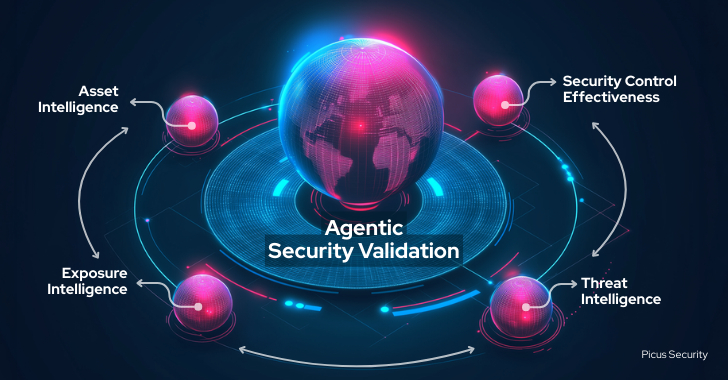
You may consider this as a Safety Information Material, constructed from three important dimensions.
- Asset Intelligence covers the complete stock of your setting: servers, endpoints, customers, cloud sources, functions, and containers, in addition to their relationships. As a result of you possibly can’t validate what you possibly can’t see.
- Publicity Intelligence encompasses vulnerabilities, misconfigurations, id dangers, and different weaknesses throughout your assault floor. That is the uncooked materials that attackers work with.
- Safety Management Effectiveness is the dimension that almost all organizations are lacking fully. It isn’t sufficient to know that you have deployed a firewall or an EDR agent. You might want to know, with proof, whether or not these controls will really block the precise threats which are concentrating on your particular belongings.
When these dimensions come collectively, the result’s greater than an asset database or vulnerability feed. It turns into a residing mannequin of the group’s minute-to-minute safety actuality. That mannequin modifications because the setting modifications. New belongings seem. New vulnerabilities are disclosed. Controls are reconfigured. New threats emerge.
And that’s precisely the context the agentic AI wants.
With a wealthy safety knowledge cloth behind it, an agentic AI is now not working one-size-fits-all checks. It will possibly tailor validation to precise topology, your group’s precise crown jewels, its precise management protection, and precise assault paths.
That’s the distinction between listening to “this CVE is critical” and studying “this CVE is critical on this server, your controls don’t block exploitation, and there’s a validated path to one of your most sensitive business systems.”
The place Safety Validation Is Headed
The way forward for safety validation is evident. Periodic testing is changing into steady validation. Handbook effort is evolving into autonomous operation. Level merchandise are consolidating into unified platforms. And reporting issues is morphing into enabling higher safety selections.
Agentic AI is the catalyst, nevertheless it solely works with the appropriate basis. Autonomous brokers want actual context: an correct, linked view of the setting, not a fragmented set of instruments and findings.
When agentic workflows, wealthy context, and unified validation come collectively, the result’s a essentially completely different mannequin. As an alternative of ready for somebody to ask whether or not the group is protected, the system repeatedly solutions that query with proof grounded in how even the newest assaults are literally taking place.
The market is already validating this shift. In Frost & Sullivan’s Frost Radar: Automated Security Validation, 2026, Picus Security was named the Innovation Index Leader, with its agentic capabilities and CTEM-native architecture highlighted as key differentiators.
Get your demo today to discover how Picus helps organizations unify adversarial, defensive, and risk validation in a single platform.
Note: This article was written by Huseyin Can YUCEEL, Security Research Lead at Picus Security.
