



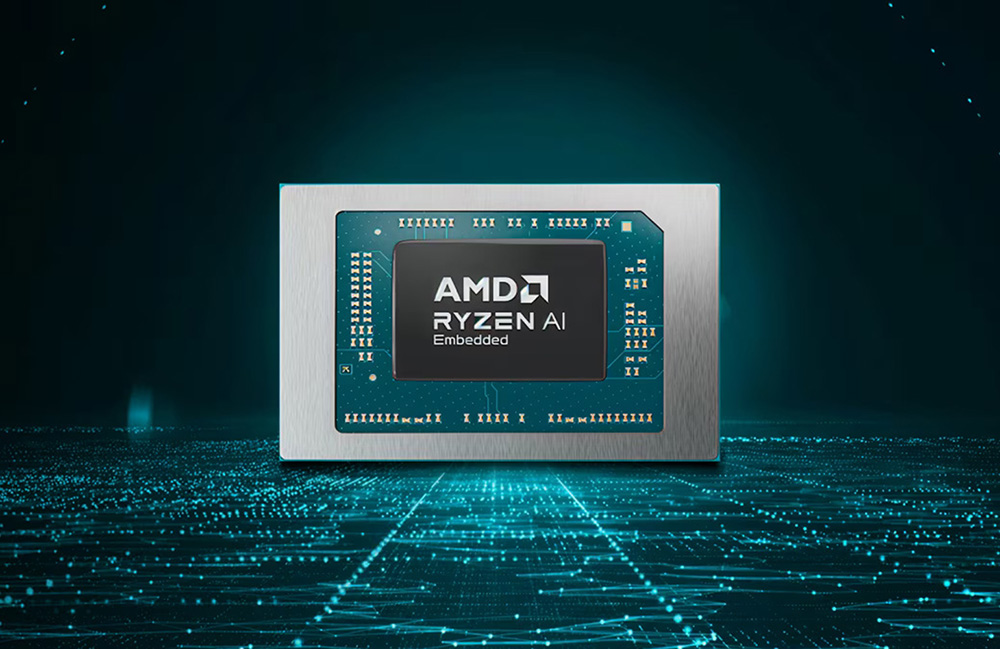
AMD’s Ryzen AI Embedded P100 Collection processor. | Supply: AMD
AMD at present expanded its Ryzen AI Embedded P100 Collection processor portfolio. The corporate stated the expanded line will higher swimsuit the quickly evolving computing wants of manufacturing unit automation, cell robots, and different AI-driven edge purposes.
The Santa Clara, Calif.-based firm stated its new processors characteristic as much as two occasions increased CPU core items, eight occasions increased graphics processing unit (GPU) compute, and an estimated 36% increased system tera operations.
On a single chip, the processors characteristic:
- Eight to 12 “Zen 5” cores
- As much as 80 system TOPS for bodily AI acceleration
- AMD RDNA 3.5 graphics for real-time visualization
- A neural processing unit (NPU) primarily based on the AMD XDNA 2 structure for low-latency, power-efficient AI inference
AMD Ryzen AI Embedded P100 Collection processors that includes eight to 12 cores are presently sampling, with manufacturing shipments anticipated to start in July 2026. P100 Collection four- to six-core processors are sampling now, with manufacturing anticipated within the second quarter of 2026.
AMD presents scalable AI compute
The processors allow consolidation of programmable logic controllers (PLCs), machine imaginative and prescient, and human-machine interface (HMI) right into a single industrial PC, whereas delivering the CPU efficiency required for real-time inspection and course of optimization. The built-in GPU and NPU speed up multicamera imaginative and prescient and wealthy HMI dashboards whereas enabling low-latency anomaly detection utilizing fashions like DeepSORT, RAFT-Stereo, CenterPoint, GDR-Web, PaDiM, and Llama 3.2-Imaginative and prescient.
For cell robots, the processors handle navigation, movement management, and route planning on the CPU. In the meantime, the GPU processes multicamera feeds for spatial consciousness, Visible SLAM, and superior AI workloads like vision-language-action (VLA) fashions. Unified reminiscence between the CPU and GPU unlocks low latency for higher responsiveness.
The NPU delivers always-on low-power inference for object detection and scene understanding utilizing fashions resembling YOLOv12 and MobileSAM.
The processors allow the powering of 3D imaging for ultrasounds, endoscopes, tissue classification, and tumor detection on the edge utilizing fashions like U-Web, nnU-Web, and MONAI. The processors speed up image-to-report workflows with MedSigLIP and help medical reasoning and Q&A with Med-PaLM 2. Healthcare authentic tools producers (OEMs) can consolidate imaging, AI evaluation, and reporting on a scalable, long-life-cycle x86 embedded platform.
In contrast with the prior technology AMD Ryzen Embedded 8000 Collection, the P100 Collection is anticipated to supply as much as 39% increased multithreaded efficiency and as much as 2.1 occasions increased whole system TOPS2. The brand new processors ship distinctive AI performance-per-watt and help nearly twice the variety of digital machines and bigger giant language fashions (LLMs), like Llama3.2-Imaginative and prescient 11B, than the prevailing P100 Collection to allow extra superior AI and blended workloads.

ROCm software program help and virtualized reference stack obtainable
Help for the AMD ROCm open software program ecosystem brings a confirmed, open-source AI software program stack to embedded purposes. Builders can run commonplace AI frameworks whereas counting on open-source compilers, runtimes, and libraries – all whereas having speedy entry to embedded-ready fashions with out rewriting code.
On the programming degree, ROCm software program makes use of the open-source Heterogeneous-computing Interface for Portability (HIP), decoupling GPU programming from the {hardware} and eliminating vendor lock-in between the software program stack and the {hardware}.
The tightly built-in CPU, GPU, and NPU structure permits environment friendly workload partitioning and predictable latency underneath blended workloads, whereas using acquainted frameworks and software program stacks helps simplify and streamline improvement and deployment throughout broad use circumstances. This degree of integration permits superior compute and graphics capabilities with out the necessity for added exterior parts, making it simpler for OEMs and system integrators to design scalable platforms.
AMD “Zen 5” CPU cores present the isolation and efficiency headroom to consolidate a number of essential workloads on a single platform with deterministic, multitasking habits. Moreover, AMD delivers a packaged and vertically built-in virtualized reference stack for industrial mixed-criticality purposes.
Constructed on the Xen hypervisor, it runs Linux, Home windows, Ubuntu, and RTOS environments in remoted domains to ship security, real-time efficiency, and adaptability.
The publish AMD expands Ryzen AI processor product line appeared first on The Robotic Report.
