



Hilo wearable blood strain monitor
ZDNET’s key takeaways
- Simply connect it to your wrist and it collects blood strain knowledge all through the day
- This nonetheless requires common calibration utilizing a blood strain cuff
- The app prices $80 a 12 months after the primary 12 months, and with out this, it limits your entry to your knowledge.
Comply with ZDNET: Add us as a most popular supply on Google.
After I was a child, I used to be completely satisfied that my demise would come because of both nuclear struggle, the Bermuda Triangle (in any case, it was solely about 4,000 miles away), quicksand — or, if I used to be actually unfortunate, some unusual and unlucky mixture of the three.
Now, whereas none of this stuff have gotten me but (fingers crossed, the day is younger), it seems the actual silent killer lurking within the shadows was… hypertension. Ah, the thrill of getting older. Near half of adults within the US undergo from hypertension, also called hypertension, and it’s a contributory think about over 1,000 deaths each day.
Final 12 months, Apple rolled out a brand new well being function for Apple Watch customers within the type of hypertension notifications. This joined options similar to AFib (atrial fibrillation) detection and high and low coronary heart fee notifications. Apple Watch Collection 9 or later and Apple Watch Extremely 2 or later use the information collected by the optical coronary heart sensor to scan for patterns which may point out hypertension over a 30-day interval. If such patterns are recognized, it sends a notification suggesting the person get a blood strain cuff to measure and monitor blood strain for seven days.
Additionally: Greatest blood strain watches: I examined the highest fashions that truly work
I wore my Apple Watch every day and by no means obtained any such notification. I would at all times hated the cuff-style blood strain screens, so it wasn’t one thing I stored a watch on a lot. Then, some time again, I used to be speaking to a good friend, they usually talked about that they’d picked up a wearable that supposedly measured blood strain for his or her father. Nevertheless, he refused to put on it, they usually questioned if I wished to attempt it.
It instructed me virtually instantly that I had hypertension. Nice.
A professional piece of kit
OK, earlier than I am going any additional, I should be clear that Apple makes it clear that the hypertension notifications function “is not intended to diagnose, treat, or aid in the management of hypertension,” and that “not all people with hypertension will receive a notification.”
Additionally: This smartwatch can monitor your blood strain, however it’s not for everybody – here is why
The wearable in query is known as Hilo, and it is yet one more gadget competing for house on our our bodies. This one suits on the wrist and appears like a Fitbit with out a show. It’s a Class IIa medical gadget that is gone by means of the testing wanted to be FDA cleared, and it is also ISO 81060-2 licensed, a normal that covers the accuracy of sphygmomanometers (blood strain screens).
So, it is undoubtedly a professional piece of kit and never snake oil. It takes blood strain readings all through the day and charts them on graphs in an app.
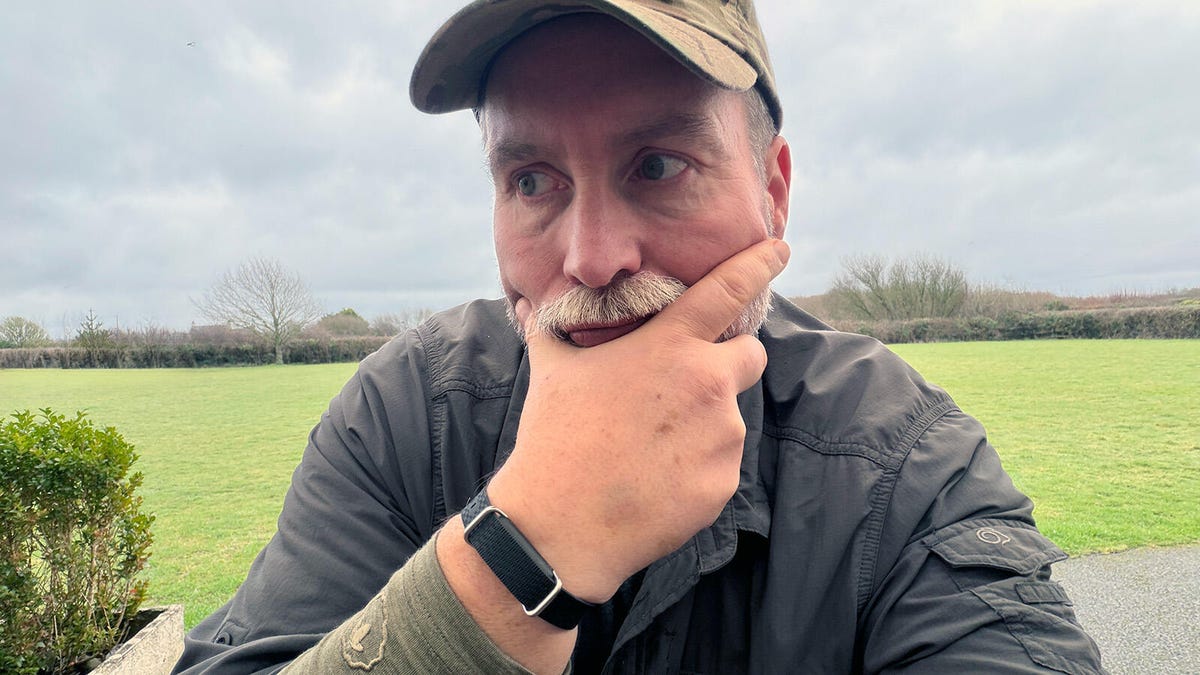
Hilo is a neat, if considerably thick band.
Adrian Kingsley-Hughes/ZDNET
It is constructed utilizing robust polycarbonate with chrome steel fittings and attaches to the wrist utilizing a hypoallergenic silicone band. It is IP68 rated, so it is 100% dustproof and has no downside dealing with showering, bathing, and swimming. Akita, the maker, additionally claims that the battery is nice for 15 days on a single cost.
The Hilo is thicker than my Apple Watch Extremely 3.
Adrian Kingsley-Hughes/ZDNET
And it does all this with out that cuff squeezing your arm like a ravenous boa constrictor and with out the racket of that air pump, each of which may set off an alarm response in some folks and trigger their blood strain to spike (a phenomenon referred to as white coat hypertension).
I hate cuffs (and proprietary cables)
Think about my shock after I discovered the very first thing I needed to do was take a normal blood strain studying utilizing the included cuff.
Yup, the package comes with a normal blood strain cuff that is used for calibration.
Adrian Kingsley-Hughes/ZDNET
Sure, the Hilo band comes with a Bluetooth cuff that is used to calibrate the readings. And you must use this cuff at the very least month-to-month to be sure that your knowledge is correct. As somebody who hated these cuffs, it was one thing I needed to get used to.
The cuff comes with directions, and the app additionally guides you on the right way to get one of the best studying.
Adrian Kingsley-Hughes/ZDNET
The following factor I observed, which I am certain prompted my blood strain to spike, was how I used to be alleged to cost the bits and items. The band has a cable with a proprietary two-pin connector, whereas the cuff expenses utilizing micro USB.
Additionally: 10 helpful cables and connectors I take advantage of on a regular basis (they usually’re affordably priced)
A little bit of a cursed, old fashioned charging setup — USB-A, micro USB, and proprietary dock.
Adrian Kingsley-Hughes/ZDNET
Each of those charging cables must plug into USB-A sockets. USB-A and micro USB at the moment are fairly outdated, principally changed by USB-C, and I have a tendency to have a look at something that wants a proprietary charging cable as a bit cursed as a result of I do know it is solely a matter of time earlier than I lose the cable (and I’ve not had any success discovering any third-party choices).
A subscription too?!
The following factor that undoubtedly prompted my blood strain to rise even additional was discovering out that after a 12 months, I would must pay a membership to get full entry to the app at a value of round $80. With out this, I would lose options like entry to an in depth timeline of my readings, my time within the goal vary (exhibiting how lengthy I spend within the perfect vary), and — and this actually boiled my blood — I would solely be capable to entry seven days of knowledge, and the sync with the Apple Well being app would go from every day to month-to-month.
Additionally: 7 methods well being tech guarantees to enhance your life in 2026
I get the company pondering. Why promote a chunk of {hardware} as soon as when you may promote the {hardware} after which artificially bond it to a subscription? However this degree of artificially limiting entry to my very own knowledge simply does not sit effectively with me. Doubly so after I simply do not feel just like the app is pretty much as good because the free apps that corporations similar to Withings and Hume are transport with their health and medical {hardware}. And sure, whereas these corporations do supply subscription plans that provide you with a deeper dive into your knowledge and stuff like train plans and well being ideas, they do not conceal your precise knowledge behind paywalls, they usually do not attempt to silo your knowledge in their very own app.
The Hilo app is fairly primary in the case of what I can do with the information.
Adrian Kingsley-Hughes/ZDNET
It does monitor blood strain effectively
However, all this mentioned, as soon as the calibrations are performed, the Hilo band does work very effectively in the case of monitoring blood strain. It appears to be very correct and matches the provided cuff and different third-party cuffs I’ve tried (sure, I am slowly getting used to the cuffs). It is also good as a step tracker and is barely ever just a few steps off from what my Apple Watch measures.
One place the place it falls down badly is sleep monitoring. I sleep round 6 to 7 hours a day, however the band thinks I dwell on a lot much less. Each morning after I sync my knowledge, the app asks me if the time I went to sleep and the time I awakened have been appropriate, and each day it is flawed (I’ve stopped bothering with correcting it). My Apple Watch is infinitely extra correct in the case of sleep monitoring than the Hilo.
The Hilo does a very dangerous job of logging sleep knowledge.
Adrian Kingsley-Hughes/ZDNET
I am not a physician (and I do not play one on TV or the web), so I made a decision to take a look and ask round as to when these cuffless continuous-monitoring blood strain units are available helpful. The consensus appears to be that they are helpful for these with white coat hypertension and for individuals who really feel dizzy at random factors within the day.
Additionally: After years of use, here is why I nonetheless put on my Apple Watch Extremely 2 proudly
Other than this, the case for steady monitoring is not clear. Sure, it gathers numerous knowledge, however whether or not this knowledge is beneficial or not shouldn’t be but recognized. After I talked about this to my healthcare skilled, they did not see any profit in having an ocean of readings.
ZDNET’s shopping for recommendation
For me, paying $240 for a monitor that then wants me to pay $80 a 12 months pushes this gadget into the realm of an excessive amount of cash for not sufficient return. Sure, it picked up on my hypertension (which is now underneath management), however so would a $36 iHealth cuff (this has Bluetooth and an app that is free, and it has a really excessive buyer score), or the $68 WellVu cuff, once more with a free app, or the $130 Withings BPM Join, which has a superb app.
Or go old fashioned and decide up an aneroid sphygmomanometer for less than $15.
Additionally: Prepared to your first good ring? Here is a subscription-free one I like to recommend
Sure, these do all use a cuff, so in case you hate the cuff, I sympathize. It sucks. However one of many advisable workarounds to white coat hypertension is to take readings at dwelling utilizing your personal gadget so that you develop into desensitized to it. Once more, it is a dialogue so that you can have along with your healthcare skilled, as a result of there could also be different choices, and white coat hypertension itself could also be one thing that wants remedy.
Due to dropping pounds, consuming higher, and the miracles of recent drugs, I’ve kicked coronary heart illness down the highway a bit, giving the atom bombs, Bermuda Triangle, or that quicksand extra time to take me out.
