



Key Insights
- DeFi TVL grew 41.6% QoQ to $2.65 million, pushed by the introduction of lending primitives. Gearbox and Tokos collectively accounted for almost 59% of complete TVL, signaling a structural shift towards credit-based use instances.
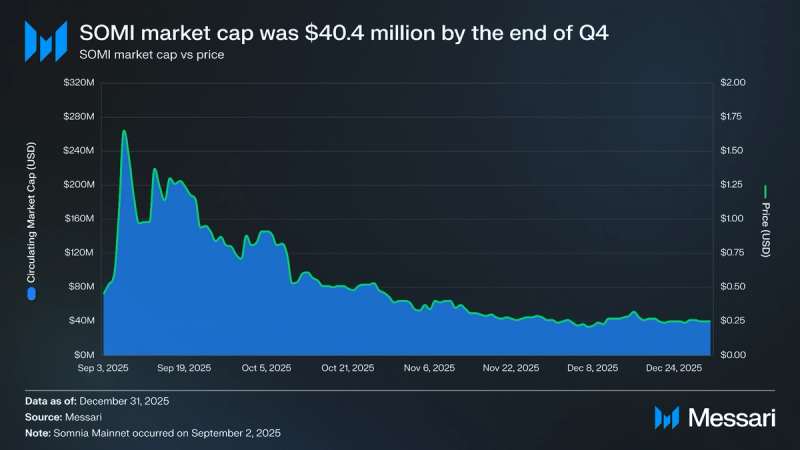
- SOMI entered a post-airdrop value discovery part in This autumn, with market cap declining to $40.4 million, down 64.7% QoQ.
- Somnia accomplished the ultimate part of its preliminary token distribution in This autumn, closing the Somnia Odyssey airdrop after distributing SOMI to over 95,000 contributors.
- DEX exercise normalized following post-mainnet highs, with common every day quantity declining 87.1% QoQ to $299,500. Whereas absolute volumes fell, market share stabilized amongst main venues and new entrants akin to Elix expanded Somnia’s market construction.
- Strategic partnerships in This autumn expanded Somnia’s practical floor space, spanning lending, prediction markets, cross-chain liquidity, id, creator and gaming distribution, and group tooling.
Primer
Somnia (SOMI) is a high-performance Layer-1 blockchain designed to help real-time, large-scale functions akin to gaming, social platforms, and interactive digital worlds. Based by Unbelievable, the community goals to ship internet-scale efficiency whereas sustaining Ethereum Digital Machine (EVM) compatibility, enabling builders emigrate or construct seamlessly utilizing present Web3 tooling.
Somnia’s structure is optimized for mass participation and low-latency interplay. The community claims throughput exceeding a million transactions per second (TPS) with sub-second finality and near-zero transaction charges. This design permits onchain experiences beforehand restricted by scalability constraints, together with high-frequency multiplayer video games and AI-driven environments.
The SOMI token serves because the community’s native asset, used for transaction charges, staking, and governance. Validators stake SOMI to safe the community, whereas customers can delegate their tokens to earn rewards and take part in governance as soon as it turns into totally activated. Half of all fuel charges are completely burned, introducing a deflationary mechanism that ties community utilization on to token shortage.
Somnia’s ecosystem is constructed round interoperability and accessibility. The community integrates with infrastructure companions akin to Google Cloud, BitGo, Fireblocks, and Banxa, and connects to exterior blockchains through LayerZero. Its partnership with Dune Analytics enhances knowledge visibility, whereas integrations with OpenSea and Rarible help NFT liquidity and creator onboarding.
For a full primer on Somnia, discuss with our Initiation of Protection report.
Web site / X / Discord / Docs / Weblog / Explorer
Monetary Overview
Market Cap vs Worth
By the top of This autumn 2025, SOMI’s market cap fell to $40.4 million, down 64.7% QoQ from $114.3 million on the finish of Q3. The token’s value declined in parallel to $0.25, additionally down 64.7% QoQ from $0.71. The decline was brought on by submit airdrop sell-offs and early participant profit-taking, which amplified promoting strain as speculative curiosity cooled.
Transaction Charges
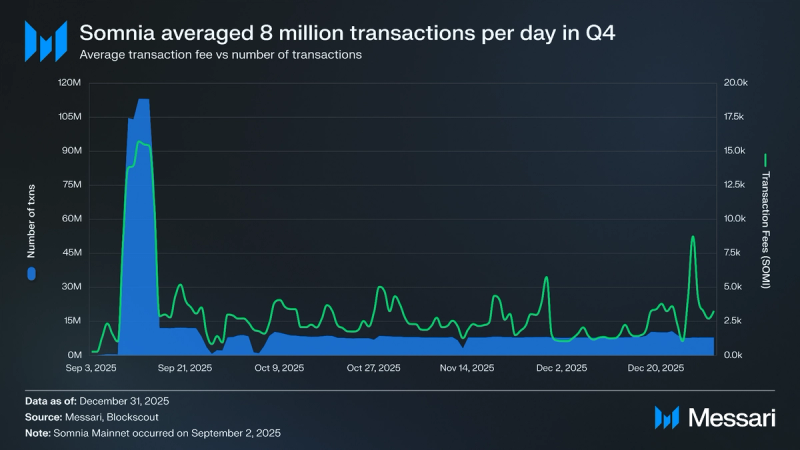
The community averaged 8 million transactions per day throughout This autumn, down 70.5% QoQ from 27.4 million every day transactions in Q3, which captured the rapid post-mainnet interval. Common every day transaction charges adopted the same trajectory. Somnia generated 2,580 SOMI per day in charges throughout This autumn, down 48.2% QoQ from 4,976 SOMI per day in Q3. The contraction in each metrics displays a normalization part following mainnet launch, as early experimentation, airdrop-related exercise, and incentive-driven transactions tapered off.
Community Overview
SOMI Tokenomics and Airdrop
SOMI is the native token of the Somnia community, launched alongside mainnet on September 2, 2025. The token underpins community exercise because the fuel asset for transactions and good contract execution, whereas additionally enjoying a task in validator staking, delegated safety, and future onchain governance. Validators are required to stake a minimal of 5 million SOMI, and tokenholders can delegate to validators or pooled staking applications to earn rewards and help community safety.
Key parameters for SOMI’s tokenomics embody:
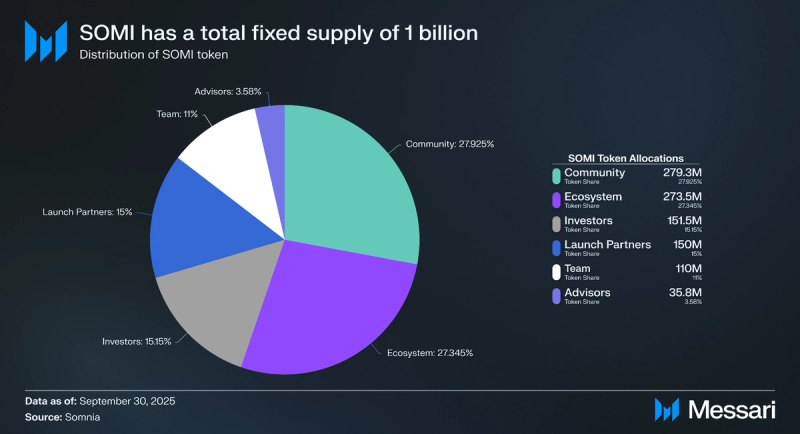
- Mounted provide: The whole provide is capped at 1 billion SOMI.
- Deflationary mechanism: 50% of all fuel charges are burned completely, decreasing the circulating provide as community utilization will increase.
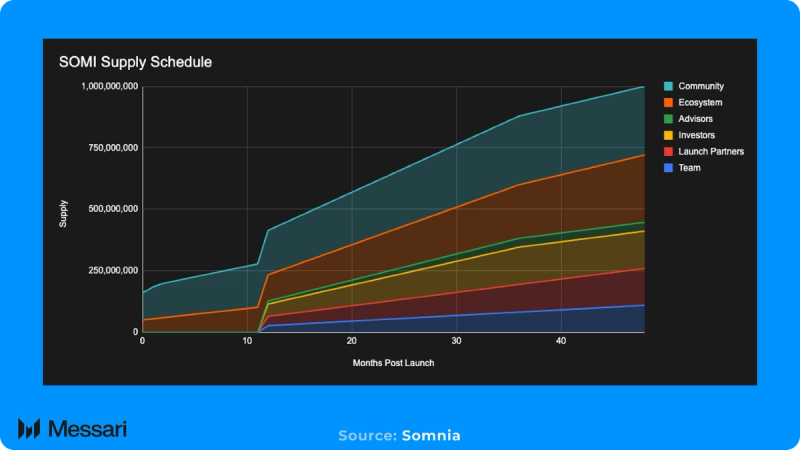
- Allocation and Vesting: Token distribution is split amongst a number of stakeholder classes with vesting and cliff schedules aimed toward controlling provide launch. For instance:
- Crew: 11 % (110 million tokens), 12-month cliff, then 48-month linear vesting.
- Launch Companions: 15 % (150 million tokens), 12-month cliff, 48-month vesting.
- Buyers: 15.15 % (151.5 million tokens), 12-month cliff, 36-month vesting.
- Advisors: 3.58 % (35.8 million tokens), 12-month cliff, 36-month vesting.
- Ecosystem fund: 27.345 % (273.45 million tokens), with a 5.075 % TGE unlock and 48-month vesting.
- Group incentives: 27.925 % (279.25 million tokens), with 10.945 % unlocked at TGE and vesting over 36 months
Somnia’s preliminary airdrop was launched at TGE to reward early contributors and bootstrap post-mainnet exercise. Roughly 50 million SOMI (5% of complete provide) had been allotted to customers who participated within the testnet, ecosystem quests, staking applications, or held eligible Somnia NFTs. Eligibility and allocation had been decided by way of a points-based system monitoring verified onchain exercise. To average rapid provide strain, solely 20% of airdropped tokens unlocked at TGE, with the remaining 80% vesting linearly over 60 days by way of weekly declare home windows and onchain duties beneath the Somnia Odyssey program.
Throughout This autumn 2025, Somnia accomplished the ultimate part of the airdrop rollout, protecting Odyssey Weeks 5 by way of 8. These remaining weeks launched a set of structured onchain actions, together with NFT minting, buying and selling quantity thresholds, and liquidity provision, designed to maintain engagement past preliminary claims. The eighth and remaining unlock went stay on October 29. December 1 marked the final day for customers to finish required missions and declare their remaining allocations. Unclaimed tokens had been redirected to the Ecosystem Fund, reinforcing long-term improvement sources slightly than re-entering circulation.
By the shut of the quarter, the Somnia Basis confirmed the conclusion of the airdrop, distributing SOMI to over 95,000 contributors who supported the community’s testing, development, and early improvement.
Information Streams
Throughout This autumn 2025, Somnia made a sequence of bulletins detailing the upcoming launch of Somnia Information Streams, a core infrastructure function aimed toward enabling real-time, reactive blockchain functions. Whereas Information Streams had not but launched on mainnet by quarter-end, the disclosures supplied a clearer view into how Somnia intends to help functions that require steady state consciousness slightly than periodic updates.
At a excessive degree, Information Streams will permit functions to subscribe to onchain state modifications and obtain verified updates as they happen, changing the polling-based mannequin generally utilized in blockchain functions. As an alternative of repeatedly querying the chain or counting on exterior indexers, functions obtain push-based updates when related state transitions occur. This design reduces latency, removes pointless confirmations, and aligns blockchain knowledge flows extra intently with how trendy net functions deal with real-time data.
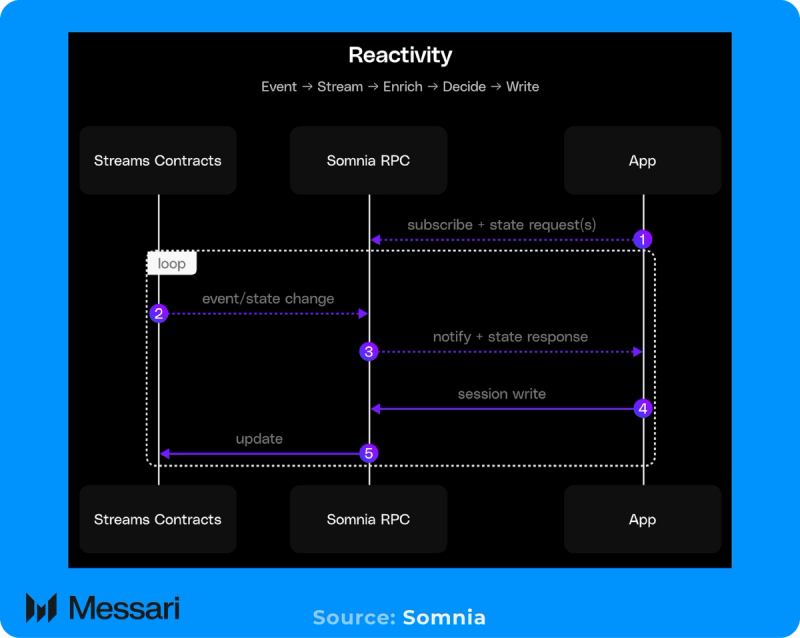
Somnia positioned Information Streams as notably related for prediction markets, buying and selling, gaming, and threat administration, the place delays of even just a few seconds can materially have an effect on consumer expertise or outcomes. For prediction markets, Information Streams permits structured occasion feeds that help steady odds updates and near-instant settlement as soon as outcomes are verified onchain. Extra broadly, the infrastructure is meant to help granular, event-driven markets, real-time leaderboards, responsive auctions, automated liquidation safety, and safety monitoring techniques that react instantly to altering situations.
To encourage early experimentation, Somnia hosted a Information Streams mini hackathon from November 4 to November 15. Builders had been challenged to construct testnet functions utilizing the Information Streams SDK, leading to early prototypes throughout gaming, DeFi monitoring, governance tooling, safety analytics, and marketplaces. Tasks demonstrated use instances akin to real-time leaderboards, immediate portfolio monitoring, exploit detection by way of stay transaction evaluation, and responsive bidding techniques that synchronize state throughout customers with out refresh delays. Whereas exploratory in nature, the hackathon highlighted how Information Streams might shift software design away from delayed reads and towards steady, event-driven interplay.
Ecosystem Overview
DeFi TVL
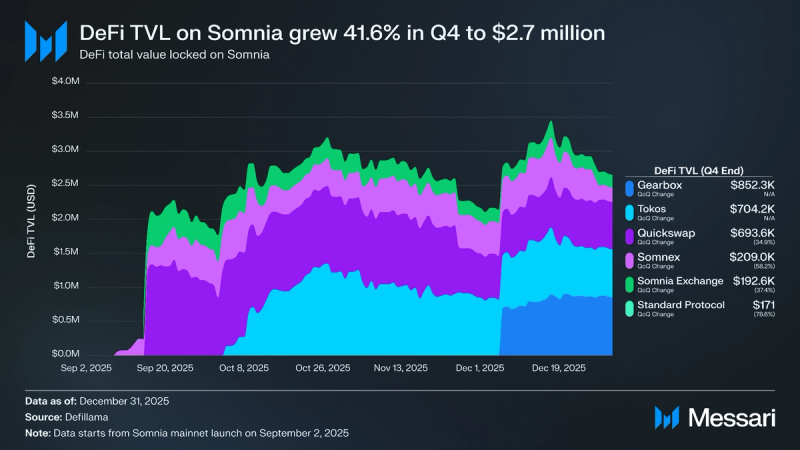
By the top of This autumn 2025, Somnia’s DeFi TVL elevated to $2.7 million, up 41.6% QoQ from $1.9 million on the finish of Q3. The biggest protocol by TVL was Gearbox, which held $852,300 by quarter-end, accounting for 32.1% of complete DeFi TVL. Gearbox’s development adopted Somnia’s partnership announcement on December 2, which launched lending swimming pools for SOMI and USDC.e. By integrating Gearbox’s modular credit score infrastructure, Somnia enabled native functions to help leveraged methods with out bespoke lending improvement. The launch catalyzed contemporary capital inflows and positioned lending as a brand new pillar of Somnia’s DeFi stack.
Tokos, a local lending protocol launched on September 25, completed This autumn with $704,200 in TVL, representing 26.6% of the market. Collectively, Gearbox and Tokos accounted for almost 59% of Somnia’s DeFi TVL, signaling a transparent shift towards credit-based use instances because the community’s major supply of capital formation.
In contrast, DEX and trading-focused protocols noticed absolute and relative declines. Quickswap remained the biggest DEX on Somnia however ended the quarter with $693,600 in TVL, down 34.9% QoQ, and its market share fell from 56.9% to 26.2%. Somnex, a local perps and memecoin platform, declined to $209,000 in TVL (7.9% share), whereas Somnia Alternate ended This autumn with $192,600 (7.3% share). Though these protocols participated in buying and selling competitions and incentive applications, they had been unable to offset broader declines in speculative buying and selling exercise and the rotation of capital towards lending.
On the tail finish, Customary Spot remained negligible, with $171 in TVL by quarter-end. Total, This autumn marked a structural rebalancing of Somnia’s DeFi ecosystem, with lending protocols driving web TVL development whereas earlier exchange-led liquidity swimming pools ceded dominance.
DEX Quantity
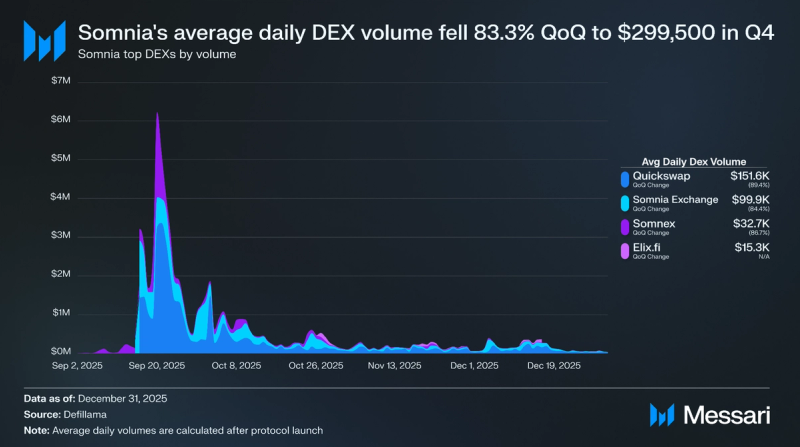
By the top of This autumn 2025, Somnia’s DEXs averaged $299,500 in every day buying and selling quantity, down 87.1% QoQ from $2.32 million in Q3. Quickswap remained the biggest DEX on Somnia, averaging $151,600 per day in This autumn (down 89.4% QoQ) and accounting for 50.6% of complete DEX quantity. Somnia Alternate ranked second, with $99,900 in common every day quantity (down 84.4% QoQ). Somnex averaged $32,700 per day in This autumn, down 86.7% QoQ, and captured 10.9% of DEX quantity.
Rounding out the panorama was Elix, a CLOB-based DEX that went stay on Somnia on October 21. Elix averaged $15,300 in every day quantity throughout the quarter, accounting for five.1% of complete DEX exercise.
Whereas absolute exercise declined sharply, market share stabilized amongst main exchanges, and new entrants continued to develop the protocol floor space regardless of subdued situations.
Staking
Somnia’s staking ecosystem continued to mature in This autumn 2025, with progress throughout each core staking infrastructure and liquid staking. Developments throughout the quarter centered on enhancing transparency for delegators whereas increasing capital effectivity by way of DeFi-integrated staking.
A key milestone was the launch of Lair Finance, on October 31, which launched Somnia’s first liquid staking token, stSOMI. Lair permits customers to stake SOMI and obtain stSOMI in return, permitting staked capital to stay usable throughout the DeFi ecosystem. At launch, customers might stake a minimal of 20 SOMI to mint stSOMI and supply liquidity to the stSOMI–SOMI pool on Somnex, establishing early liquidity for the asset. To bootstrap adoption, Lair participated in Somnia’s onchain quest system, incentivizing early staking and liquidity provision by way of SOMI rewards. On November 5, stSOMI was additionally integrated into Somnia’s Liquidity Level Program, additional encouraging participation by rewarding customers for contributing liquidity.
Alongside liquid staking, Somnia noticed enhancements in staking transparency and validator tooling by way of the discharge of Somnia.information, developed by validator operator Excessive Tower. The platform aggregates real-time knowledge on validator efficiency, together with uptime, fee charges, delegation volumes, historic rewards, and network-level metrics akin to complete stake and validator distribution. By centralizing this data, Somnia.information lowers the data barrier for token holders choosing validators and monitoring staking efficiency. The platform additionally gives reward calculators and comparative analytics, supporting extra knowledgeable delegation choices and reinforcing decentralization by way of higher visibility into validator operations.
Strategic Partnerships
Throughout This autumn 2025, Somnia Basis and the Somnia community fashioned a sequence of high-profile partnerships that replicate a deliberate shift towards infrastructure completeness and ecosystem acceleration. Beneath are chosen highlights.
- Elix.fi: On October 2, 2025, Elix launched its CLOB-based DEX on Somnia, including an orderbook-driven buying and selling venue alongside present AMM-based exchanges. The combination diversified Somnia’s market construction choices and positioned the community to help extra subtle buying and selling workflows, at the same time as total DEX volumes normalized post-mainnet.
- Hubzz: On October 9, 2025, Somnia partnered with Hubzz, a social leisure platform, to help community-driven onchain experiences. The combination centered on creator tooling and engagement mechanics, aligning with Somnia’s emphasis on consumer-facing functions and ecosystem discoverability.
- Rarible: On October 14, 2025, Somnia NFTs grew to become obtainable on Rarible, enabling creators and tasks to mint, commerce, and distribute digital collectibles. The combination strengthened Somnia’s cultural and creator-facing floor space, notably for gaming and media use instances.
- Safety.xyz: On October 15, 2025, Somnia partnered with Safety.xyz to launch an open safety market. The partnership allotted $100,000 in safety grants to assist tasks entry trusted audits, enhance transparency, and strengthen onchain security.
- Collab Land: On October 28, 2025, Somnia built-in Collab Land to help token-gated communities and entry management throughout Discord and different social platforms. The partnership enhanced group administration capabilities for tasks constructing on Somnia and supported ecosystem coordination throughout early-stage development.
- Vectra: On October 30, 2025, Vectra launched on Somnia as a local prediction market powered by Anomaly Video games’ AI-driven engine. The platform introduces a swipe-based interface that enables customers to create and take part in markets spanning crypto tendencies, on-line tradition, and real-time occasions. The combination marked Somnia’s first stay prediction market and served as an early check case for real-time, consumer-facing data markets on the community.
- Humannode: On November 5, 2025, Somnia partnered with Humannode to introduce biometric-based id primitives, increasing the community’s experimentation with proof-of-personhood and identity-aware functions. This integration complemented Somnia’s curiosity in social, gaming, and client functions that profit from sybil resistance.
- Orbiter Finance: On December 2, 2025, Somnia partnered with Orbiter Finance to enhance cross-chain bridging and liquidity entry. The combination strengthened Somnia’s interoperability stack, decreasing friction for customers transferring belongings between Somnia and exterior ecosystems.
- Gearbox: On December 2, 2025, Somnia introduced an integration with Gearbox Finance, introducing modular lending swimming pools for SOMI and USDC.e. The partnership introduced battle-tested credit score infrastructure to Somnia, enabling builders to include leveraged methods, credit score accounts, and capital routing with out growing native lending techniques. Gearbox’s launch reshaped Somnia’s DeFi stack, catalyzing lending-led TVL development and establishing credit score as a core primitive on the community.
- YOM: On December 29, 2025, Somnia introduced a partnership with YOM,a decentralized compute and sport streaming infrastructure supplier. The partnership focuses on enabling high-performance, consumer-grade Web3 gaming by streaming gameplay from a world GPU edge community slightly than counting on centralized sport servers or native {hardware}.
Gaming
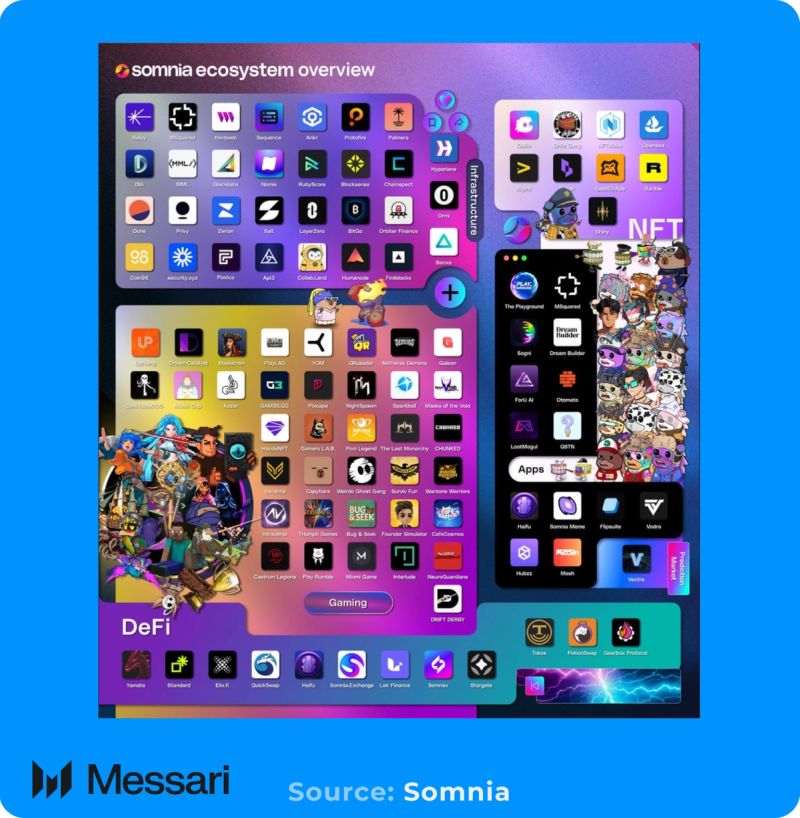
- Darkish Desk: On November 25, 2025, Darkish Desk launched on Somnia. Constructed as a four-player aggressive card sport, Darkish Desk leverages onchain belongings and gameplay mechanics to allow multiplayer duels centered round collectible champions and in-game technique. The launch, powered by Somnia and Thirdweb, expanded Somnia’s client software footprint and strengthened the community’s concentrate on totally onchain, interactive gaming experiences.
- Vodra: On December 4, 2025, Somnia introduced a partnership with Vodra, a Web3-native gaming and livestream distribution platform. The collaboration focuses on integrating streaming, creator payouts, and sport distribution into Somnia’s gaming ecosystem. Somnia powers USDC-based creator payouts on Vodra, enabling immediate, fee-free funds, whereas Vodra serves as a distribution layer that brings Somnia-built video games on to creators throughout platforms like Twitch, Kick, and YouTube.
- Flipsuite: On November 19, 2025, Flipsuite launched on Somnia, bringing an all-in-one Web3 integration layer for Discord communities to the ecosystem. The platform permits tasks to embed onchain performance straight into Discord servers, together with token gating, NFT interactions, and group engagement instruments.
- Miomi Sport: On December 12, 2025, Miomi joined the Somnia ecosystem, launching a Web3-native esports area that helps tournaments, ranked aggressive play, and multi-game codecs. The platform integrates social options designed to carry gamers and communities collectively onchain, positioning Miomi as a hub for aggressive gaming slightly than a single-title expertise.
2026 Roadmap
By the top of 2025, Somnia had largely accomplished its preliminary infrastructure rollout and shifted its focus towards ecosystem discovery and developer engagement. Following the mainnet launch, the staff spent the latter a part of the 12 months taking part in business occasions and holding direct conversations with builders throughout gaming, markets, and data-intensive functions. Whereas gaming remained a visual early use case, these discussions surfaced a broader and recurring constraint: most present blockchains battle to help functions that should react to real-world occasions in actual time. Latency, gradual finality, and rigid state updates had been persistently cited as blockers for extra dynamic, consumer-facing use instances.
Towards this backdrop, Somnia printed its 2026 roadmap in early Q1 2026, outlining a extra opinionated shift from core infrastructure buildout towards software enablement. The roadmap focuses on use instances that rely upon real-time knowledge, low-latency execution, and steady state updates, with three major areas of emphasis: reactive infrastructure, prediction markets, and AI-adjacent tooling.
Prediction markets are a central space of improvement. The latest development of platforms like Polymarket has proven demand for hypothesis tied to political, financial, and cultural occasions; nonetheless, most functions are restricted by latency and gradual finality. Somnia’s roadmap emphasizes help for higher-frequency and event-driven markets, together with these tied to stay sports activities, esports, and streaming exercise, the place outcomes might must be resolved rapidly and repeatedly.
These use instances rely upon Somnia’s reactive options, which permit functions to answer onchain and exterior knowledge updates with minimal delay. In 2026, the community plans to proceed refining this performance primarily based on developer suggestions, with the aim of enhancing reliability and decreasing integration complexity. Past prediction markets, the identical infrastructure is anticipated to help functions in areas akin to buying and selling, insurance coverage, and interactive video games.
The roadmap additionally introduces the idea of a “market of markets,” the place prediction markets are created permissionlessly by customers slightly than curated centrally. By decreasing the operational and upkeep prices of launching markets, Somnia goals to make smaller, area of interest markets economically viable, together with these tailor-made to particular communities, creators, or occasions. Vectra, presently the first prediction market stay on Somnia, serves as an early proof level for this design path.
Total, the early publication of the 2026 roadmap marks a transparent inflection level. The place late 2025 was outlined by listening and validation, the 2026 plan displays a deliberate transfer towards enabling real-time, consumer-facing functions, with Somnia positioning itself as a base layer optimized for reactive, event-driven onchain markets.
Closing Abstract
Somnia closed This autumn 2025 in a consolidation part following its September mainnet launch, with execution centered on defining the networks main use instances. Whereas market exercise cooled because the airdrop distribution concluded, Somnia continued to course of significant throughput at scale, averaging 8 million transactions per day and producing ongoing charges.
On the ecosystem aspect, Somnia’s DeFi footprint expanded regardless of weaker buying and selling situations, with TVL rising to $2.7 million and rotating decisively towards credit score primitives. The Gearbox integration and Tokos’ development repositioned lending as the first driver of capital formation, whereas new market construction and liquidity venues, together with Elix and liquid staking through Lair’s stSOMI, broadened the set of onchain monetary constructing blocks. In parallel, Somnia continued to spend money on consumer-oriented distribution and onboarding by way of partnerships throughout gaming, streaming, and group infrastructure, together with Vodra, YOM, and Discord-native tooling.
Heading into 2026, Somnia’s roadmap and Information Streams bulletins body the community’s subsequent part as an software enablement push constructed round reactive habits and real-time knowledge. With Vectra stay as an early prediction market and builders already prototyping Information Streams use instances, Somnia’s near-term problem is changing its infrastructure thesis into repeatable product adoption. This autumn’s progress suggests the community is assembling the primitives and partnerships wanted to pursue its broader aim: supporting interactive functions that require low-latency state updates, steady settlement, and consumer experiences that extra intently resemble standard real-time software program.
