



Key Insights
- Falcon Finance is diversifying the artificial greenback collateral base by integrating Actual-World Belongings (RWAs), similar to gold and Mexican CETES, to again USDf. This transition from a purely crypto-native funding price mannequin to a multi-collateral “control tower” strategy enhances protocol resilience towards market volatility whereas establishing a yield profile.
- Falcon Finance is accelerating the utility of tokenized RWAs by launching a $50 million ecosystem fund to bridge the hole between institutional-grade yield and onchain liquidity.
- The implementation of FIP-1 introduces a tiered staking structure that incentivizes sticky capital by means of the Prime FF mannequin. By granting long-term stakers 10x governance weight and considerably larger yield accrual in comparison with the 0.1% baseline, the protocol successfully aligns its trajectory with dedicated stakeholders slightly than short-term speculative flows.
Primer
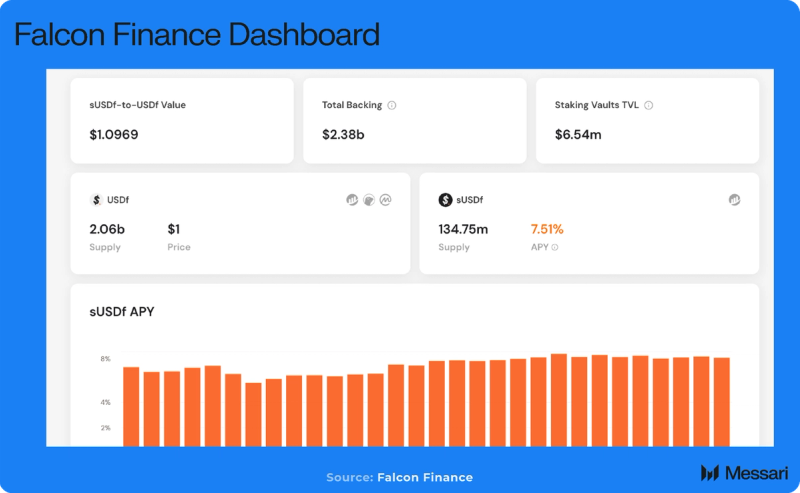
Falcon Finance introduces a brand new strategy to artificial {dollars} by combining multi-collateral administration, diversified yield technology, and clear danger controls. Consider world crypto markets as a busy sky filled with unpredictable climate, volatility storms, liquidity turbulence, and sudden directional swings, and that stablecoin protocols are the planes attempting to fly by means of it. Falcon Finance steps in because the air-traffic management tower, managing collaterals, supervising danger throughout markets, and making certain each artificial greenback (USDf) reaches its vacation spot safely. Somewhat than counting on a single “weather pattern” similar to funding-rate arbitrage, Falcon employs a broad suite of institutional-grade navigation instruments that uphold stability whereas constantly producing yield. The result’s a flight system constructed for readability, resilience, and belief. Whereas RWA adoption remains to be in its infancy, Falcon Finance is proactively constructing the infrastructure required to steer the market as these belongings evolve from area of interest collateral to a main pillar of the onchain economic system.
Falcon Finance was based by Andrei Grachev, who serves as its founding companion and Managing Accomplice, in addition to co-founder of DWF Labs. This shared management highlights a symbiotic relationship through which Falcon Finance operates as a venture incubated and supported by DWF Labs’ group. As a seed investor and incubator of Falcon Finance, DWF Labs offers strategic assist, together with funding, ecosystem development, and enterprise and operational assist, for Falcon Finance to construct an artificial stablecoin infrastructure (e.g., USDf). It isn’t framed as a standard “partnership,” however slightly an built-in initiative, with DWF Labs publicly positioning Falcon as a part of its portfolio of supported protocols.
Web site / X / LinkedIn / Telegram / Docs
Constructing for RWAs
Falcon Finance has signaled its perception that RWAs would be the main driver for establishments coming onchain. By transferring past purely crypto-native collateral (ETH/SOL), Falcon Finance creates a steady steadiness sheet that’s much less correlated with the unstable crypto market cycles, making it extra interesting to traders.
Falcon bifurcates its RWA technique into two distinct classes:
- Unstable RWAs (e.g., XAUt, xStocks): Belongings like gold or Tesla (TSLAx) enable customers to keep up worth publicity whereas utilizing the worth to unlock onchain liquidity.
- Yield-Bearing RWAs (e.g., JTRSY, JAAA (CLO), USTB, Mexican CETES): These belongings convey “real-world” rates of interest (sovereign yield, company credit score) into the protocol, diversifying yield sources past crypto funding charges.
- USTB vs. JAAA: Falcon makes use of USTB (Brief Length U.S. Govt Securities) for low-volatility publicity to the U.S. federal funds price. In distinction, JAAA (AAA-rated CLOs) offers publicity to senior-secured company credit score. Whereas USTB tracks sovereign debt yields, JAAA makes use of floating-rate company devices to seize a credit score unfold, providing a better yield profile whereas sustaining an institutional-grade credit standing.
Vaults as an Interface
Within the Falcon ecosystem, vaults should not merely liquidity swimming pools; they’re dynamic “user-facing wrappers” that bridge the hole between institutional-grade asset administration and the decentralized finish person. Whereas the underlying protocol capabilities as a Common Collateral Engine, these vaults function an evolving interface layer – an experimental implementation for testing how various RWA varieties may be made liquid and yield-bearing inside the Falcon framework. Somewhat than representing the ultimate type of RWA adoption, the vaults act as sensible conduits that summary away operational friction, similar to offchain custody and regulatory compliance, whereas the protocol matures its long-term technique for institutional-grade collateral.
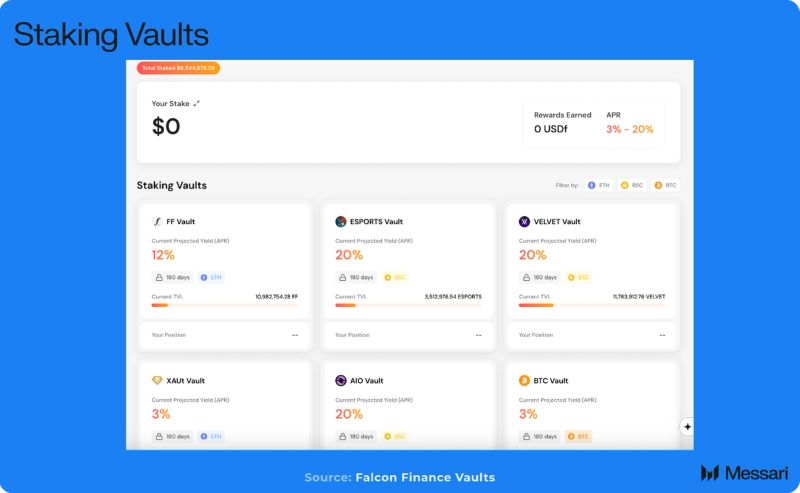
The first philosophy behind Falcon’s vaults is to resolve the “dead capital” downside inherent in conventional shops of worth.
- The Gold (XAUt) Vault: Gold is the final word macro hedge however has traditionally lacked “carry.” By utilizing XAUt as collateral, Falcon runs market-neutral methods that enable customers to keep up 100% worth publicity to the metallic whereas incomes a 3–5% APR paid in USDf. This transforms gold from a static reserve right into a productive monetary instrument.
- The Bitcoin Vault: Recognizing that BTC is the guts of the reserves (accounting for over 80% of protocol collateral), Falcon launched a vault that generates 3–5% yield with out wrapping or bridging the asset. By retaining BTC inside a safe custody infrastructure and producing yield by means of offchain institutional execution, Falcon eliminates the good contract and bridge dangers which have traditionally deterred Bitcoin maximalists from DeFi.
- The SPYx Vault (Shares on Solana): Constructing on its growth into RWA’s, Falcon has launched a devoted vault for SPYx, a tokenized model of the S&P 500 ETF (SPY) issued on Solana by way of Backed Finance. This vault permits customers to generate yield on their fairness publicity with out liquidating their positions or exiting the Solana ecosystem. Just like the Gold and Bitcoin vaults, the SPYx vault embodies Falcon’s thesis that unstable RWAs can stay price-exposed whereas changing into productive by means of managed execution environments.
As an growth of the collateral varieties, Falcon has additionally introduced on non-US currencies and AAA-rated RWAs:
- The Mexican Sovereign (CETES): Partnering with Etherfuse, Falcon has built-in tokenized Mexican authorities payments (CETES) as a main collateral kind, marking the protocol’s first growth into non-USD sovereign-yield belongings. These CETES are issued natively on Solana by means of Etherfuse’s Stablebonds structure, offering a bankruptcy-remote instrument backed 1:1 by short-term Mexican authorities debt with every day NAV updates and immediate settlement. Whereas Mexican authorities payments supply excessive nominal charges (~11%), the vault serves a strategic goal past yield; it affords customers in main remittance markets like Mexico, which receives upwards of $70 billion yearly (based mostly on a private remittance price of three.6% of Mexico’s GDP of $1.85 trillion in 2024), a strategy to protect publicity to native sovereign alpha whereas concurrently unlocking dollar-denominated liquidity by way of USDf.
- Falcon Finance has additional expanded its institutional-grade collateral base by integrating Centrifuge’s JAAA, a tokenized portfolio of senior investment-grade company credit score. This partnership permits Centrifuge’s high-quality, AAA-rated real-world belongings to function liquid collateral for Falcon’s USDf stablecoin, bridging the hole between conventional credit score markets and onchain liquidity. By onboarding JAAA, Falcon continues its “control tower” technique of diversifying past crypto-native funding charges into yield-bearing RWAs, offering customers with a resilient stablecoin backed by diversified, bankruptcy-remote company debt.
By integrating high-quality, regulated devices from outdoors the U.S. Treasury system, Falcon offers important geographic and foreign money diversification, bolstering the resilience of its multi-collateral framework. In observe, this technique transforms these devices from static balance-sheet belongings into lively members in hedging and liquidity methods by means of offchain institutional execution. By abstracting this operational complexity away from the person, Falcon preserves strict danger controls whereas making certain RWAs contribute meaningfully to the protocol’s total yield and stability.
FIP-1
Falcon Enchancment Proposal 1 (FIP-1) represents an evolution within the protocol’s tokenomic framework by introducing the “Prime FF” staking mechanism. Permitted by group consensus, FIP-1 transitions the venture from a uniform staking mannequin to a tiered dual-structure consisting of Prime FF (sFF-Prime) and Versatile FF (sFF). The “Prime” tier requires customers to decide to a 180-day lock-up interval in trade for a local FF yield of 5.22% and a 10x multiplier on Snapshot governance voting energy. Conversely, the “Flexible” tier offers quick liquidity with no lock-up requirement however affords a nominal yield of 0.1%, successfully establishing a transparent distinction between lively, dedicated members and passive holders.
The first advantage of FIP-1 is the formal alignment of long-term holder incentives with the protocol’s strategic development and stability. By weighting governance energy closely in favor of “Prime” stakers, the venture ensures that its trajectory is set by these with the best long-term publicity, thereby mitigating the affect of short-term speculative capital. That is meant to construct a stickier capital base, cut back circulating provide volatility, and create a extra resilient basis for the USDf ecosystem.
The Highway Forward
Falcon Finance has introduced a $50 million ecosystem fund devoted to advancing the infrastructure for tokenized RWAs, particularly focusing on U.S. Treasuries, gold, and different institutional-grade yield merchandise. The fund is structured as a 50/50 break up between direct capital and vested FF tokens. By prioritizing groups with current MVPs in areas similar to fixed-income protocols and RWA danger tooling, Falcon goals to handle the present fragmentation of tokenized collateral.
Falcon Finance Crew Commentary on RWAs
The Venture Crew Commentary part of this report was written by Artem Tolkachev, Chief RWA Officer at Falcon Finance, and displays the views, opinions, and forward-looking statements of Falcon Finance solely. This part is included to offer further context on the venture’s technique, priorities, and outlook and doesn’t essentially replicate the views or opinions of Messari, Inc.
Past capital deployment, Falcon’s longer-term RWA thesis is formed by how adoption is prone to evolve in observe. Within the close to to medium time period, RWA development is anticipated to be uneven and largely infrastructure-led slightly than balance-sheet pushed. Falcon views this section as foundational: constructing the collateral, liquidity, and composability rails required earlier than RWAs can change into meaningfully deployable at scale inside DeFi and stablecoin programs.
Trying into 2026, Falcon expects RWA growth alongside two parallel paths. On the yield-bearing aspect, adoption is prone to transfer additional alongside the chance–reward curve, from U.S. Treasuries towards non-U.S. sovereigns, structured credit score, personal credit score, and yield-generating methods. On the unstable asset aspect, rising geopolitical and macro volatility is anticipated to drive demand for tokenized equities, reserve belongings similar to gold and silver, and exchange-traded commodities. Falcon positions itself as infrastructure for this future state: supporting any RWA that meets its standards round liquidity, enforceability, and risk-adjusted yield, whereas abstracting operational complexity right into a unified collateral and stablecoin layer.
Closing Abstract
Falcon Finance is repositioning the artificial greenback panorama by performing as a multi-collateral “control tower” for its USDf stablecoin, transferring past the singular reliance on crypto-native funding charges. By integrating Actual-World Belongings (RWAs), together with gold, equities, and Mexican CETES, the protocol offers a diversified, yield-bearing infrastructure designed to stay resilient throughout unstable market cycles. This institutional-grade framework is additional matured by the FIP-1 proposal, which introduces a tiered staking mannequin to lock in sticky capital and consolidate governance energy amongst long-term members. Finally, Falcon abstracts the complexities of delta-neutral execution and offchain custody right into a scalable ecosystem optimized for sustainable, risk-adjusted returns.
