



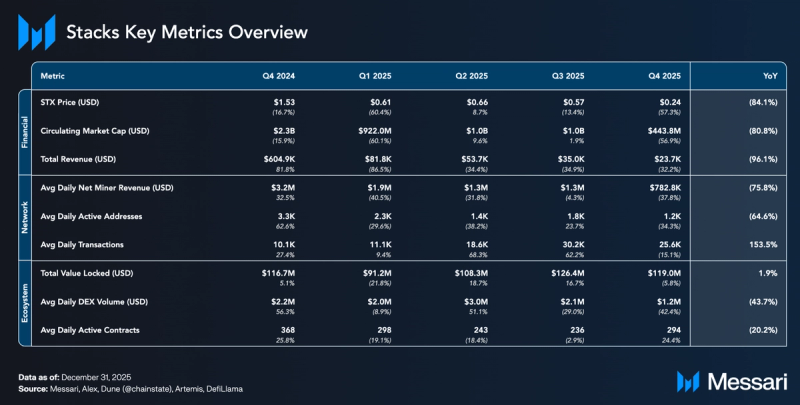
Key Insights
- Stacks noticed QoQ progress throughout a number of metrics, together with DeFi TVL in STX (+120.8%), common whole STX stacked (+6.1%), and DeFi variety rating (+1, from 4 to five).
- In distinction, a number of metrics declined QoQ, together with STX worth (–57.3%), circulating market cap (–56.9%), protocol income (–32.2%), DeFi TVL in USD (–5.8%), common day by day transactions (–15.1%), and common day by day energetic addresses (–34.3%).
- Twin Stacking launched on October 30, introducing a BTC-native yield pilot the place customers pair sBTC with STX in contracts to earn BTC-denominated rewards. Twin Stacking represents Stack’s first step towards self-custodial Bitcoin staking, a analysis initiative printed that will permit BTC holders to earn native Bitcoin yield by locking BTC on L1 whereas utilizing STX as staking capability.
- Ecosystem execution accelerated by means of governance + infrastructure rollout, because the Stacks Endowment grew to become operational with a $27 million 2026 funds, Stacks Labs went dwell as a core working entity, and integrations like Dexscreener SIP-010 assist and WalletConnect expanded distribution for apps and property.
- Readability 4 was activated in This fall, delivering community throughput enhancements that now see 95.7% of blocks arriving inside 5 seconds and ~⅓ confirming in <2 seconds. The improve primes the Stacks community for product launches later in 2026.
Primer
Stacks (STX) is a Bitcoin Layer-2 (L2) that allows sensible contracts and decentralized purposes to make use of Bitcoin as a safe base layer. Transactions are executed on Stacks and settled on Bitcoin, leveraging Bitcoin’s safety and capital whereas providing arbitrary programmability that isn’t potential on its scriptable settlement layer.
Stacks has data of the complete Bitcoin state, because of its Proof-of-Switch (PoX) consensus mechanism and Readability programming language, permitting it to learn from Bitcoin at any time. With PoX, miners commit BTC to eligible Stacks addresses that take part in consensus. This course of, wherein STX tokenholders take part in consensus and earn BTC from miners, is named Stacking. PoX operates in parallel to Bitcoin’s Proof-of-Work (PoW) consensus, hashing and settling Stacks transactions on the Bitcoin blockchain. Metadata from newly mined Stacks blocks is anchored to each Bitcoin block, permitting customers to confirm the canonical Stacks blockchain through Bitcoin blocks.
The earlier Nakamoto improve strengthened Stacks’ integration with Bitcoin by (i) introducing sBTC, a decentralized tokenized BTC, (ii) enabling quicker block manufacturing, (iii) bettering Bitcoin finality, and (iv) decreasing the possibilities of Maximal Extractable Worth (MEV) exploitation.
Web site / X (Twitter) / Discord
Key Metrics
Efficiency Evaluation
Market Cap and Value
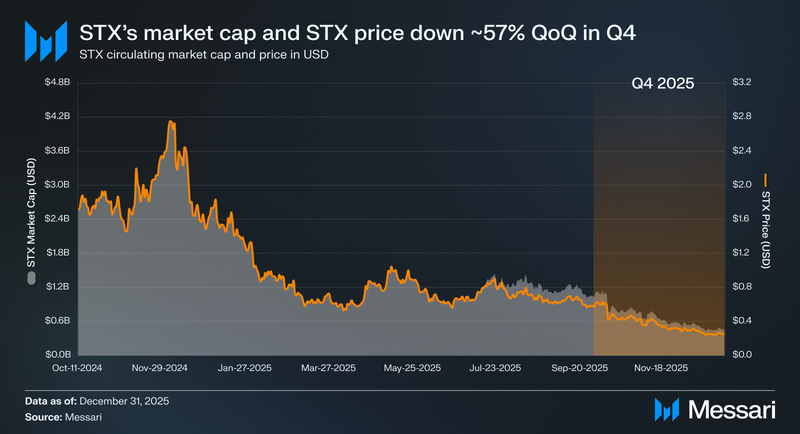
Relative to BTC and ETH market caps, which declined 23.1% and 28.5% QoQ, respectively, Stacks noticed a materially sharper drawdown. STX’s circulating market cap fell 56.9% QoQ from $1.0 billion to $443.8 million, whereas STX’s worth declined 57.3%, from $0.57 to $0.24. On a year-over-year foundation, the decline was much more pronounced: STX’s market cap fell 80.8%, and its worth fell 84.1%.
Income
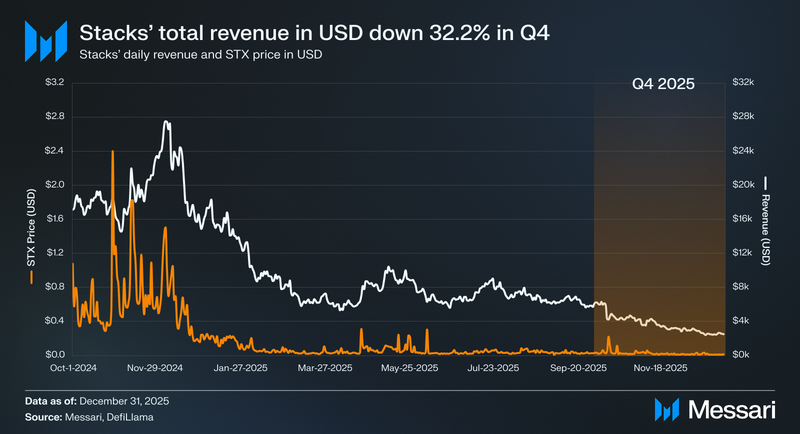
Stacks’ income is measured as whole transaction charges and is distributed to Miners by means of Stacks’ PoX mechanism (together with the coinbase reward, i.e., issuance).
Stacks’ protocol income continued its decline in This fall, falling 32.2% QoQ from $34,956 to $23,701, and is now down 96.1% year-over-year from the This fall 2024 peak of over $604,000. This sustained contraction displays diminished transactional demand and decrease STX costs.
Utilization
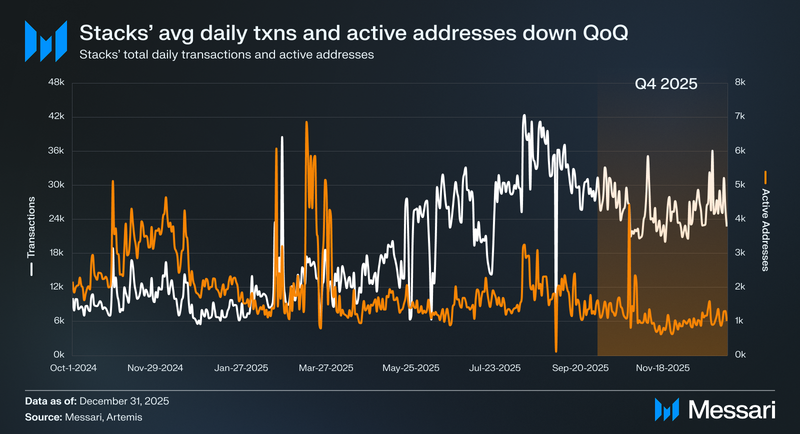
After rebounding in Q3, community exercise cooled in This fall. Common day by day transactions declined 15.1% QoQ to 25,629, down from 30,169 in Q3, however nonetheless remained nicely above the primary half of the 12 months. Common day by day energetic addresses fell 34.3% QoQ to 1,150 from 1,751.
On a year-over-year foundation, common day by day transactions greater than doubled, up 153.5% from 10,111 in This fall 2024, whereas energetic addresses dropped 64.6% from 3,252 over the identical interval. This divergence displays deeper engagement from present customers regardless of a shrinking participant base.
Complete Worth Locked (TVL)
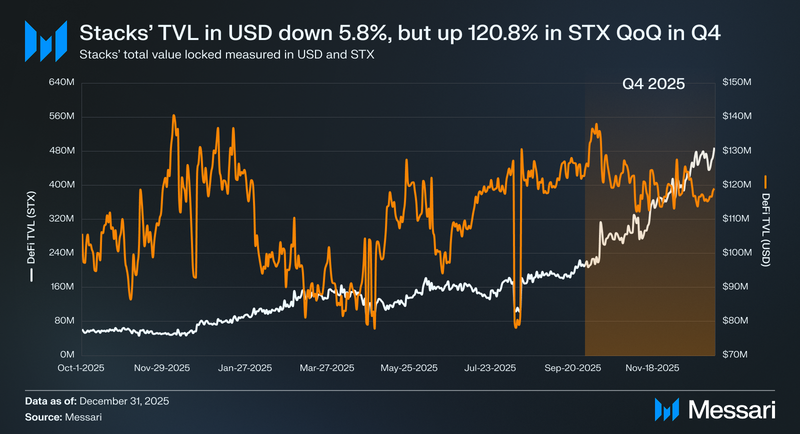
Stacks’ whole worth locked skilled distinctive progress in This fall, greater than doubling in native STX phrases and rising modestly YoY in USD phrases. TVL in STX rose 120.8% QoQ, from 221.1 million STX to 488.1 million STX, marking a 541.5% improve YoY.
Nonetheless, in USD phrases, TVL declined barely by 5.8% QoQ, from $126.4 million to $119.0 million, reflecting the impression of broader market volatility and a weaker STX worth. Total, the sharp rise in native phrases highlights rising person confidence, deeper DeFi participation, and a strengthening Bitcoin-native capital base on Stacks.
Stacking
Stacking, just like mining on Bitcoin, is essentially dominated by swimming pools. Within the post-Nakamoto period, practically everybody should delegate to a pool. Thus, it’s inconceivable to know what number of contributors are within the custodial swimming pools as the info just isn’t instantly onchain.
The system operates as a suggestions loop pushed by the interplay between miners and Stackers by means of the Proof-of-Switch (PoX) mechanism. Miners switch BTC to provide blocks, whereas Stackers lock STX to assist consensus, community safety, and obtain BTC rewards. Particularly, the extra miners collaborating within the community, the less BTC rewards may be distributed amongst Stackers. Moreover, assuming the variety of miners stays fixed, a rise in Stacker participation reduces rewards for Stackers total.
Stackers, Miners, and Stacking
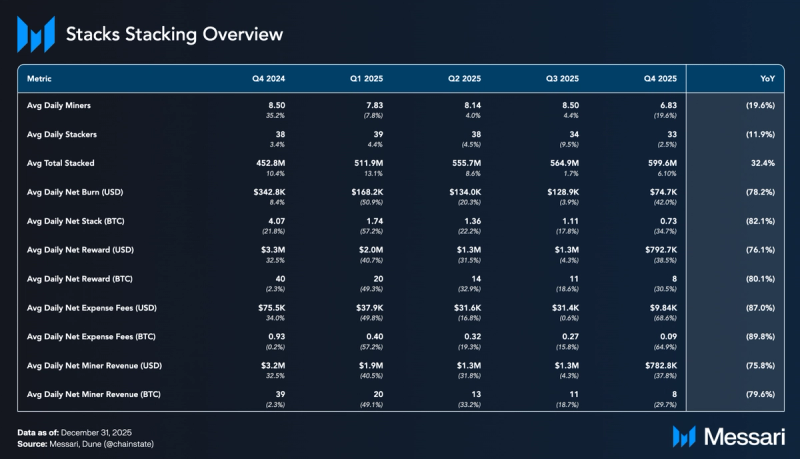
Stacking pool dominance continued by means of This fall, persevering with to obscure visibility into distinctive person participation. Nonetheless, capital dedication traits remained extra measurable. Common whole STX locked in stacking rose 6.1% QoQ to 599.6 million STX in This fall, extending its progress streak for a fourth consecutive quarter. This marks a 32.4% improve YoY, up from 452.8 million STX in This fall 2024, demonstrating sustained institutional or high-net-worth participation regardless of macro uncertainty. In distinction, common day by day Stackers declined 2.5% QoQ to 33, representing an 11.9% drop YoY and reaching its lowest stage because the Nakamoto improve. This divergence suggests rising capital focus, with fewer contributors locking extra capital. In the meantime, common day by day miners fell 19.6% QoQ to six.8, additionally down 19.6% YoY, ending the 12 months at its lowest stage since early 2024.
Web Burn and Web Stack
Stacking incentives deteriorated additional in This fall. Common day by day internet burn in USD, fell 42.0% QoQ to $74,705, persevering with the multi-quarter downtrend that started after This fall 2024. On a YoY foundation, internet burn declined 78.2%. Common day by day internet stack additionally dropped 34.7% QoQ to 0.73 BTC/day, down 82.1% YoY from 4.07 BTC/day in This fall 2024.
Web Rewards and Expense Charges
Reward compression deepened in This fall. Common day by day internet rewards in USD dropped 38.5% QoQ to $792,655, whereas BTC-denominated rewards fell 30.5% to eight BTC/day. These characterize YoY declines of 76.1% (USD) and 80.1% (BTC), respectively. Expense charges, one other indicator of financial exercise, adopted go well with. In USD phrases, common day by day charges declined 68.6% QoQ to $9,835/day, and in BTC phrases, dropped 64.9% to 0.1 BTC/day, representing YoY declines of 87.0% (USD) and 89.8% (BTC), respectively. Collectively, these metrics reinforce the pattern of reward compression and additional focus amongst large-scale contributors.
Miner Income
Common day by day miner income continued its downward trajectory in This fall 2025. In USD phrases, income fell 37.8% QoQ, from $1.3 million/day to $782,819/day. BTC-denominated earnings dropped 29.7%, from 10.9 BTC/day to 7.6 BTC/day. On a YoY foundation, miner rewards declined 75.8% in USD (from $3.2 million) and 79.6% in BTC (from 39 BTC). This displays each decreased community exercise and chronic incentive misalignment, the place the chance price of stacking or mining grows as BTC appreciates and STX underperforms.
Regardless of the rising whole STX stacked, overparticipation stays in structural decline. The drop in energetic Stackers to only 33/day, mixed with a virtually 80% YoY decline in BTC-denominated rewards, underscores worsening incentive alignment. The continued compression in internet burn, stack, and miner revenues displays each macro headwinds and chronic mispricing between BTC and STX. With BTC appreciating and STX underperforming, the chance price of locking STX or mining grows, additional concentrating participation amongst bigger actors.
Qualitative Evaluation
Stacks Enchancment Proposals (SIP)
From October to December 2025, two new SIPs had been launched to reinforce Stacks’ sensible contract performance, whereas foundational governance and funding infrastructure from prior quarters continued to form the ecosystem’s evolution.
SIP-033: Readability 4 – Excessive Demand New Builtins
Activated in November 2025 at Bitcoin block 923222, SIP-033 launched a significant improve to the Readability sensible contract language. The improve enhances safety, developer expertise, and protocol composability by introducing key options, together with onchain contract verification, asset-protecting post-conditions, block timestamp entry for time-based logic, ASCII string conversion, and native assist for secp256r1 passkeys. These capabilities instantly deal with developer requests and are foundational for constructing extra sturdy DeFi protocols, cross-chain bridges, and sensible wallets on Bitcoin.
SIP-034: Dimension-Particular Tenure Extensions
Handed alongside SIP-033 as a technical rider, SIP-034 launched extra granular management over Readability’s useful resource funds system, permitting resets in particular dimensions (e.g., read-count) with out resetting the complete block funds. This enhancement improves developer flexibility and permits high-throughput workloads, significantly for DeFi and market contracts.
Collectively, SIP-033 and SIP-034 strengthen Stacks’ place as essentially the most superior sensible contract layer secured by Bitcoin and open new pathways for complicated Bitcoin-native app improvement.
sBTC Development & Bitcoin Staking Roadmap
The Nakamoto improve was efficiently activated in This fall 2024, following Stacks’ proposed rollout plan. This improve laid the muse for sBTC, the primary decentralized Bitcoin (BTC) peg that enables sensible contracts to jot down again to the Bitcoin blockchain. A significant milestone in This fall 2025 was the uncapping of the sBTC peg, which eliminated limits on how a lot BTC could possibly be minted into sBTC. This transformation was essential for ecosystem scaling, permitting deeper capital inflows and bettering utility throughout DeFi protocols. Trying forward, the Stacks R&D replace printed in This fall outlines a sequence of developments collectively often known as the Satoshi Upgrades. These embrace self-custodial Bitcoin staking for native BTC yield and unlocking quick, scalable, low-cost Bitcoin funds with out Lightning’s liquidity or routing constraints.
Twin Stacking Launch & Self-Custodial Bitcoin Staking Analysis
On October 30, 2025, Stacks Labs launched the Twin Stacking pilot, permitting BTC holders to pair sBTC with STX in particular contracts to earn BTC-denominated rewards. This aligns incentives for each BTC and STX holders and creates an early framework for Bitcoin-native yield, with out introducing consensus modifications. Different sBTC developments embrace a Tier-1 Trade Itemizing on November 25, 2025, the place MEXC listed sBTC, bettering entry and liquidity for world customers.
Moreover, Stacks Labs additionally printed analysis on self-custodial Bitcoin staking, which might permit BTC holders to earn native Bitcoin yield by locking BTC on L1 whereas utilizing STX as staking capability to unlock and improve that yield, with Twin Stacking serving as step one towards this mannequin.
Basic Growth and Development
A number of ecosystem-wide initiatives and protocol updates occurred between October and December, reflecting continued momentum in Bitcoin DeFi, infrastructure, governance, and group improvement.
October
- Stacks Labs went dwell because the core working entity funded by the Endowment, targeted on engineering, enterprise improvement, and DeFi infrastructure.
- Dexscreener started supporting SIP-010 tokens, bettering token visibility. Stacks Labs and contributors accelerated this rollout by delivering customized API assist.
- A important patch was launched for node operators to deal with a vulnerability that required no person or signer motion.
- Grayscale’s Stacks Belief (STCK) started buying and selling on OTC Markets, providing the primary U.S. public funding car with STX publicity.
November
- Circle launched USDCx on Stacks, bringing a 1:1-backed, tier-1 stablecoin to the ecosystem. This marked a milestone for stablecoin entry in Bitcoin DeFi.
- WalletConnect was built-in, enabling seamless entry to Bitcoin-native dApps for hundreds of thousands of customers throughout the WalletConnect ecosystem.
- Twin Stacking ranked #1 among the many high Bitcoin yield methods.
- Hermetica introduced its lengthy awaited hBTC Bitcoin Earn Vault for Stacks with their early-access checklist open now.
December
- A brand new problem sequence kicked off in collaboration with Expertise Protocol, that includes a 22,500 STX prize pool that incentivizes builders to ship new Bitcoin apps.
- Neighborhood voting started for the annual Stackies Awards, spotlighting standout builders, initiatives, and contributors.
- The Treasury Committee launched a really disciplined 2026 funds. It’s doubling down on engineering, safety, and sustainable DeFi liquidity. Full particulars of their newest replace.
- Lending and Borrowing Protocol Zest formally has over 650 sBTC flowing by means of their protocol.
Ecosystem Overview
Stablecoin Market Cap
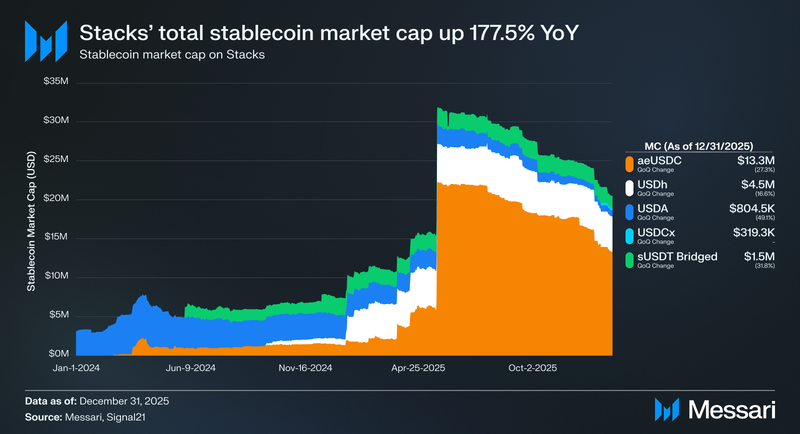
The stablecoin market cap serves as a proxy for a community’s liquidity and monetary exercise. Its growth is intently tied to the proliferation of dollar-denominated buying and selling pairs, DEX exercise, and lending protocols. As an example, Hermetica’s USDh now powers liquidations for Zest Protocol, boosting DeFi liquidity and enabling extra scalable sBTC-backed loans. The expansion of stablecoins can also be linked to the demand for capital effectivity and composability inside DeFi.
In This fall 2025, the whole stablecoin market cap on Stacks contracted 25.7% QoQ, falling from $27.6 million to $20.5 million, although it nonetheless mirrored a 177.5% YoY improve from $7.4 million in This fall 2024. Among the many largest contributors, aeUSDC, declined 27.3% QoQ to $13.3 million, whereas USDh fell 16.6% to $4.5 million. sUSDT dropped 31.8% to $1.5 million, and USDA continued its slide with a 49.1% QoQ drop to $804.5K. Notably, USDCx, a completely backed tier-1 stablecoin issued by Circle, launched in This fall and reached a market cap of $319K by year-end.
Supporting that is the development in Stacks’ DeFi variety rating, which rose from 4 to five in This fall. This metric displays the variety of distinctive protocols that meaningfully contribute to a sequence’s TVL, providing a snapshot of the ecosystem’s breadth and well being. A rise to five means that TVL is turning into extra evenly distributed, moderately than being concentrated in a single or two dominant protocols.
DeFi TVL
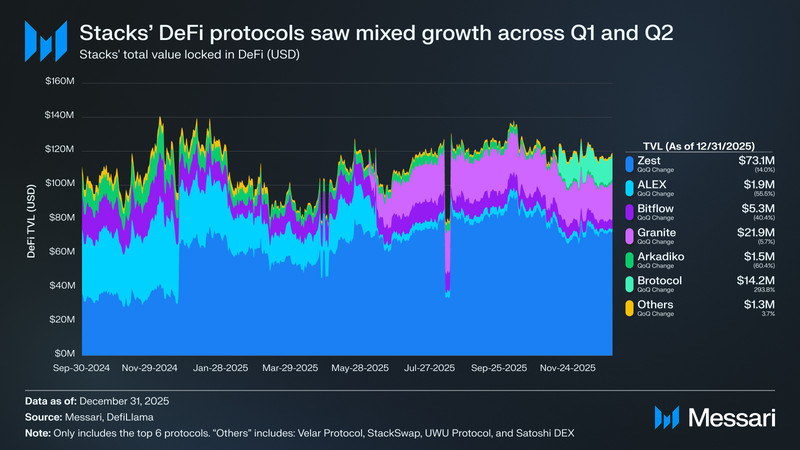
The vast majority of protocols remained secure or optimistic in TVL when measured in native STX phrases, regardless of USD-denominated drawdowns pushed by declining STX and BTC costs. Zest retained its place as the highest DeFi protocol on Stacks by TVL, ending This fall at $73.1 million, down 14.0% QoQ from $85.0 million in USD phrases, nevertheless it continued to develop in BTC phrases, reflecting sustained and rising capital inflows. ALEX, nonetheless reeling from its H1 exploit, dropped one other 55.5% QoQ to $1.9 million, representing a 93.9% YoY drawdown and signaling persistent lack of person confidence. Bitflow fell 40.4% QoQ to $5.3 million, although it too remained up in STX phrases. Granite held regular with a modest 5.7% decline to $21.9 million, persevering with to anchor itself as a core liquidity venue. Arkadiko prolonged its multi-quarter decline, shedding 60.4% of its Q3 TVL to complete at $1.5 million, an 83.3% YoY decline. The standout was XLink (rebranded as Brotocol), which elevated from $3.6 million to $14.2 million, a 293.8% QoQ improve. Smaller protocols below the “Others” class, together with StackSwap, UWU Protocol, and SatoshiDEX, grew 3.7% QoQ to a mixed $1.3 million, although they proceed to characterize a minor share of the ecosystem’s DeFi exercise.
Stacks Endowment and Grants
In late 2025, the Stacks Endowment transitioned from proposal to operational actuality, guided by the Treasury Committee established through SIP‑031. The Endowment secured its governance and funds framework, approving a $27 million 2026 working funds and 25 million STX for working capital targeted on engineering, safety, progress, and DeFi liquidity.
On the grants aspect, interim grant purposes closed on September 30, 2025, with group reviewers assessing submissions, and 5 high-TVL groups receiving bridge funding. Nonetheless, DeGrants reopened on October 10, 2025, for continued grassroots assist.
Trying forward, a rebooted grant program launching in January 2026 will function three tracks (i.e., Mandatory, Getting Began, and Neighborhood‑Chosen) to fund ecosystem incentives, early proofs of idea, audits/safety, and person acquisition. These funding initiatives, along with upcoming accelerator cohorts and liquidity incentives, goal to maintain developer momentum and broaden participation within the Bitcoin DeFi economic system.
What We Anticipate Subsequent
Crew Commentary Disclaimer
The Venture Crew Commentary part of this report was written by the Stacks Basis group and displays the views, opinions, and forward-looking statements of Stacks solely. This part is included to offer further context on the undertaking’s technique, priorities, and outlook and doesn’t essentially mirror the views or opinions of Messari, Inc.
Self-custodial Bitcoin staking is anticipated to be the defining narrative for Stacks in 2026. The R&D replace printed in This fall outlines a design the place BTC holders lock Bitcoin on L1 and use STX as staking capability to earn native BTC yield, with out custodial wrappers or federated bridges. Twin Stacking, launched in This fall, serves because the preliminary implementation of this mannequin. If profitable, this targets the most important untapped capital base in crypto: idle BTC held by people, establishments, treasuries, and ETFs.
Institutional Bitcoin yield merchandise are maturing round this infrastructure. Hermetica’s Bitcoin Earn Vault, constructed on sBTC, presents a one-click deposit for institutional contributors, with vault logic enforced by sensible contracts and settlement anchored to Bitcoin. Mixed with Fireblocks integration and controlled entry autos like Grayscale’s Stacks Belief, Stacks is positioning for productive Bitcoin treasuries the place firms and funds earn yield with out surrendering custody.
Capital-efficient BTC/USD rails turn out to be potential with USDC dwell on Stacks through Circle. Onchain AMMs like Bitflow can now facilitate BTC-to-USD liquidity and settlement with out reliance on centralized exchanges, addressing custody danger, opaque execution, and jurisdictional friction.
Self-custodial transfers and privateness are rising analysis priorities. Stacks’ R&D outlines a possible mannequin for self-custodial sBTC transfers the place Bitcoin holders retain custody whereas transacting on the L2, unlocking scalable funds with out Lightning’s routing or liquidity constraints. Paired with that is early-stage work on privateness options for Bitcoin on Stacks, doubtlessly together with shielded transactions or confidential transfers that obscure quantities and counterparties whereas preserving verifiability. As clear on-chain exercise turns into an operational danger for establishments managing giant positions, privacy-preserving infrastructure is more and more a prerequisite for significant capital deployment moderately than a distinct segment function.
Closing Abstract
Stacks ended This fall 2025 with a divergence between USD-denominated metrics and onchain fundamentals. Whereas STX worth fell 57.3% QoQ and market cap declined 56.9%, these drawdowns largely mirrored broader market weak spot and BTC/STX underperformance moderately than ecosystem contraction. Community utilization cooled, day by day energetic addresses dropped 34.3%, and common day by day transactions fell 15.1% QoQ, however exercise remained greater than 2.5x larger YoY. Protocol income declined 32.2% QoQ to $23.7K, and PoX incentive flows, together with internet burn, stacking rewards, and miner earnings, continued to compress throughout the board.
In distinction, core onchain metrics in native STX phrases noticed constant progress: DeFi TVL rose 120.8% QoQ to 488 million STX, common whole STX stacked elevated 6.1%, and the DeFi variety rating improved from 4 to five – all whereas the stablecoin market cap remained 4x larger YoY, reflecting deepening onchain liquidity. Twin Stacking emerged as a flagship yield technique, aligning incentives for BTC and STX holders and rating among the many high Bitcoin-native incomes alternatives. On the governance aspect, the Endowment grew to become totally operational, approving a $27 million funds for 2026 and formalizing new grant tracks for builders. These developments, together with the rollout of SIP-033 and SIP-034, infrastructure integrations like WalletConnect and USDCx, mirror robust execution even in a down market.
Trying forward, 2026 marks step one towards dual-stacking, a significant analysis precedence geared toward unlocking native BTC yield for long-term holders with out custodians or federated bridges. With institutional rails forming round sBTC and Circle’s USDC now dwell on Stacks, the community is more and more positioned as a house for productive Bitcoin. Regardless of short-term headwinds, the foundations for a strong Bitcoin DeFi ecosystem proceed to strengthen.
