



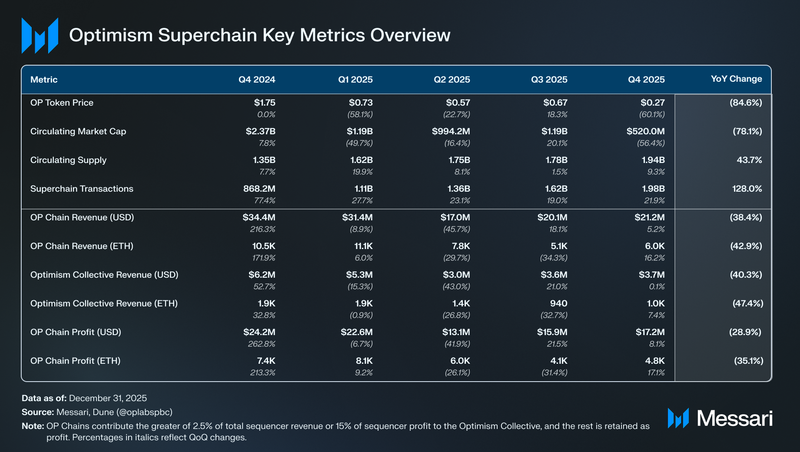
Key Insights
- The Superchain captured 12.7% of complete crypto transactions by H2 finish and has maintained greater than half of the whole L2 market share by transactions since April 2025.
- Mixture Superchain GDP reached $415.4 million, led by Uniswap ($159.4 million), reflecting an App Income Seize Ratio of 10.1x relative to sequencer income.
- Lively loans throughout the Superchain rose 95.8% YoY to $1.95 billion, pushed primarily by Morpho, whose excellent loans surged to $1.19 billion following Coinbase integration.
- Superchain transactions reached a brand new all-time excessive of three.60 billion in H2 2025, up 44% for the reason that finish of June 2025, pushed primarily by exercise on Base and World.
- Institutional adoption of the OP Stack accelerated, with Upbit, OKX, and EY-backed Dusk deploying exchange-backed L2s and enterprise infrastructure.
Primer
Optimism (OP) has been on the core of Ethereum’s rollup-centric roadmap and its journey of outsourcing Ethereum Digital Machine (EVM) execution to Layer-2 (L2) rollups. After years of analysis by founders Benjamin Jones, Karl Floersch, Jing Wang, Mark Tyneway, and Kevin Ho, Optimism’s genesis blockchain, OP Mainnet, was launched in June 2021.
Optimism’s long-term technique is rooted in its imaginative and prescient for a “Superchain.” The OP Stack is a modular, open-source expertise stack that allows the creation of L2 and L3 networks (OP Chains). The aim of the Superchain is to carry seamless interoperability between OP Chains that share safety, bridging, governance, and community upgrades. At present, the Superchain is a community of 34 OP Chains that make up over half of all L2 exercise and over 10% of all crypto exercise.
More and more, Optimism is positioning the OP Stack as institutional-grade infrastructure, enabling exchanges, enterprises, and utility groups to deploy purpose-built chains with higher management over execution, economics, and compliance whereas remaining interoperable inside a shared Superchain surroundings.
For real-time metrics and extra superchain protection, check with the Optimism Portal.
Web site / X / Discord
Optimism Superchain Ecosystem
By H2 2025, the Optimism Superchain had progressed from a scaling initiative right into a production-grade, multichain execution surroundings supporting materials financial exercise and institutional participation. With 34 OP chains reside on mainnet, the Superchain more and more resembles a standardized blockchain runtime layer, the place organizations can onboard incrementally, function inside outlined efficiency and safety constraints, and broaden into extra custom-made deployments as operational necessities mature.
Onchain Economics
Property and Chain GDP
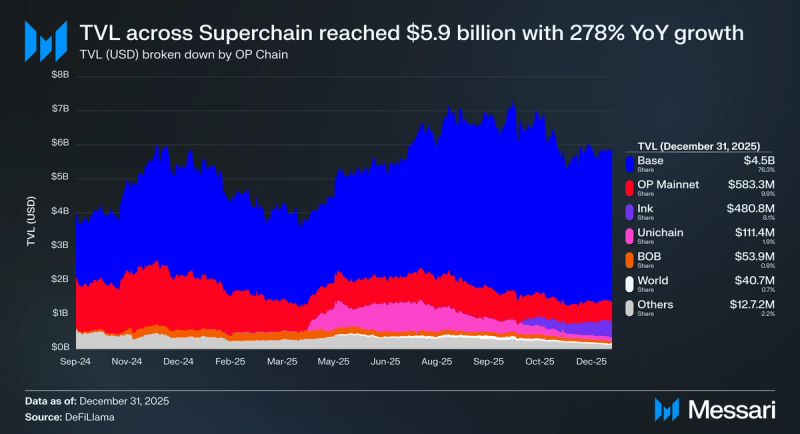
By the tip of 2025, TVL throughout the Superchain ecosystem reached $5.9 billion, representing 278% year-over-year (YoY) progress. Base and OP Mainnet drove nearly all of this growth, rising 1,845.5% to $4.5 billion and 153.7% to $583.3 million, respectively. Ink entered the highest three OP Chains by TVL for the primary time in H2, reaching $408.8 million by year-end. Ink’s speedy TVL progress was largely pushed by the launch of Tydro, a white-label Aave V3 lending protocol launched in October 2025.
The SuperStacks incentive program, which ended on June 30, 2025, contributed roughly $205 million in TVL throughout its marketing campaign interval. Regardless of this system’s conclusion, mixture TVL throughout the Superchain ecosystem continued to rise, rising 31.5% from $5.17 billion on the finish of Q2 2025 to $6.80 billion by the tip of 2025.
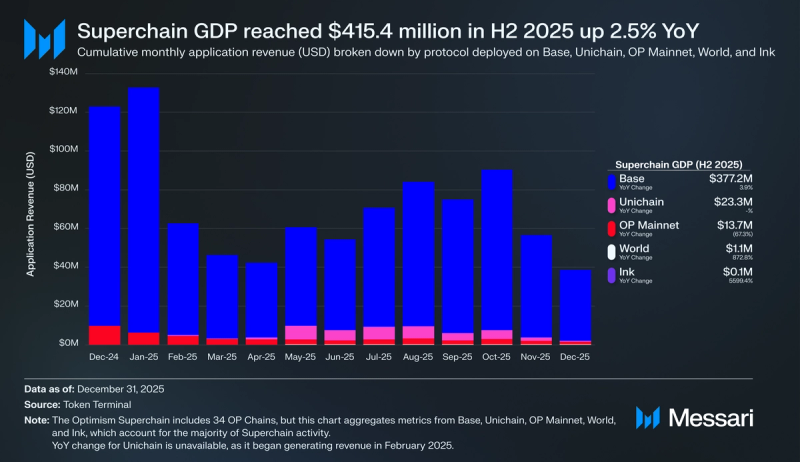
Chain GDP, which refers back to the complete utility income (USD) generated on a community, totaled $415.4 million throughout Base, Unichain, OP Mainnet, World, and Ink in H2 2025, representing 2.5% YoY progress. Base posted regular however modest 3.9% YoY progress, whereas newer Superchain deployments accounted for almost all of incremental upside. Unichain, launched by Uniswap Labs in February 2025, scaled quickly to $23.3 million in H2 utility income, making it the second-largest contributor and demonstrating the monetization benefit of vertically built-in distribution.
Smaller chains drove outsized proportion progress from low bases. World generated $1.1 million in H2 income, representing 872.8% YoY progress, with month-to-month income rising from roughly $40,000–$45,000 in early 2025 to peaks above $240,000 within the second half earlier than moderating into year-end. Ink, which started producing income solely in December 2024, remained small in absolute phrases however confirmed clear late-year acceleration, with month-to-month income inflecting from sub-$4,000 ranges by September to $83,506 in December.
Monitoring Chain GDP alongside TVL offers a extra subtle lens into community maturity. Whereas TVL measures the whole worth of property being deposited in DeFi protocols, Chain GDP tracks the income generated by these property, distinguishing between idle capital and energetic financial velocity. This shift signifies that the highest Superchains are evolving into useful economies the place capital is not parked however actively used to drive sustainable utility progress.
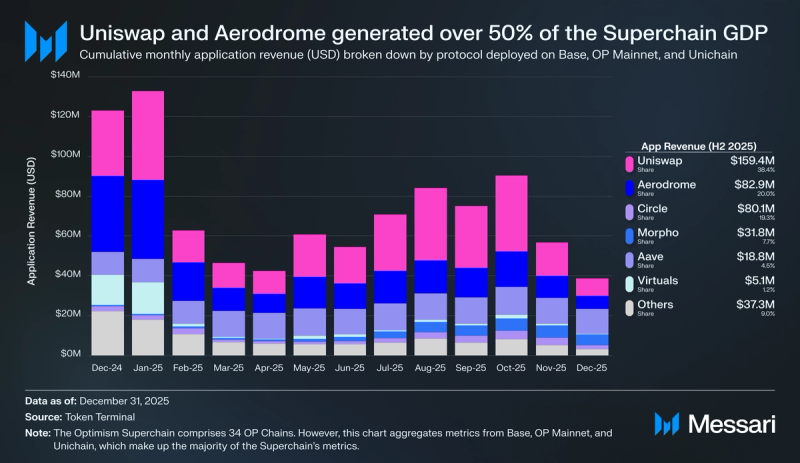
Uniswap, Aerodrome, and Circle proceed to account for almost all of the Optimism Superchain’s GDP in H2 2025, collectively making up 87.7%. Uniswap led with $159.4 million (38.4% share), adopted by Aerodrome with $82.9 million (20.0% share) and Circle with $80.1 million (19.3% share) in utility income.
A community’s App Income Seize Ratio (App RCR) is the ratio of income generated by its apps to its Actual Financial Worth (REV). Within the case of networks on the Optimism Superchain, REV is outlined because the sum of base transaction charges and precedence charges paid to sequencers, also referred to as sequencer income. The Superchain’s REV (USD) totaled $41.3 million in H2 2025, whereas utility income reached $415.4 million, leading to an App RCR of ~10.1x. Which means that for each $100 spent in transaction charges on the Superchain, functions generated $1,010 in income.
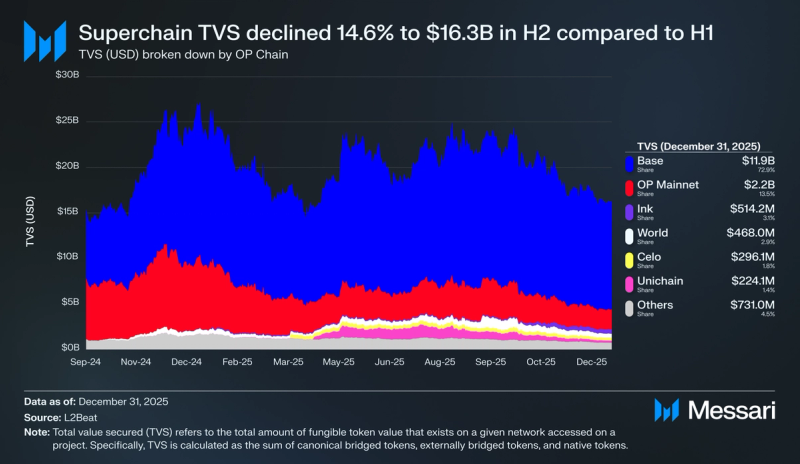
Whole worth secured (TVS) represents the whole worth of fungible tokens on a given community, together with property held in DeFi protocols and people held elsewhere. Particularly, TVS is calculated because the sum of canonical bridged tokens, externally bridged tokens, and native tokens.
The TVS throughout the Superchain ecosystem totaled $16.33 billion by the tip of 2025. Base and OP Mainnet stay the 2 largest chains by TVS, with Base main at $11.90 billion (72.9% share) and OP Mainnet following with $2.20 billion (13.5% share). Ink ranked third, securing $514.2 million in TVS (3.1% share). World, which ranked fourth, recorded a pointy surge in Q3, with TVS rising to $1.01 billion by the tip of the quarter, following the announcement of a $250 million treasury deal by Eightco Holdings to amass WLD. World’s TVS ranges then stabilized by This fall, indicating the rise was largely event-driven.
DeFi
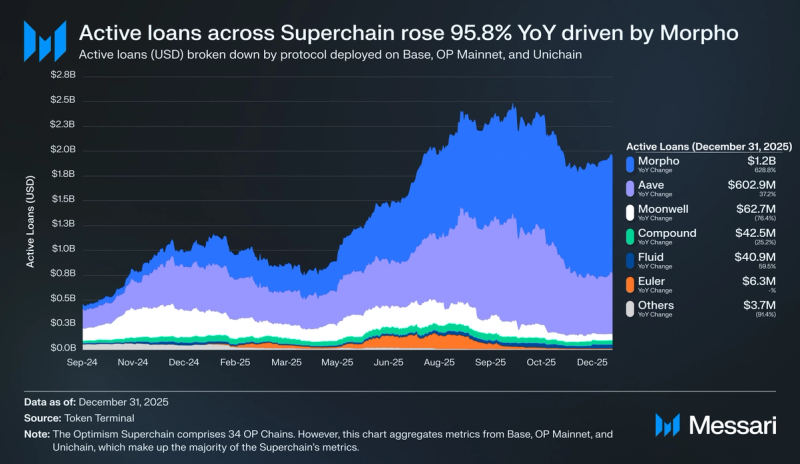
Lively loans measure the whole worth of excellent borrow positions on a lending protocol and function a key indicator of person exercise and capital utilization. Whole energetic loans throughout the Superchain elevated 95.8% YoY, rising from $993.7 million to $1.95 billion by the tip of 2025. Morpho was the first driver of this progress, with its energetic loans surging 628.8%, from $162.2 million to $1.19 billion over the identical interval.
After Coinbase Pockets built-in Morpho in January 2025 to allow borrowing USDC towards Bitcoin deposits, Morpho’s TVL on Base grew quickly and surpassed Aave, with the cbBTC/USDC pool changing into the biggest lending market on Base at over $1.07 billion equipped, practically double the scale of the identical pool on Ethereum. Morpho’s vault structure, which permits permissionless market creation with customizable threat parameters, enabled the speedy deployment of optimized lending markets tailor-made to Superchain’s rising DeFi ecosystem.
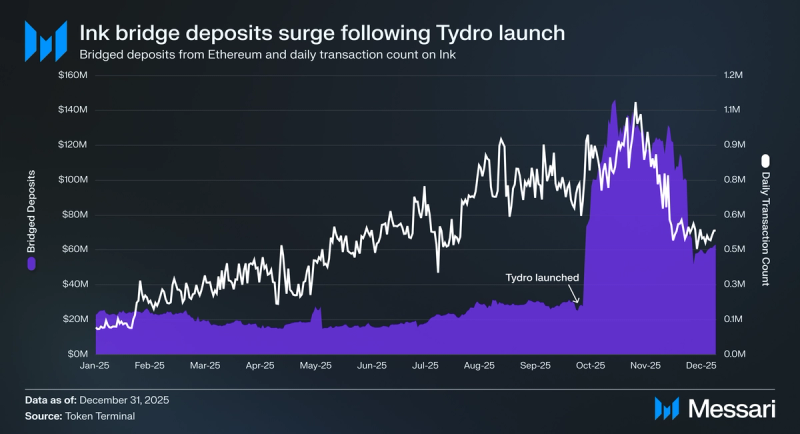
Tydro, Ink’s native lending and borrowing protocol, launched on Oct. 15, 2025, driving substantial progress in onchain exercise. Bridged deposits from Ethereum surged from roughly $30 million in early October to a peak of $144 million by early November, representing a virtually 5x improve. Whereas exercise moderated towards year-end, bridge deposits stabilized round $60 million in late December, nonetheless double the pre-Tydro ranges. Day by day transaction counts confirmed regular progress all through 2025, rising from a mean of 120,000 in January to over 1 million at their peak in November.
One other newly launched protocol, Nado, is a CLOB DEX in personal beta as of February 2026. Regardless of its early stage, Nado has generated $21 billion in cumulative perpetual quantity with 75% month-over-month progress.
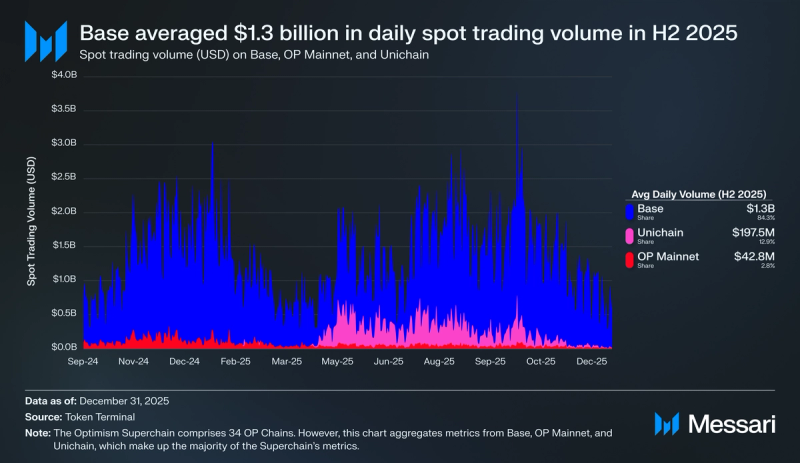
Base stays the main DEX venue by spot buying and selling quantity throughout the Optimism Superchain. In H2 2025, Base averaged $1.29 billion in day by day spot buying and selling quantity, accounting for 84.3% of complete exercise. When it comes to progress, Unichain posted the quickest growth, with common day by day quantity rising 58.7% in H2 relative to H1, in comparison with 29.2% progress on Base.
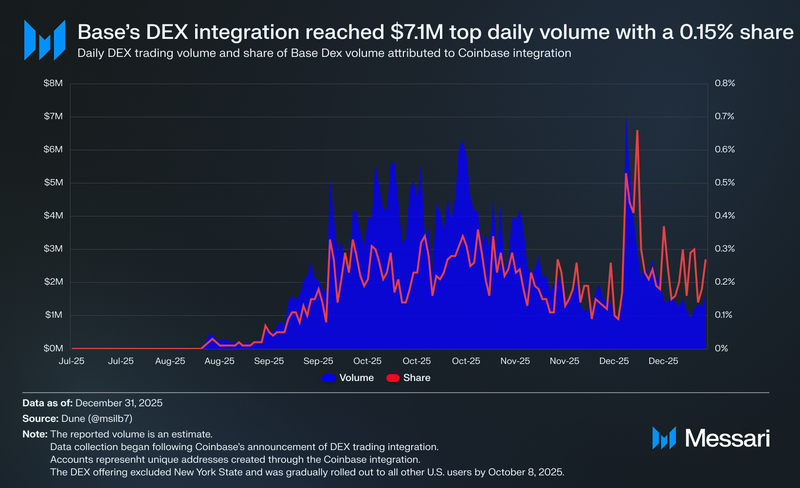
Coinbase launched DEX buying and selling on Aug. 8, 2025, permitting U.S. customers (excluding New York) to commerce Base-native tokens straight inside the Coinbase app by integrations with DEXs resembling Aerodrome and Uniswap. Since launch, the function has generated tens of millions in buying and selling quantity on Base and as much as 10,000 new Coinbase-linked addresses per day. Initially rolled out to pick customers, the DEX integration turned accessible to all eligible U.S. clients by Oct. 8, 2025. Coinbase additionally plans to increase DEX help to extra networks, together with Solana, and broaden entry to worldwide markets.
OP Chain Exercise
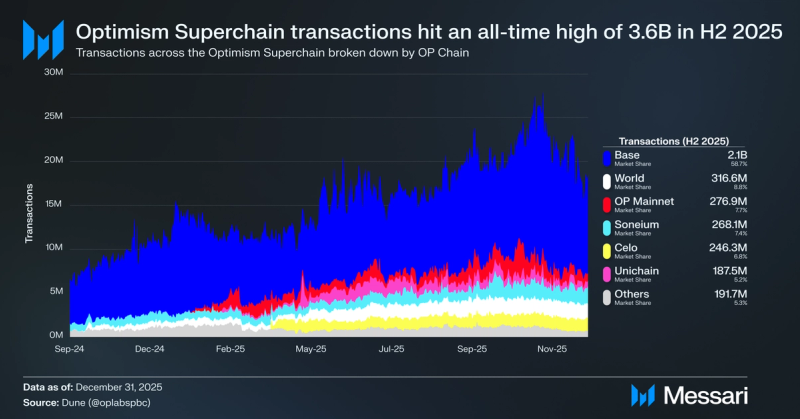
Transactions throughout the Optimism Superchain reached a brand new all-time excessive of three.60 billion in H2 2025, up 44% from 2.47 billion in H1. Progress was led by Celo, World, and OP Mainnet, which recorded the sharpest will increase in transaction quantity: 135.4% to 246.3 million, 95.0% to 316.6 million, and 61.9% to 276.9 million, respectively.
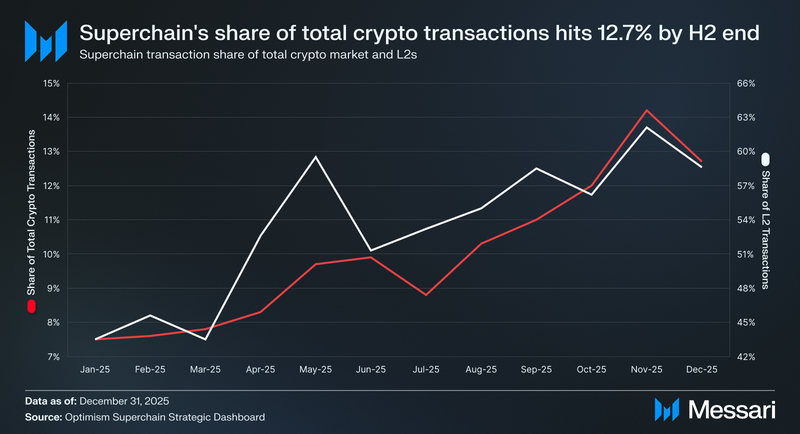
By the tip of H2 2025, the Optimism Superchain ecosystem accounted for 12.7% of all crypto transactions. Since early April 2025, the ecosystem has persistently captured over half of the whole L2 market share by transaction quantity. This sustained dominance reveals that OP Stack chains are driving persistently excessive community exercise, reinforcing the Superchain’s main position within the L2 panorama.
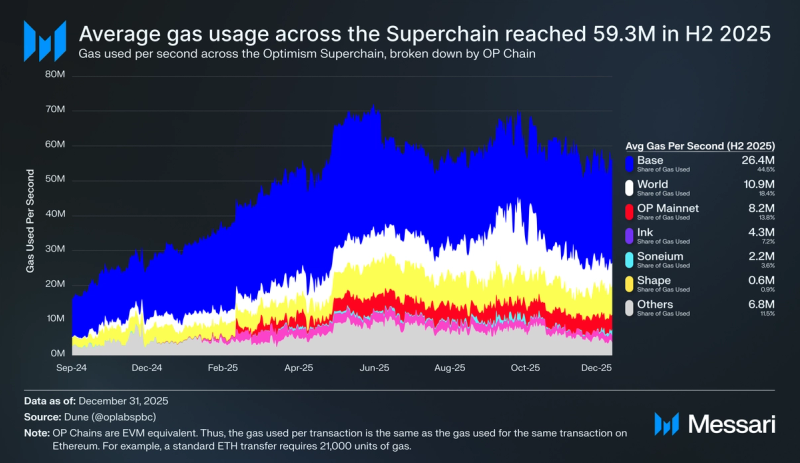
Fuel used per second (fuel/s) is a metric that issues for the Optimism Superchain. Fuel refers back to the unit that measures the quantity of computational effort required to execute operations on the Ethereum Digital Machine (EVM). Fuel, additionally known as blockspace, is a restricted useful resource offered by blockchains. Fuel utilization metrics present how a lot of that useful resource is definitely being consumed.
The overall common fuel used throughout the Superchain ecosystem reached 59.3 million in H2 2025, representing a 14.6% improve from the 50.7 million common on the finish of H1 2025. This progress was pushed partly by sharp will increase in fuel consumption on particular person Superchain networks, most notably World.
World’s common fuel utilization per second surged to twenty.0 million in Q3 2025, up from 5.8 million within the first half of the yr, pushed by a pointy improve in day by day energetic addresses and the community’s reliance on good pockets architectures resembling Gnosis Secure and ERC-4337, which eat considerably extra fuel than commonplace externally owned accounts (EOAs). The introduction of Precedence Blockspace for People (PBH) in June additional contributed to the rise, because it reserved blockspace for verified customers at mounted charges whereas requiring bots and non-verified customers to compete for the remaining capability at greater costs, resulting in elevated fuel charges.
Superchain Enterprise Developments
The ecosystem updates under mirror Optimism’s shift towards institutional and enterprise adoption by the OP Stack. Relatively than centering progress solely on a single public L2, Optimism is prioritizing purpose-built chains that give organizations higher management over execution, governance, and financial design, whereas remaining interoperable inside the broader Superchain.
OP Mainnet anchors this strategy because the Superchain’s enterprise launch pad, offering a credibly impartial, high-performance L2 the place enterprises can validate use instances, entry liquidity, and construct preliminary traction earlier than migrating to a devoted OP Stack chain. Designed to mix low charges, excessive throughput, and manufacturing reliability, OP Mainnet serves as each a proving floor and reference implementation for enterprises transitioning from first onchain deployments to totally custom-made networks.
Upbit Unveils Giwa Layer 2 on OP Stack
On Sep.9, 2025, South Korea’s largest cryptocurrency alternate, Upbit, introduced the launch of Giwa, a brand new L2 constructed utilizing the OP Stack. Giwa is designed to combine Upbit’s large retail person base straight into the Optimism ecosystem. This transfer marks a big growth of Optimism into the Asian market, offering tens of millions of customers with a high-performance, exchange-backed gateway to decentralized functions and onchain liquidity.
OKX Migrates XLayer to the OP Stack
On Dec. 9, 2025, OKX introduced the migration of its XLayer community to the OP Stack, bringing the exchange-backed L2 into the Optimism ecosystem. The transfer aligns X Layer with Optimism’s shared infrastructure and interoperability roadmap, enabling decrease charges, improved scalability, and deeper integration with different OP Stack chains.
Dusk Deploys on Celo
On Sep.30, the Celo Basis launched Dusk, an open-source zk privateness layer developed by EY, as a Layer 3 (L3) on the Celo community. The deployment permits confidential but auditable B2B funds, extending Celo’s mobile-first funds infrastructure into enterprise use instances.
Vertex Protocol Crew to Be a part of Ink Basis
On Jul. 1, 2025, the Ink Basis introduced an settlement to carry the Vertex Protocol crew and its core infrastructure into the Ink ecosystem. As a part of this transition, Vertex will sundown its present deployments to launch a purpose-built DEX completely on Ink, integrating its high-performance synchronous orderbook and perpetuals stack.
Messari Launches Optimism Portal
Messari launched a devoted Optimism Portal that consolidates ecosystem-wide knowledge, analytics, and analysis right into a single, no-login interface. The portal offers real-time community metrics, ecosystem maps, and AI-powered analysis summaries throughout the Superchain, with protection set to broaden in 2026 as Optimism’s community of OP Stack chains continues to develop.
Optimism Collective
Superchain Income Sharing
Optimism is ruled by the Optimism Collective, a bicameral system comprising the Token Home and Residents’ Home, together with stewardship offered by Optimism Basis. The Collective brings collectively firms, communities, and particular person residents to coordinate the expansion of the Superchain and reward contributions to public items.
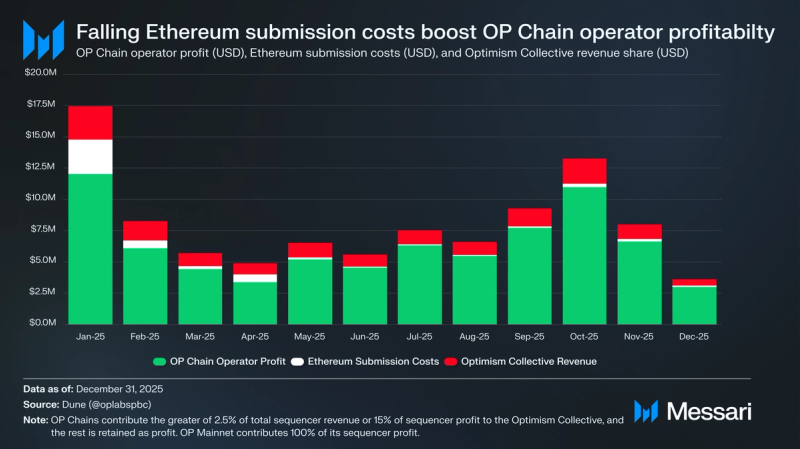
Whereas the Optimism Collective doesn’t have a publicly viewable, singular treasury, it generates constant income by a revenue-sharing mannequin. In keeping with the Customary Rollup Constitution, all OP Chains inside the Optimism Superchain should contribute the higher of both 2.5% of sequencer income or 15% of sequencer revenue (sequencer income minus Ethereum submission prices). The lone exception is OP Mainnet, which contributes 100% of its sequencer revenue.
Month-to-month submission prices on Ethereum have declined considerably for the reason that Dencun improve in March 2024. Earlier than the introduction of blobs, month-to-month knowledge posting prices peaked at $2.8 million in January 2025. By the tip of H2 2025, these prices had dropped to a mean of $156,186 per 30 days. The Dencun improve enormously improved the profitability of OP Chain operators by lowering knowledge submission bills.
In H2 2025, operators generated $44.5 million in revenue, up 24.9% from $35.7 million on the finish of H1. Of this quantity, about $7.2 million in sequencer income was allotted to the Optimism Collective, representing a 13.0% decline from the $8.3 million distributed in H1.
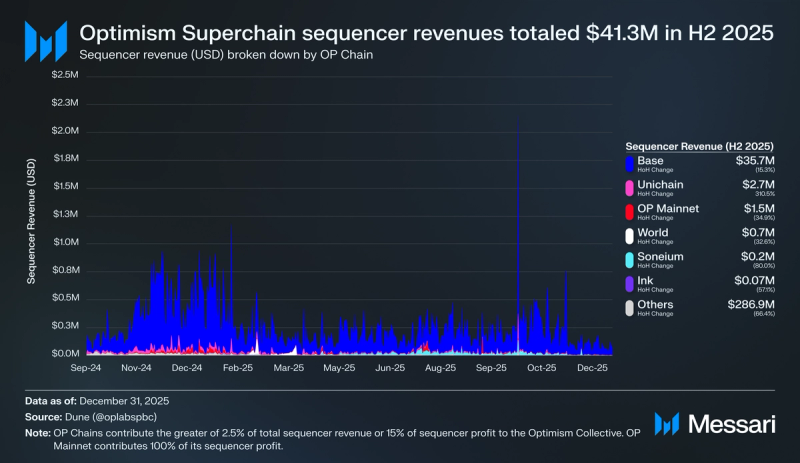
Base remained the biggest OP Chain by sequencer income in H2 2025, producing $35.7 million, adopted by Unichain at $2.7 million and OP Mainnet at $1.5 million. Whole sequencer income fell 14.7% HoH from $48.4 million in H1. Among the many prime chains, Unichain was the one one to develop, surging 310.5% HoH from $659,994, whereas Base declined 15.3% from $42.2 million and OP Mainnet fell 34.9% from $2.3 million. Regardless of decrease absolute sequencer income in H2 2025, the Superchain gained a significant share of complete crypto transaction charges. Its share rose from 2.0% on the finish of Q1 to 4.2% by This fall, indicating continued progress in utilization and throughput whilst per-chain monetization eased. Whereas sequencer income declined, OP chains maintained 7 of the ten lowest transaction prices throughout main networks.
Governance
Overview
The Optimism Collective operates a public decision-making course of that enables key stakeholders (tokenholders, end-users, apps, and chains) to take part in necessary selections concerning the protocol and treasury.
To date, the Optimism Collective has accomplished seven governance seasons, every advancing decentralization and ecosystem coordination by distinct themes resembling interoperability, blockspace charters, and collective governance.
Season 8 was launched on July 31, 2025, operating by December 24, 2025, below the theme “Purpose-built Governance.” This season represents a significant evolution of the governance framework, shifting from a general-purpose mannequin to a system particularly designed to cut back platform threat for individuals throughout the Superchain.
Season 8 introduces a number of main updates that operationalize this imaginative and prescient:
- The Stakeholder Voting Mannequin formally integrates new classes of governance individuals, granting voting illustration to chains, functions, and finish customers alongside token holders.
- The Optimistic Approval course of has been adopted for many proposal sorts, permitting measures to cross mechanically until vetoed, creating sooner and extra predictable decision-making.
- The Protocol Improve Course of was overhauled, introducing a Developer Advisory Board (DAB) to evaluation and approve technical upgrades, whereas delegates and Residents now train veto energy throughout a one-week evaluation interval.
Technical Developments
Optimism underwent a number of vital technical developments and community upgrades in H2 2025:
- OptimismFlashbots Integration: Optimism partnered with Flashbots to deploy verifiable sequencing throughout OP Stack chains, with Flashblocks reside on Base, Unichain, and OP Mainnet, enabling roughly 200 millisecond transaction preconfirmations.
- Superchain Improve 16: OP Labs launched Improve 16, getting ready the community for Superchain interoperability by eradicating a permissioned position, updating Cannon to Go 1.23, and rising the fuel restrict to 500 million per block.
- Improve 16a Proposal: In September 2025, Optimism proposed Improve 16a to refine interop options, add configurable toggles, and enhance improve flexibility whereas sustaining community stability.
- Jovian Exhausting Fork: As a part of the U17 improve, the Jovian arduous fork was activated in December 2025, introducing protocol-level enhancements to onchain charge markets, together with configurable minimal base charges and knowledge availability footprint block limits to allow continued scaling with secure charges and spam mitigation. The improve additionally enhanced the fault proof system with the most recent model of golang and patched two disclosed vulnerabilities that weren’t exploited.
- Reth-Primarily based Sequencing: The primary OP Stack chains transitioned to a Reth-based structure, delivering vital enhancements in block constructing and execution efficiency. This development permits future will increase in fuel limits and throughput whereas simplifying the event course of for including new options to the stack.
- Fusaka Hardfork Went Stay: Ethereum activated the Fusaka arduous fork on mainnet, delivering a significant growth of information availability for rollups and the Superchain. The improve introduces PeerDAS and the Blob Parameter Solely (BPO) mechanism, enabling Ethereum to securely improve blob capability and cut back L2 charges with out ready for a full arduous fork, thereby instantly enhancing throughput and scalability for OP Stack chains.
Closing Abstract
The Optimism Superchain closed H2 2025 firmly established as probably the most energetic and economically productive Ethereum L2 ecosystem, marked by report excessive transaction throughput, sustained dominance in L2 market share, and continued evolution towards a revenue-generating onchain financial system. Base remained the clear anchor of the Superchain, whereas the speedy progress of networks resembling World, Unichain, Ink, and Celo mirrored an more and more diversified and resilient ecosystem.
Financial indicators bolstered this maturation. Mixture TVL and TVS continued to climb even after main incentive applications concluded; Chain GDP expanded regardless of blended efficiency throughout particular person chains; and utility income persistently outpaced sequencer income by an order of magnitude, highlighting sturdy app-layer worth seize. In the meantime, declining Ethereum knowledge prices materially improved operator profitability, enabling sustained income sharing with the Optimism Collective.
In parallel, Optimism strengthened the Superchain’s institutional readiness by technical upgrades, governance evolution, and associate onboarding. Sub-second execution by way of Flashblocks, elevated adoption of good account architectures, and progress towards full Superchain interoperability improved efficiency and operational predictability at scale. The onboarding of exchange- and enterprise-backed deployments resembling Upbit, OKX, and Dusk, alongside speedy progress on smaller chains, reinforces the OP Stack’s emergence as a standardized framework for institutional rollups and production-grade onchain deployment.
