



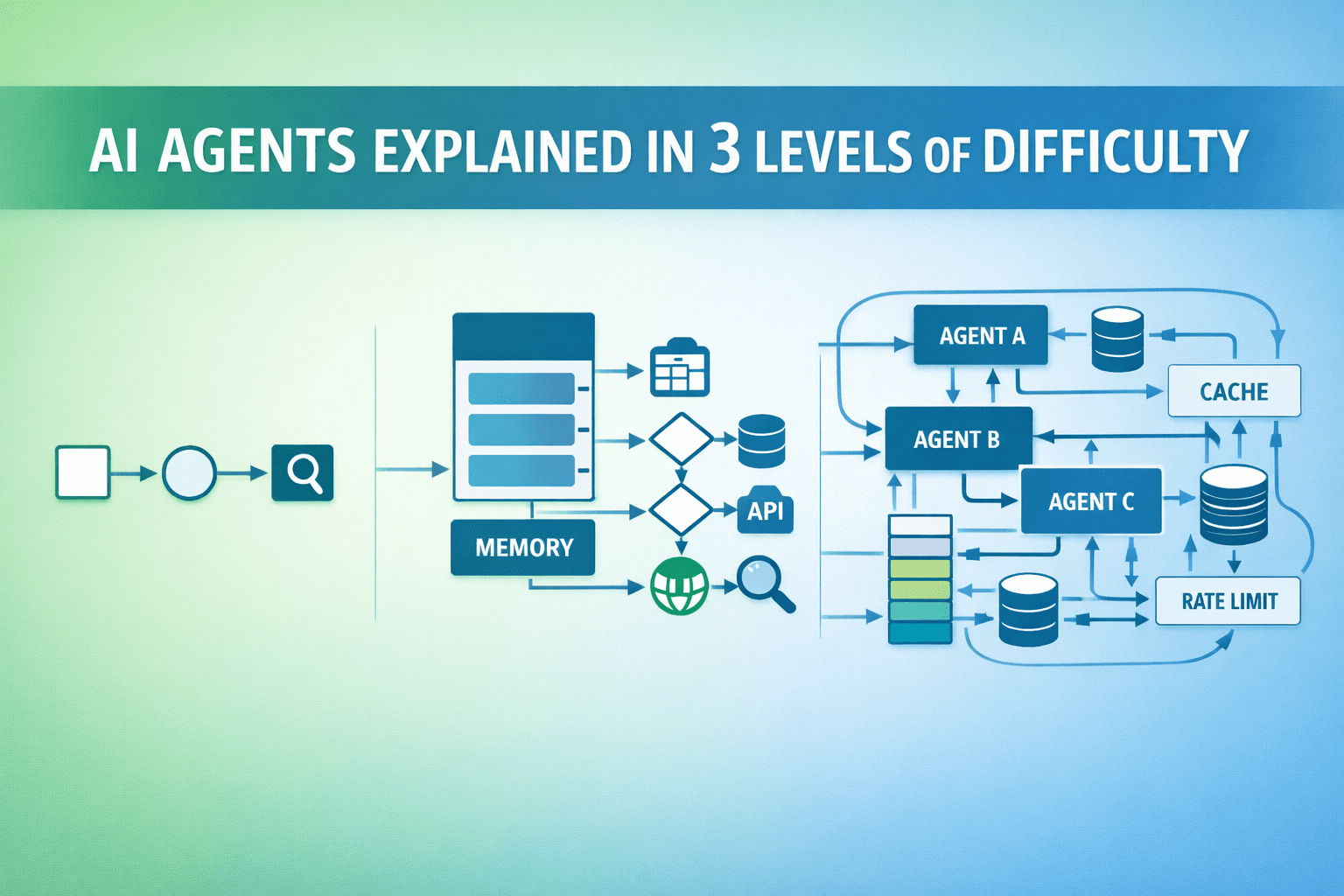
Picture by Writer
# Introduction
Synthetic intelligence (AI) brokers symbolize a shift from single-response language fashions to autonomous programs that may plan, execute, and adapt. Whereas a typical massive language mannequin (LLM) solutions one query at a time, an agent breaks down complicated objectives into steps, makes use of instruments to collect info or take actions, and iterates till the duty is full.
Constructing dependable brokers, nevertheless, is considerably tougher than constructing chatbots. Brokers should cause about what to do subsequent, when to make use of which instruments, the right way to get better from errors, and when to cease. With out cautious design, they fail, get caught in loops, or produce plausible-looking however incorrect outcomes.
This text explains AI brokers at three ranges: what they’re and why they matter, the right way to construct them with sensible patterns, and superior architectures for manufacturing programs.
# Stage 1: From Chatbots to Brokers
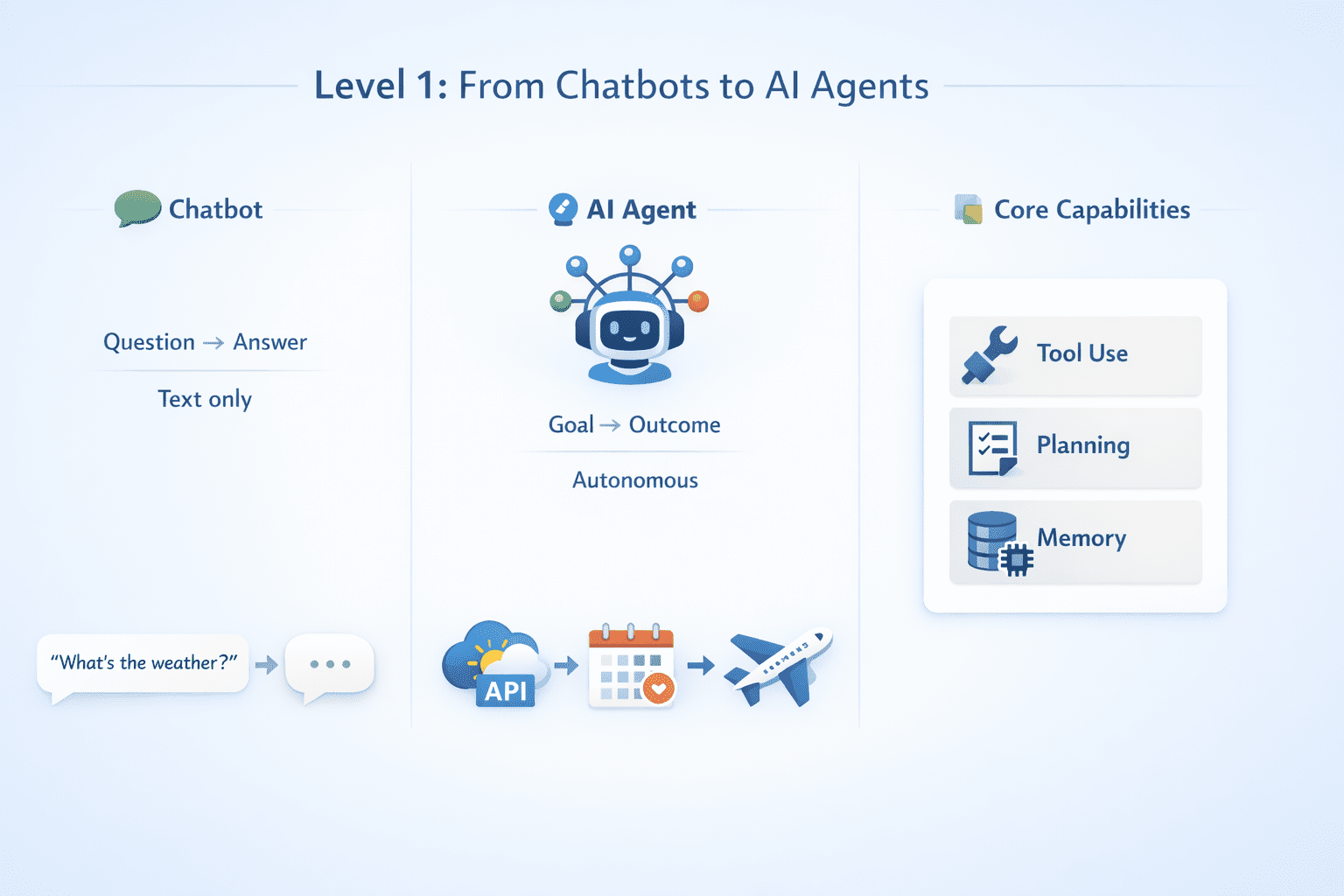
A chatbot takes your query and provides you a solution. An AI agent takes your purpose and figures out the right way to obtain it. The distinction is autonomy.
Let’s take an instance. While you ask a chatbot “What’s the weather?”, it generates textual content about climate. While you inform an agent “What’s the weather?”, it decides to name an software programming interface (API) for climate, retrieves actual knowledge, and reviews again.
While you say “Book me a flight to Tokyo next month under $800”, the agent searches flights, compares choices, checks your calendar, and will even make the reserving — all with out you specifying how.
Brokers have three core capabilities that distinguish them from conventional chatbots.
// Instrument Use
Instrument use is a basic functionality that enables brokers to name exterior features, APIs, databases, or providers. Instruments give brokers grounding in actuality past pure textual content era.
// Planning
Planning permits brokers to interrupt down complicated requests into actionable steps. While you ask an agent to “analyze this market,” it transforms that high-level purpose right into a sequence of concrete actions: retrieve market knowledge, determine tendencies, examine to historic patterns, and generate insights. The agent sequences these actions dynamically primarily based on what it learns at every step, adapting its method as new info turns into accessible.
// Reminiscence
Reminiscence permits brokers to keep up state throughout a number of actions all through their execution. The agent remembers what it is already tried, what labored, what failed, and what it nonetheless must do. This persistent consciousness prevents redundant actions and permits the agent to construct on earlier steps towards finishing its purpose.
The agent loop is straightforward: observe the present state, determine what to do subsequent, take that motion, observe the end result, repeat till performed. In follow, this loop runs inside a scaffolding system that manages software execution, tracks state, handles errors, and determines when to cease.
Stage 1: From Chatbots to Brokers | Picture by Writer
# Stage 2: Constructing AI Brokers In Follow
Implementing AI brokers requires express design selections throughout planning, software integration, state administration, and management circulate.
// Agent Architectures
Totally different architectural patterns allow brokers to method duties in distinct methods, every with particular tradeoffs. Listed below are those you’ll use most frequently.
ReAct (Cause + Act) interleaves reasoning and motion in a clear method. The mannequin generates reasoning about what to do subsequent, then selects a software to make use of. After the software executes, the mannequin sees the end result and causes concerning the subsequent step. This method makes the agent’s resolution course of seen and debuggable, permitting builders to grasp precisely why the agent selected every motion.
Plan-and-Execute separates strategic pondering from execution. The agent first generates a whole plan mapping out all anticipated steps, then executes every one in sequence. If execution reveals issues or sudden outcomes, the agent can pause and replan with this new info. This separation reduces the prospect of getting caught in native loops the place the agent repeatedly tries related unsuccessful approaches.
Reflection permits studying from failure inside a single session. After trying a activity, the agent displays on what went mistaken and generates express classes about its errors. These reflections are added to context for the subsequent try, permitting the agent to keep away from repeating the identical errors and enhance its method iteratively.
Learn 7 Should-Know Agentic AI Design Patterns to be taught extra.
// Instrument Design
Instruments are the agent’s interface to capabilities. Design them rigorously.
Outline clear schemas for dependable software use. Outline instruments with express names, descriptions, and parameter schemas that depart no ambiguity. A software named search_customer_orders_by_email is much simpler than search_database as a result of it tells the agent precisely what the software does and when to make use of it. Embody examples of acceptable use instances for every software to information the agent’s decision-making.
Structured outputs make info extraction dependable and constant. Instruments ought to return JavaScript Object Notation (JSON) reasonably than prose, giving the agent structured knowledge it may simply parse and use in subsequent reasoning steps. This eliminates ambiguity and reduces errors brought on by misinterpreting pure language responses.
Express errors allow restoration from failures. Return error objects with codes and messages that designate precisely what went mistaken.

Stage 2: Constructing AI Brokers in Follow | Picture by Writer
// State And Management Movement
Efficient state administration prevents brokers from shedding observe of their objectives or getting caught in unproductive patterns.
Activity state monitoring maintains a transparent report of what the agent is making an attempt to perform, what steps are full, and what stays. Hold this as a structured object reasonably than relying solely on dialog historical past, which might turn out to be unwieldy and tough to parse. Express state objects make it simple to verify progress and determine when the agent has drifted from its unique purpose.
Termination circumstances stop brokers from operating indefinitely or losing sources. Set a number of cease standards together with a activity completion sign, most iterations (sometimes 10—50 relying on complexity), repetition detection to catch loops, and useful resource limits for tokens, value, and execution time. Having various stopping circumstances ensures the agent can exit gracefully below varied failure modes.
Error restoration methods enable brokers to deal with issues with out fully failing. Retry transient failures with exponential backoff to deal with non permanent points like community issues. Implement fallback methods when major approaches fail, giving the agent different paths to success. When full completion is not doable, return partial outcomes with clear explanations of what was achieved and what failed.
// Analysis
Rigorous analysis reveals whether or not your agent truly works in follow.
Activity success charge measures the elemental query: given benchmark duties, what share does the agent full accurately? Observe this metric as you iterate in your agent design, utilizing it as your north star for enchancment. A decline in success charge signifies regressions that want investigation.
Motion effectivity examines what number of steps the agent takes to finish duties. Extra actions is not all the time worse; some complicated duties genuinely require many steps. Nevertheless, when an agent takes 30 actions for one thing that ought to take 5, it signifies issues with planning, software choice, or getting caught in unproductive loops.
Failure mode evaluation requires classifying failures into classes like mistaken software chosen, appropriate software known as incorrectly, acquired caught in loop, or hit useful resource restrict. By figuring out the most typical failure modes, you’ll be able to prioritize fixes that may have the most important impression on general reliability.

Stage 2: State, Management, and Analysis | Picture by Writer
# Stage 3: Agentic Methods In Manufacturing
Constructing brokers that work reliably at scale requires subtle orchestration, observability, and security constraints.
// Superior Planning
Refined planning methods allow brokers to deal with complicated, multi-faceted duties that easy sequential execution can’t handle.
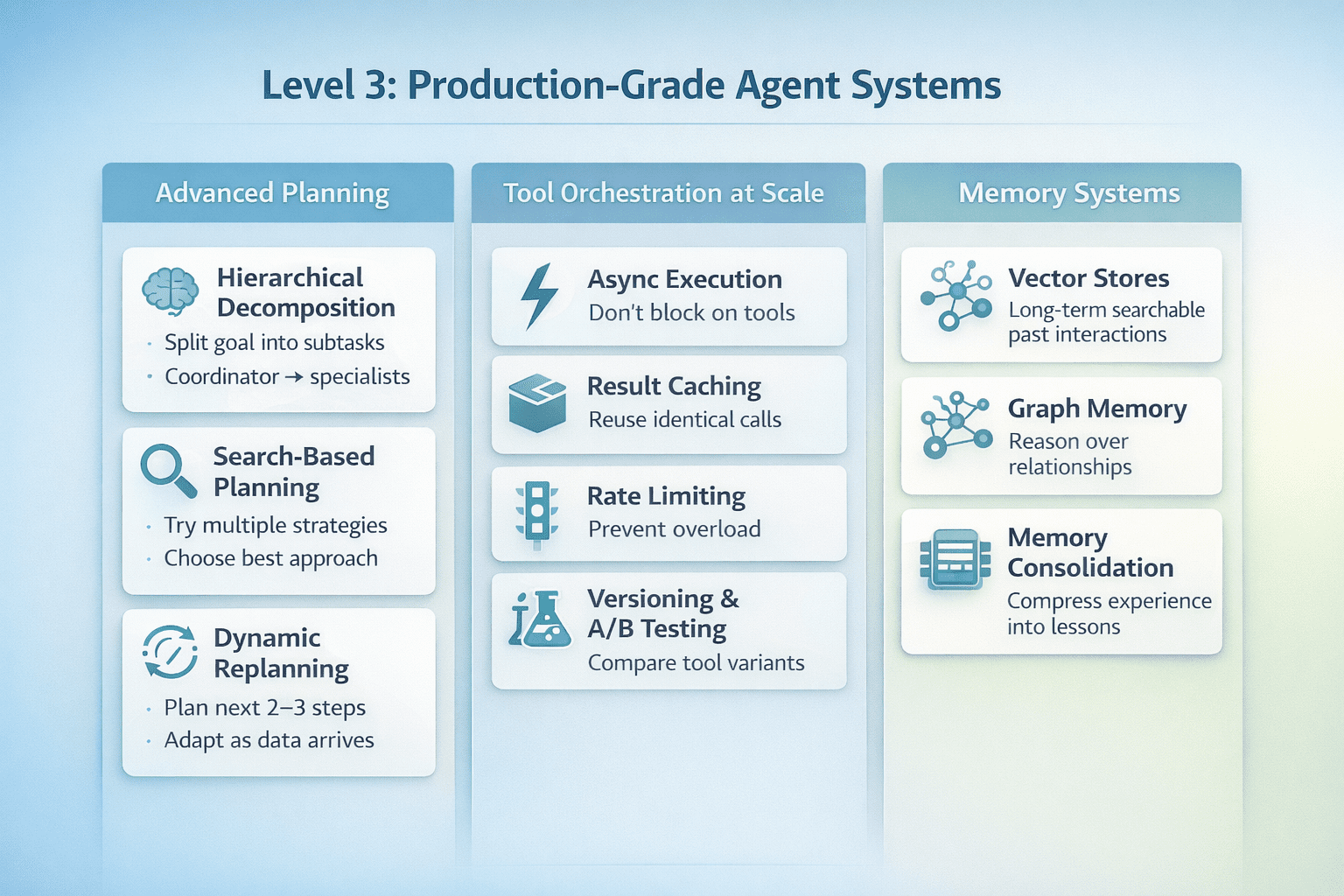
Hierarchical decomposition breaks complicated duties into subtasks recursively. A coordinator agent delegates to specialised sub-agents, every geared up with domain-specific instruments and prompts tailor-made to their experience. This structure permits each specialization — every sub-agent turns into efficient at its slim area — and parallelization, the place impartial subtasks execute concurrently to cut back general completion time.
It’s also possible to attempt search-based planning to discover a number of doable approaches earlier than committing to at least one. You’ll be able to interleave planning and execution for max adaptability. Quite than producing a whole plan upfront, the agent generates solely the subsequent 2-3 actions, executes them, observes outcomes, and replans primarily based on what it realized. This method permits the agent to adapt as new info emerges, avoiding the restrictions of inflexible plans that assume a static atmosphere.
// Instrument Orchestration At Scale
Manufacturing programs require subtle software administration to keep up efficiency and reliability below real-world circumstances.
Async execution prevents blocking on long-running operations. Quite than ready idle whereas a software executes, the agent can work on different duties or subtasks. End result caching eliminates redundant work by storing software outputs. Every software name is hashed by its operate title and parameters, creating a novel identifier for that actual question. Earlier than executing a software, the system checks if that equivalent name has been made just lately. Cache hits return saved outcomes instantly. This avoids redundant API calls that waste time and charge restrict quota.
Fee limiting prevents runaway brokers from exhausting quotas or overwhelming exterior providers. Implement per-tool charge limits. When an agent hits a charge restrict, the system can queue requests, decelerate execution, or fail extra gracefully reasonably than inflicting cascading errors.
Versioning and A/B testing allow steady enchancment with out threat. Keep a number of variations of software implementations and randomly assign agent requests to totally different variations. Observe success charges and efficiency metrics for every model to validate that adjustments truly enhance reliability earlier than rolling them out to all site visitors.
// Reminiscence Methods
Superior reminiscence architectures enable brokers to be taught from expertise and cause over accrued information.
You’ll be able to retailer agent experiences in vector databases the place they are often retrieved by semantic similarity. When an agent encounters a brand new activity, the system retrieves related previous experiences as few-shot examples, displaying the agent the way it or different brokers dealt with comparable conditions. This allows studying throughout classes, constructing organizational information that persists past particular person agent runs.
Graph reminiscence fashions entities and relationships as a information graph, enabling complicated relational reasoning. Quite than treating info as remoted information, graph reminiscence captures how ideas join. This permits multi-hop queries like “What projects is developer A working on that depend on developer B’s database?” the place the reply requires traversing a number of relationship edges.
Reminiscence consolidation prevents unbounded progress whereas preserving realized information. Periodically, the system compresses detailed execution traces into generalizable classes — summary patterns and methods reasonably than particular motion sequences. This distillation maintains the dear insights from expertise whereas discarding low-value particulars, maintaining reminiscence programs performant as they accumulate extra knowledge.
Stage 3: Manufacturing-Grade Agent Methods | Picture by Writer
// Security And Constraints
Manufacturing brokers require a number of layers of security controls to forestall dangerous actions and guarantee reliability.
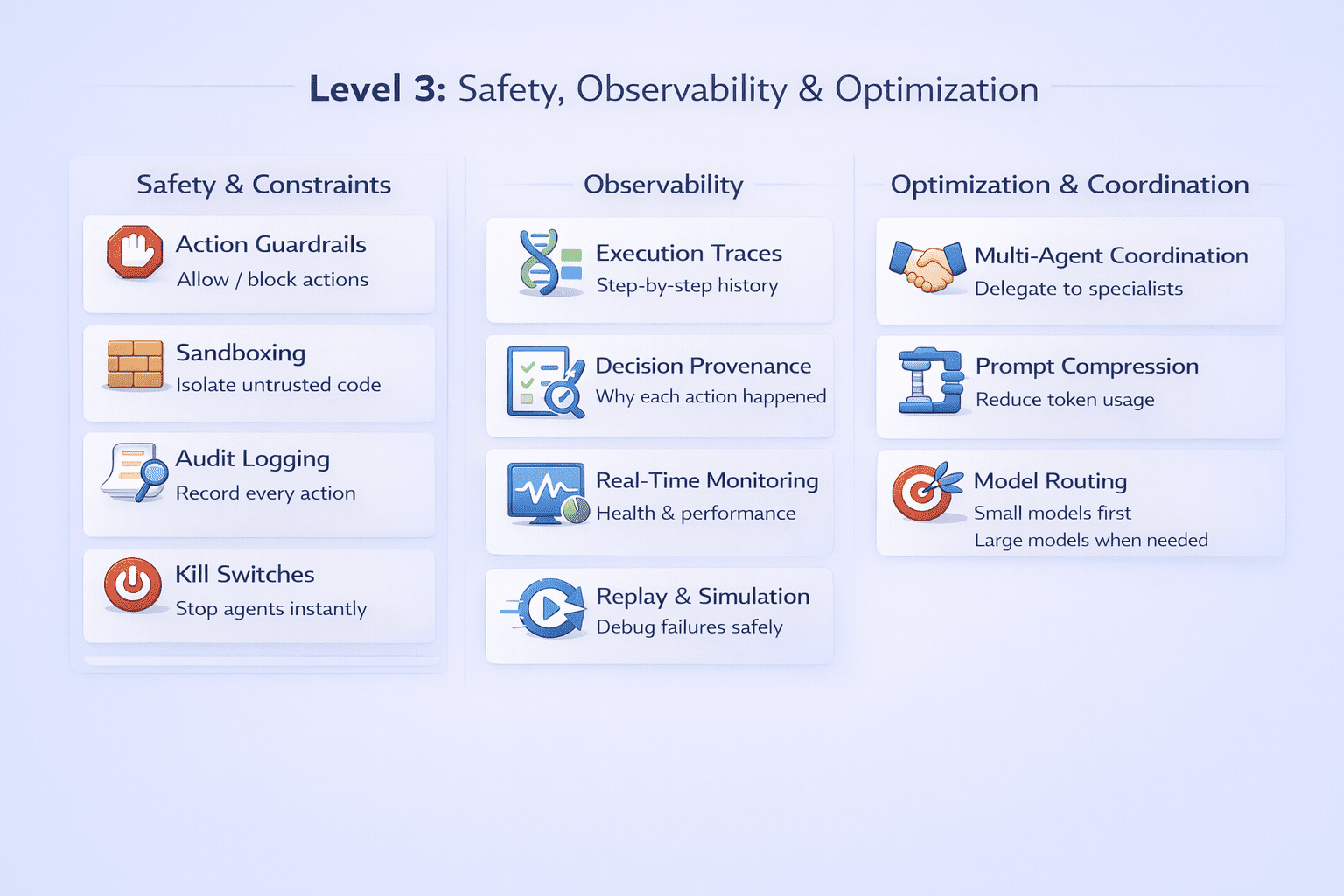
Guardrails outline express boundaries for agent conduct. Specify allowed and forbidden actions in machine-readable insurance policies that the system can implement mechanically. Earlier than executing any motion, verify it in opposition to these guidelines. For prime-risk however typically reputable actions, require human approval by means of an interrupt mechanism.
Sandboxing isolates untrusted code execution from vital programs. Run software code in containerized environments with restricted permissions that restrict what injury compromised or buggy code may cause.
Audit logging creates an immutable report of all agent exercise. Log each motion with full context together with timestamp, consumer, software title, parameters, end result, and the reasoning that led to the choice.
Kill switches present emergency management when brokers behave unexpectedly. Implement a number of ranges: a user-facing cancel button for particular person duties, automated circuit breakers that set off on suspicious patterns like fast repeated actions, and administrative overrides that may disable complete agent programs immediately if broader issues emerge.
// Observability
Manufacturing programs want complete visibility into agent conduct to debug failures and optimize efficiency.
Execution traces seize the entire resolution path. Report each reasoning step, software name, remark, and resolution, creating a whole audit path. These traces allow post-hoc evaluation the place builders can look at precisely what the agent was pondering and why it made every selection.
Choice provenance provides wealthy context to motion logs. For each motion, report why the agent selected it, what options have been thought-about, what info was related to the choice, and what confidence degree the agent had.
Actual-time monitoring supplies operational visibility into fleet well being. Observe metrics like variety of lively brokers, activity period distributions, success and failure charges, software utilization patterns, and error charges by sort.
Replay and simulation allow managed debugging of failures. Seize failed execution traces and replay them in remoted debug environments. Inject totally different observations at key resolution factors to check counterfactuals: what would the agent have performed if the software had returned totally different knowledge? This managed experimentation reveals the foundation causes of failures and validates fixes.
// Multi-Agent Coordination
Advanced programs usually require a number of brokers working collectively, necessitating coordination protocols.
Activity delegation routes work to specialised brokers primarily based on their capabilities. A coordinator agent analyzes incoming duties and determines which specialist brokers to contain primarily based on the required abilities and accessible instruments. The coordinator delegates subtasks, screens their progress, and synthesizes outcomes from a number of brokers right into a coherent last output. Communication protocols allow structured inter-agent interplay.
// Optimization
Manufacturing programs require cautious optimization to satisfy latency and value targets at scale.
Immediate compression addresses the problem of rising context dimension. Agent prompts turn out to be massive as they accumulate software schemas, examples, dialog historical past, and retrieved recollections. Apply compression methods that cut back token rely whereas preserving important info — eradicating redundancy, utilizing abbreviations constantly, and pruning low-value particulars.
Selective software publicity dynamically filters which instruments the agent can see primarily based on activity context. Mannequin routing optimizes the cost-performance tradeoff through the use of totally different fashions for various selections. Route routine selections to smaller, sooner, cheaper fashions that may deal with easy instances. Escalate to bigger fashions just for complicated reasoning that requires subtle planning or area information. This dynamic routing can cut back prices by 60—80% whereas sustaining high quality on tough duties.
Stage 3: Security, Observability, and Optimization | Picture by Writer
# Wrapping Up
AI brokers symbolize a basic shift in what’s doable with language fashions — from producing textual content to autonomously conducting objectives. Constructing dependable brokers requires treating them as distributed programs with orchestration, state administration, error dealing with, observability, and security constraints.
Listed below are a couple of sources to degree up your agentic AI toolkit:
Comfortable studying!
Bala Priya C is a developer and technical author from India. She likes working on the intersection of math, programming, knowledge science, and content material creation. Her areas of curiosity and experience embrace DevOps, knowledge science, and pure language processing. She enjoys studying, writing, coding, and low! At present, she’s engaged on studying and sharing her information with the developer group by authoring tutorials, how-to guides, opinion items, and extra. Bala additionally creates partaking useful resource overviews and coding tutorials.
